
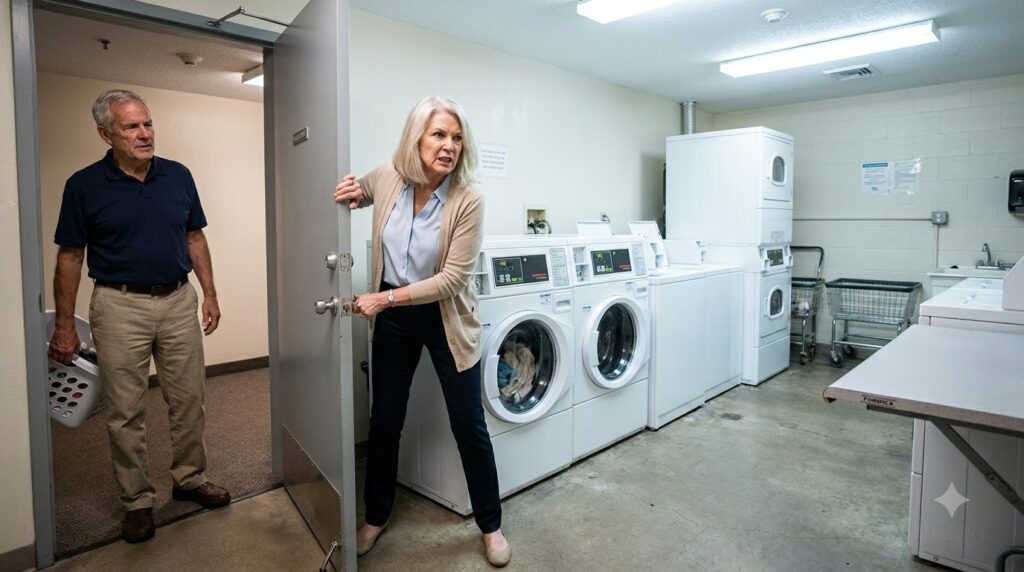
CHAPTER 4: THE STRAIN ON THE STEEL
“That’s not water damage, Evelyn.”
Arthur’s hand closed around the cold, notched edge of the iron pry-bar. The metal was frigid, sweating condensation out of the subterranean air, vibrating with a high-frequency shudder that transferred straight through the meat of his palm into his forearm bone.
Evelyn didn’t answer. She stood pinned against the humming carcass of the dryer, the yellow rubber gloves still dripping suds onto the scuffed vinyl tiles. Her breath came in short, shallow hitches, her mouth hanging slightly open as if she had forgotten the words she had spent all evening preparing.
Arthur pulled the snapped brass inspection tag free from the pry-bar. He held it up to the harsh fluorescent tube. The city seal was stamped deep into the alloy: DEPT. OF BUILDING SAFETY — HAZARD CLASS 1 — ORDER TO VACATE.
The date was punched twenty-four hours ago. Not next month. Not pending an appeal by the condominium board.
“Koval wasn’t down there patching weeping tiles,” Arthur said. He kept his voice low, but every syllable had the weight of an anvil dropping into dust. “You don’t shear a city enforcement lock for five thousand dollars of mortar. What did he do down there?”
A tremor ran through the concrete under their shoes. It wasn’t the rhythmic churn of Washer Three; the cycle had died, the drum sitting motionless in its puddle of scorched water. This was an uneven, grinding groan—the sound of three hundred tons of cured Portland cement settling four millimeters into an underground cavern that was never meant to hold it.
From the dark gap beneath the hatch, the draft blew harder. It carried the dry, chalky taste of powdered aggregate, the distinct smell of concrete failing under sheer compression.
“He was trying to weld the footings,” Evelyn whispered. Her voice had lost all its brass, reduced to the thin whistle of an old kettle. “Pillar Twelve. The main southeast corner. It cracked straight through to the rebar when the utility company dredged the ditch last spring. The inspector said if the board didn’t vacate immediately, the city would seal the doors with marshals. We couldn’t afford to leave, Arthur. Where would Martha go? Where would the Miller kids go?”
“You brought an unlicensed mechanic into a sheared load vault,” Arthur said, his eyes drilling into her. “With an electric torch.”
“He said he could brace it from underneath!” She took a step toward him, her hands clasping together in a grotesque yellow knot. “He brought hydraulic jacks from the railroad depot. He said if he set four fifty-ton jacks on the bedrock, we’d pass the reinspection on Monday. But the jack slipped. The ram kicked out and caught his shoulder. He’s up in 408 right now, Arthur. My son is stitching his collarbone with dental floss and butterfly tape because we can’t take him to the emergency room without the police calling the building department.”
Arthur knelt by the hatch. The ache in his bad knee was sharp, but he ignored it, bracing one palm on the wet lip of the iron rim. He reached into his back pocket, took out his brass inspection flashlight, and clicked the switch.
The white beam cut through the churning dust below.
It wasn’t a standard maintenance crawlspace. The cinderblock partition wall had been sledgehammered out. Beyond the rubble lay the foundation slab—and across its pale gray face ran a diagonal fissure wide enough to swallow a boot.
Resting right in the throat of the fracture were four steel shoring towers, completely unanchored, bowed under the crushing weight of the five stories above them. The screw jacks were turned down to their last threads, the steel plates groaning against the ceiling concrete with a slow, agonizing tink-tink-tink as micro-fissures spiderwebbed across the ceiling slab.
And directly above the center jack, wired to the laundry room floor joists, hung a plumb line—a braided steel wire weighted with an iron nut.
The wire was pulled taut as a bowstring, vibrating so violently that its outline blurred into an amber haze against the flashlight beam.
Arthur stood up slowly. His joints protested, but his mind had locked into depot protocol: emergency brake, isolate the line, count the seconds.
“Evelyn,” he said, his voice stripped of anger, stripped of judgment, leaving only the cold iron reality of a structure past its yield point. “How many people are sleeping on the east side of this building tonight?”
She looked at him, her eyes wide, tears finally carving pale tracks through the detergent grime on her cheeks. “Sixty. Maybe seventy.”
“Get your coat,” Arthur said, turning toward the deadbolted door. “And tell your son to drop the needle. We aren’t waiting for Monday.”
🏁 MODULE: SILENT HORIZON CHECK (AUTO-EVALUATE IF TARGET == TOTAL)








