
CHAPTER 1: THE FRICTION OF METAL
“You’re done. Go home.”
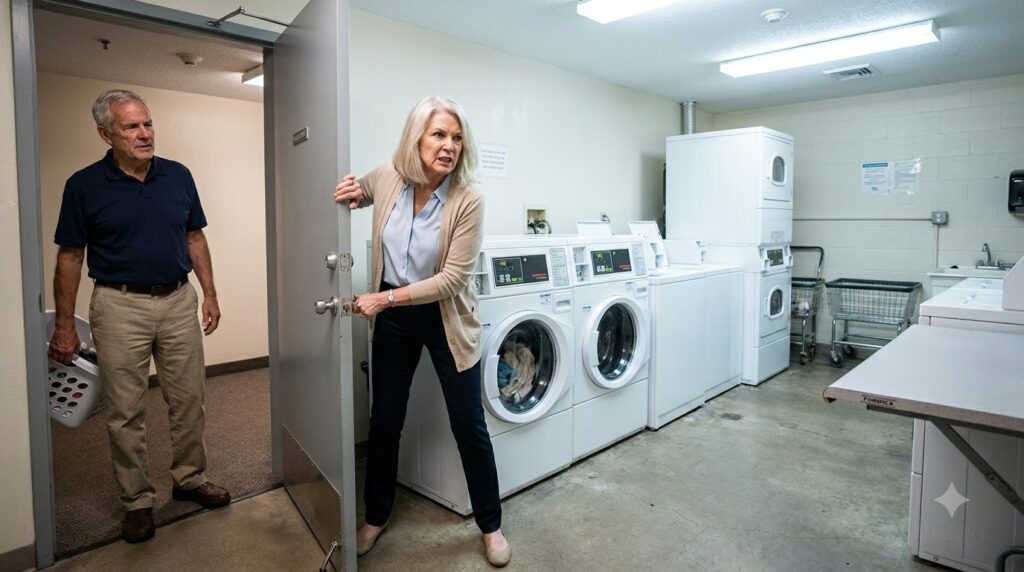
Arthur didn’t raise his hands to brace for it, and that was his mistake. Evelyn’s palms hit the front of his navy polo, flat and shockingly hard, right against the brittle crest of his collarbones. The heel of her right sneaker squeaked on the linoleum as she leaned her full weight into the shove.
Arthur caught his heel against the doorframe, the rubber sole of his walking shoe skidding half an inch before gripping. The plastic laundry basket in his left hand swung wide, hollow and clattering against the wall. The dull ache settled deep into his shoulder blades—the old, stiff rust of seventy-two years that didn’t like sudden displacement.
He didn’t hit back. He didn’t swear. He just leveled his eyes at her.
Evelyn was already backpedaling behind the zinc threshold, her silver-blonde bob trembling with an excess of nervous voltage. Her hand flew to the brass interior latch of the laundry room door. Click-snap. A heavy, mechanical deadbolt engaging against an unpainted strike plate.
Between them remained only the narrow wire-mesh glass pane—pitted, yellowed by forty years of communal cigarette smoke and cheap bleach vapors.
“That machine is running,” Arthur said. His voice was flat, dried out like cured timber. He didn’t raise it to match her pitch. In a building with four-inch cinderblock walls, the man who shouts is the man who loses the board’s ear.
“Not your business,” she spat through the gap where the door seal had rotted away. Her knuckles were white where they gripped the painted steel edge. “Hours are posted. Ten o’clock is dark. I told the committee, and I’m telling you.”
Arthur looked at the clock above the utility sink visible over her cardigan-draped shoulder. The red digital numbers read 9:41.
He didn’t point at it. Pointing gave people something to argue with. Instead, he slowly raised the empty gray basket, resting its curved rim against his hip, and let his gaze drift down past her waist, past the industrial gray baseboards, directly into the belly of Washer Number Three.
The drum was churning violently, caught in the heavy rinse cycle. Water slapped the glass with a muddy, sudsless thud.
It wasn’t a load of beige cardigans. It wasn’t the pale floral sheets Evelyn hung out on her balcony railing against HOA bylaws.
Inside the drum, heavy duck-canvas work fabric tumbled—coarse, industrial, and dyed a distinct slate gray. Every third rotation, a strip of fluorescent yellow safety webbing smacked against the circular glass like a wet hand.
Arthur knew that canvas. He’d spent thirty-four years maintaining the hydraulic lifts down at the county bus depot; you don’t forget the weave of grease-treated heavy cotton. Nobody in this condominium wore utility-grade Kevlar-blend twill.
Except the night shift that wasn’t supposed to exist anymore.
Evelyn tracked his eyes. The righteous, territorial glare on her lined face didn’t soften, but it stalled. Her jaw set so hard the tendons in her throat corded like wire. She shifted half a step left, throwing her shoulder across the narrow sightline to block the drum, but the glass was wider than her frame.
She looked down at Arthur’s empty basket, then back up at his eyes. For a fraction of a second, the latch under her fingers rattled as if her hand had lost its grip on the cold brass.
Arthur leaned in until his nose was an inch from the wire glass. He saw what she hadn’t managed to shove completely out of sight beneath the folding bench: a pair of steel-toed boots, spattered not with detergent, but with dark, tacky pipe sealant that was still off-gassing into the humid room.








