CHAPTER 5: THE LIVE REVERSAL
Marcus’s iron fingers never closed around the fabric.
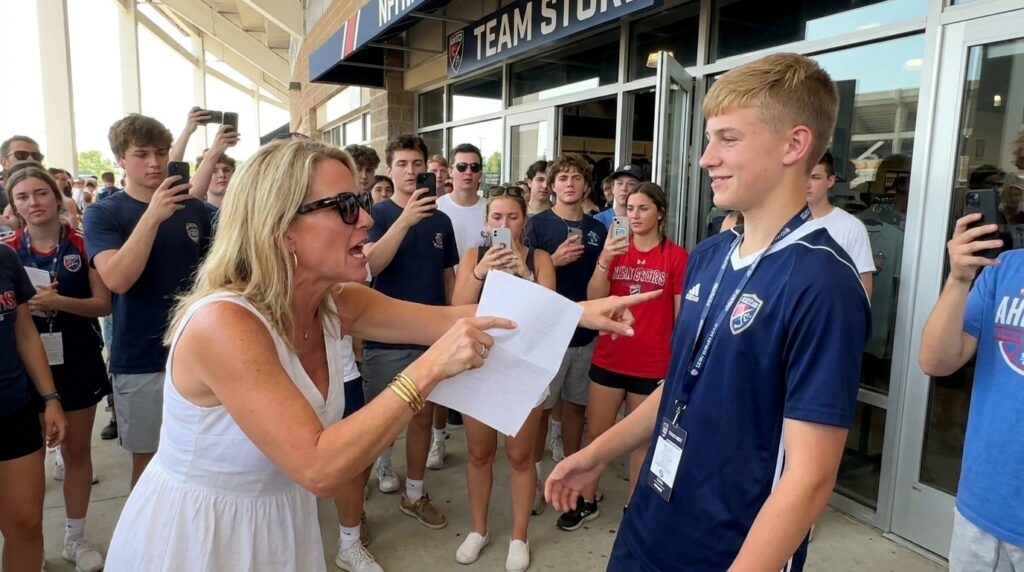
The boy didn’t flinch, didn’t pull away, and didn’t drop his phone. Instead, he twisted his chest by a fraction of an inch, using the solid brass handle of the team store door as a pivot point. The physical movement was tight, minimal, and perfectly timed. Marcus’s hand grazed the slick nylon of the boy’s navy jersey, losing its grip as his knuckles slammed hard into the rigid glass framing. The heavy metallic click of Marcus’s ring hitting the pane echoed sharply through the sudden silence of the bottleneck lane.
“The phone stays in my hand, Marcus,” the boy said. His voice was an unyielding wire, completely devoid of youth or panic, cutting through the low-frequency electromagnetic hum that had begun to vibrate the entire glass entrance.
The woman in the white dress scrambled back half a step, her gold bracelets clashing violently against her designer purse as she nearly tripped over the concrete curb. Her dark sunglasses slid down her nose, revealing wide, panicked eyes that bounced from Marcus’s locked jaw to the flashing amber strobe on the wall. “What are you doing? I didn’t authorize a physical removal. This is supposed to be a standard policy citation. You’re ruining the feed!”
She was right about the feed. The forty smartphone lenses hadn’t lowered. The restless crowd of sports fans, initially waiting for a simple eviction, had frozen. The young man in the white cap shoved his phone forward by another three inches, his screen capturing the exact moment the floor supervisor overextended his physical reach. The collective grins of the bystanders were gone, replaced by a quiet, razor-sharp focus. They weren’t watching an entitled kid anymore; they were documenting an authority figure breaking his own regulations on live video.
The boy didn’t wait for Marcus to reset his balance. He knew the isolated local router was a trap, but every trap had a dedicated master line. He reached beneath the collar of his navy jersey and pulled.
The heavy-duty nylon lanyard slid into the harsh daylight. Dangling from the clip wasn’t a standard, entry-level staff pass or a seasonal guest ticket. It was a solid, matte-black composite plate embedded with a thick, silver-rimmed holographic shard that refracted the stadium’s overhead lights into a blinding cascade of primary colors. There were no printed names, no corporate logos, and no security shift numbers on the face of the credential. There was only a single, deeply etched white icon: a stylized triple-node terminal matrix.
Marcus froze. His breath caught in his throat, a sharp, ragged sound that was instantly caught by the nearest bystander’s microphone. His eyes widened, staring at the holographic reflection against the glass doors. He recognized the master-tier administrative bypass credential—a clearance level that didn’t belong to the stadium’s operational staff, the security contractors, or the executive board. It belonged exclusively to the primary architecture team that built the entire digital foundation of the venue.
“You’re running Terminal 702 on an unindexed cache,” the boy said, his voice dropping into a flat, surgical delivery that landed heavily between them. He didn’t look at his phone screen; he didn’t have to. “You used her outdated Vance pass to trigger a localized sector purge because you thought nobody with root access was monitoring the entrance logs today. You thought you could drop this door off the grid for fifteen minutes without a master alert hitting the central architecture core.”
“Who are you?” Marcus whispered, his hand slowly withdrawing from the door frame, his fingers trembling slightly as he tried to adjust his posture back into a defensive corporate stance. The small, notched silver emblem under his collar felt like a target now, a piece of obsolete scrap metal linking him to a systemic vulnerability he had spent months trying to exploit.
The woman stepped into the light, her hand shaking as she pointed a manicured finger at the matte-black plate. “I don’t care what kind of badge that is. My directive is signed by a vice president! You cannot override a corporate order with a plastic tag!”
“Your vice president was deleted from the network routing tables forty-eight hours ago, ma’am,” the boy said, turning his cold half-grin toward her for the first time. “And if you look at the screen on the phone behind you, you’ll see exactly what your directive is worth.”
The man in the white cap blinked, his eyes dropping to his own smartphone display. The live feed he was streaming hadn’t lagged, but the overlay interface had changed. The stadium’s automated crowd-management bot, recognizing the master-tier holographic token via the camera feeds, had pushed a real-time system notification directly to every active mobile terminal within forty yards of the team store.
The text was crisp, public, and unyielding.
NOTICE: SECTOR 07 PORTAL LOCK REVERSED BY MASTER ADMIN. ALL LOCAL PRIVILEGE CLAIMS VOIDED.
A sudden, sharp burst of laughter erupted from the back row of the crowd. The man in the home jersey lowered his device, shaking his head as he looked at the woman’s pale, frozen face. “Lady, you’re holding garbage. The kid just locked out the whole system.”
The social pressure flipped on the pavement with the speed of a falling guillotine. The smartphones didn’t drop; they simply turned. The forty recording lenses shifted their focus away from the boy, aligning their angles directly onto the woman’s trembling white dress and Marcus’s collapsing posture. The grins returned to the witness layer, but they were directed entirely at the gatekeeper who had just overextended her hand into a systemic buzzsaw.
Marcus took a step back, his boots dragging against the polished concrete as the automated glass doors behind him suddenly groaned, their amber lights dying out as a clean, continuous emerald green flooded the portal. The system had forced a hard validation, and the door was open.