CHAPTER 2: THE PHYSICAL EQUATION
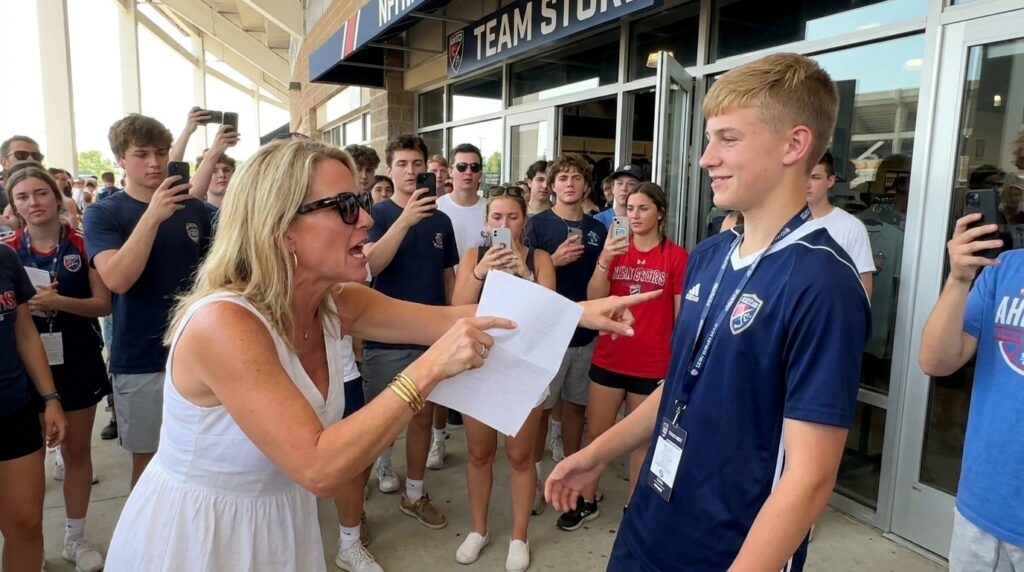
The hiss of the automatic glass doors closing behind the supervisor cut through the humid weight of the concourse like a blade splitting silk. Marcus, the floor supervisor whose face had been hardened by twelve seasons of stadium crowd logistics, did not look at the crowd. His eyes were small, flat beads fixed entirely on the corner of the white paper the woman held. Under the harsh, direct glare of the overhead stadium lights, a sharp, triangular shadow fell across her fingers, highlighting the subtle tremor in her wrist that she was trying to mask by pressing the document closer to the boy’s chest.
“Is there a problem with the premium entry lane, ma’am?” Marcus asked. His tone was a calculated instrument—perfectly polite, entirely hollow, engineered to sound like assistance while establishing a physical barrier. As he leaned forward slightly, the lapel of his dark blazer shifted. For a fraction of a second, the boy caught sight of a tiny, notched silver emblem pinned to the underside of Marcus’s collar—not the standard blue security rotation clip for this shift, but a specialized, older insignia that wasn’t supposed to be on the floor today. The boy’s eyes locked onto it, storing the anomaly away in his mind as a variable to be calculated later.
The woman didn’t notice the pin. Her focus remained entirely on the social leverage she believed she had accumulated through the forty recording smartphones surrounding them. She turned her shoulders toward Marcus, her gold bracelets striking each other with a dry, metallic rattle that sounded like gravel shifting under a boot.
“The problem is a total lack of enforcement,” she said, her index finger slicing through the air toward the boy’s chest again, her voice rising an octave to ensure the microphones captured her pitch. “This kid has been hovering by the glass doors for twenty minutes. He’s crowding the tier-one access lane, and when I told him to step back to give the executive guests room, he refused to move. I have the signed authorization directive right here. Clear him out so we can keep the lane secure.”
The boy stood perfectly still against the cold pane of the store window. Through the fabric of his jersey, the glass felt like a block of ice against his shoulder blades, a solid, grounding anchor while the social storm swirled three feet in front of him. He watched her mouth—the tight, white lines at the corners of her lips, the way her lower jaw shifted slightly to the left before she spoke. She was performing for an audience she didn’t control, throwing her weight into a corporate document because she lacked any real systemic authority of her own. She was overextending her position, exposing her flank with every syllable she shouted into the lenses.
Marcus didn’t touch the paper. He didn’t reach out his hand to take it, nor did he look at the boy for confirmation. Instead, he kept his hands clasped loosely behind his back, his posture mimicking the rigid discipline of an inspector. But his eyes remained pinned to the specific blue ink of the signature block visible on the outer fold.
“Let me see the verification stamp on that directive, ma’am,” Marcus said, his voice dropping lower, forcing her to lean in and break her expansive, crowd-facing stance.
“It’s signed by Vice President Vance himself,” she snapped, her thumb dragging along the edge of the sheet, leaving a faint, jagged crease in the heavy cardstock. “The security protocol update from the central office. It states explicitly that non-ticketed personnel are to be cleared from the glass threshold prior to kickoff. Look at the date.”
The boy monitored the exchange with a cold, analytical detachment. He knew exactly what that paper was. His phone, nestled deep in his front pocket, was currently receiving encrypted network logs from the stadium’s primary data core. He didn’t need to pull it out to know that the Vance directive had been scrubbed from the active server logs exactly forty-eight hours ago when the board finalized the emergency restructuring. The woman was holding a ghost—a piece of high-tier corporate waste that had been valid on Tuesday but was nothing more than an unauthorized liability on Friday. Yet Marcus wasn’t moving to dismiss her. He was staring at the paper with an expression that bordered on recognition, his fingers twitching behind his back near his belt line.
A low murmur rippled through the semicircle of bystanders. A young man in a white cap lowered his phone slightly, his eyes darting between the boy’s calm half-grin and the woman’s increasingly rigid posture. The collective expectation of a fast, viral humiliation was beginning to fray, replaced by the uncomfortable silence of an argument that was changing its shape in real time.
The boy let the silence stretch for exactly three seconds, allowing the weight of the crowd’s attention to settle entirely onto Marcus’s next move. He noticed the way the supervisor’s shadow intersected with the woman’s white dress, a dark, sharp angle that seemed to lock them both into the same compromised grid.
“The paper isn’t the current protocol, Marcus,” the boy said quietly. It was the first time he had used the supervisor’s name, and the syllables fell into the space between them like a heavy weight dropping onto a glass table.
Marcus stiffened, the notched silver emblem under his collar catching a flash of green light from the store’s interior digital display. The woman’s head snapped toward the boy, her dark sunglasses reflecting two identical, tiny distortions of his face.
“You don’t speak to the staff,” she hissed, her voice dropping into a raspy whisper that lacked its previous theatrical volume. “You don’t have a place in this line.”
“He does,” Marcus said. The words were short, dry, and delivered without looking at her. He finally took his hands from behind his back, his right arm rising to point not at the boy, but at the digital reader embedded in the frame of the door. “And that document isn’t an active directive anymore, ma’am. That signature was pulled from the system on Wednesday morning.”
The woman froze, her hand remaining suspended in the air, the white paper suddenly looking massive and heavy between her trembling fingers. The smartphones didn’t lower; they simply tilted, their lenses refocusing on the precise moment her constructed reality began to show its first deep, jagged fracture.