
CHAPTER 4: THE SHATTERED DECOY
The emerald blink of the optical sensor didn’t hold. Instead of the clean, continuous chug of a verified security handshake, the reader’s small glass lens let out a sharp, high-pitched buzz that rattled against its metal framing. The green light vanished, swallowed instantly by a flashing, angry amber strobe that pulsed across the boy’s face.
In his pocket, the haptic engine of his phone didn’t just pulse—it kicked violently, a rapid, continuous vibration that signaled a catastrophic failure in the data handshake. The boy’s fingers tightened against his thigh as he pulled the device into the dim space between his body and the store window. The screen didn’t show the clean, black-and-white lines of the administrative terminal; it was buried under a red cascade of flashing system exceptions.
CRITICAL OVERRIDE: SECTOR 07 CACHE PURGED BY TERMINAL 702.
The boy’s eyes flicked from the screen to Marcus. The supervisor hadn’t stepped back. His right hand was buried deep in his jacket pocket, his knuckles sharp against the dark fabric as he held something small and heavy against his side. The notched silver emblem under Marcus’s collar wasn’t glowing anymore; its polished edges had gone completely dark, matching the dead interface on the glass door.
“You’re tracking the wrong routing tables, kid,” Marcus said, his voice dropping into a flat, gravelly rasp that barely carried over the low hiss of the store’s ventilation. The corporate deflection was entirely gone, replaced by the heavy, deliberate tone of a man who had just locked the exit gates. “You think because you know Vance’s old signature block, you have a hand at this table? That paper she’s holding didn’t clear through the level-three boxes. It cleared through my terminal. Personally.”
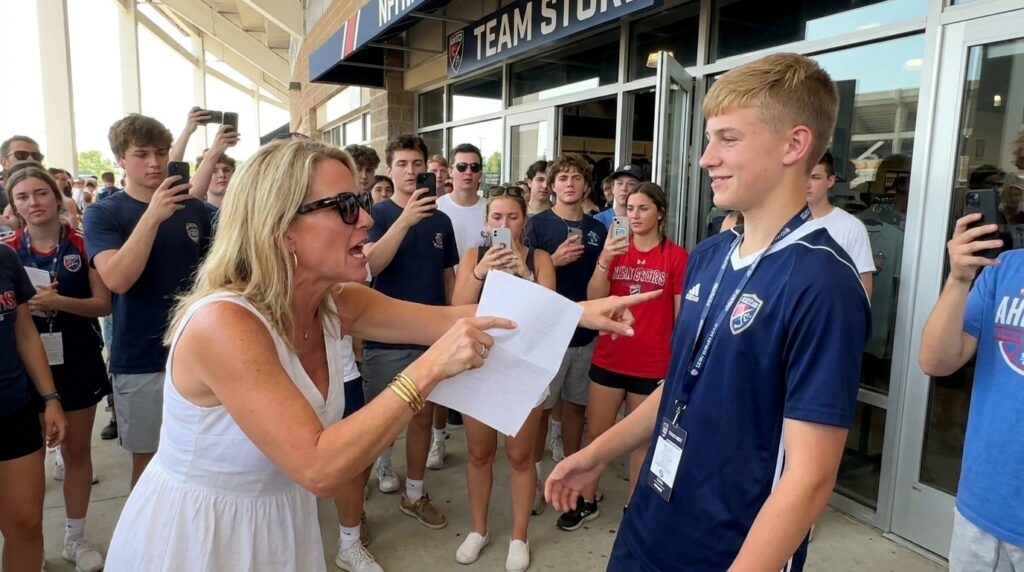
The woman shifted her weight, her gold bracelets making a sharp, confused clatter as she looked between the flashing amber light and Marcus’s rigid profile. She could see the sudden shift in the room’s architecture; the administrative breakdown had frozen, replaced by a quiet, physical tension that turned the concrete concourse into a cage. “Marcus? What is that light doing? Reset the panel and use the directive. I am not standing out here while you debate network logs with a loiterer.”
“Shut up,” Marcus muttered without looking at her. His focus stayed pinned to the boy’s eyes, watching for the slight widening of the pupils that signaled panic.
The boy felt the cold glass window behind him seem to compress against his spine. His calculated leverage had completely vanished in the span of two network cycles. He had played the situation like a standard corporate overreach, assuming Marcus was simply a low-level worker protecting an old privilege line for an important customer. But the 7-0-2 serial stamp wasn’t a legacy contractor badge—it was a localized kill-switch. Marcus hadn’t been maintaining a closed lane for the woman; he had been using her outdated corporate box pass as a cover to manually drop the entire entrance sector off the stadium’s main network grid, isolating this specific portal from central oversight.
Behind them, the semicircle of bystanders tightened. The young man in the white cap stepped forward half a foot, his smartphone raised high, the lens catching a jagged reflection of the amber strobe. “Hey, what’s with the lock? Is the store closed or what? We’re missing the pre-game setup.”
The collective pressure of the crowd shifted, turning heavy and aggressive as the line stalled. The phone screens weren’t just recording a confrontation anymore; they were documenting a system failure, their owners growing increasingly restless as the minutes ticked closer to kickoff. The social friction was turning into physical crowding, the space between the boy and the woman shrinking as the back rows pressed forward for a better view.
The boy tried to force a command through his terminal, his thumb flying across the glass screen, but the interface remained entirely unresponsive. The local router was totally dead, completely isolated by Marcus’s pocket kill-switch. He was stripped of his digital vision, reduced to what he could see and touch within three feet of the brass handles. He had overextended his hand, trusting the systemic architecture to protect his boundary, only to find that the man across from him had already cut the cables.
“You have exactly ten seconds to hand over that device,” Marcus said, taking a slow step forward, his shadow completely erasing the woman’s white dress from the light. His free hand reached out toward the boy’s collar, his fingers hooked like iron talons. “Before I have security clear this entire lane for a technical breach.”
The boy looked at Marcus’s approaching hand, his mind spinning through the remaining variables. The decoy secret—the idea that this was just an old executive memo conflict—had been utterly shattered, revealing a deeper, darker manipulation of the stadium’s infrastructure that he didn’t understand. And for the first time since the white dress had stepped into his lane, his face lost its grin.








