CHAPTER 3: THE STRATEGIC ALIGNMENT
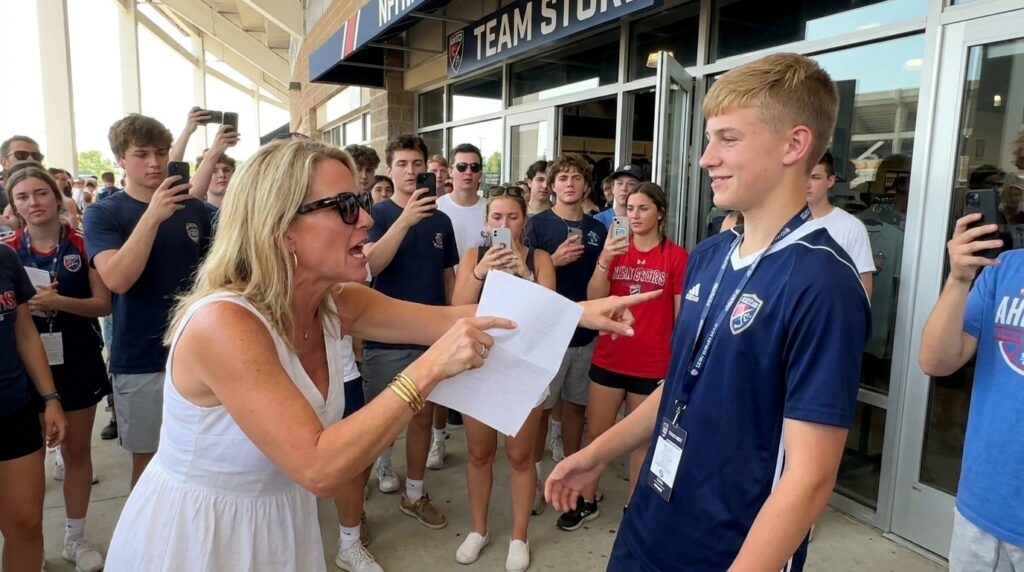
“Wednesday morning is impossible,” the woman said, her voice dropping into a harsh, dry register that barely cleared the hum of the cooling units above the team store entrance. She did not lower the white cardstock. Instead, her fingers clenched the paper tighter, the edges buckling under a sudden, physical strain that sent a sharp crackle through the heavy fiber. “This was issued through the executive logistics branch. It carries the signature stamp of the vice president. You don’t override the front office at a public gate.”
Marcus didn’t flinch. His eyes remained fixed on the lower half of the sheet where the signature sat, totally indifferent to the forty smartphone cameras tracking the micro-movements of his jaw. The notched silver emblem under his collar gleamed with a cold, metallic point as he shifted his weight. “The front office changed its routing tables forty-eight hours ago, ma’am. If you don’t have the digital token synced to the glass door reader, this paper is just inventory.”
The boy observed the interaction through a completely different filter. He didn’t focus on her indignation or Marcus’s standard corporate deflection. His gaze was anchored to the precise indentation on Marcus’s collar pin—a specific three-digit serial stamp, 7-0-2, that was visible only from this exact angle against the glass. That series wasn’t part of the active contractor roster for stadium logistics. It belonged to the older infrastructure design team, an unindexed legacy tier that should have been deactivated when the main servers migrated to the cloud-linked security platform. Marcus wasn’t just a floor supervisor stuck between an entitled fan and a kid by the door; he was operating on an old manual protocol, using the woman’s distraction to keep his own position unexamined.
The boy let his fingers drop loosely past his waist, his thumb lightly grazing the edge of his jersey. In his pocket, the haptic engine of his terminal pulsed three short times—the automated system log verifying a proximity ping from Marcus’s unindexed terminal. They were sharing the same local frequency, but Marcus was completely unaware that the boy’s hardware was silently indexing every routing choice he made.
“Then call Vance,” the woman demanded, her free hand coming down hard onto her leather purse, the gold chains clinking with a rhythmic, heavy snap that drew a collective murmur from the front row of onlookers. “Call him down to the concourse. Let him explain why his premium tier accounts are being managed by a supervisor who can’t verify a corporate seal.”
“Mr. Vance is no longer on the network, ma’am,” Marcus replied. His voice was smooth, polished down by years of administrative friction, completely free of the irritation that would give the bystanders a clean viral clip. “If you’d like to step over to the main relations desk behind section 114, they can issue a temporary day pass. But this lane stays clear for the active credential holders.”
A heavy silence dropped over the semicircle of fans. The man in the home jersey who had been filming at chest height lowered his device two inches, his thumb tapping the screen to pause the recording. The narrative he had anticipated—the quick, satisfying eviction of an overeager kid crowding a VIP entrance—had collapsed into a tedious administrative breakdown. The crowd’s interest was beginning to drift, the tension evaporating into the humid afternoon air.
The boy knew that allowing the tension to dissipate now would destroy his leverage. If she walked away to section 114, Marcus would reset the glass reader, the old routing sequence would drop off the local cache, and the master system line would clear without revealing why an unindexed supervisor was handling executive lane overrides. He needed her to stay planted. He needed her entitlement to push against Marcus until the system forced a hard validation.
“She doesn’t want section 114, Marcus,” the boy said, his voice cutting through the mechanical hum of the sliding doors with a quiet, flat clarity.
The woman’s sunglasses turned sharply toward him, the glossy black lenses catching the reflection of the concrete pillars across the concourse. “I told you to keep your mouth shut. This is an administrative matter between paying tiers.”
“He’s right,” the boy continued, looking directly at Marcus, ignoring her entirely. “She can’t go to 114 because that paper came from the corporate box registry on level three, not the public pass desk. And if she checks the back of that sheet, she’ll see the terminal imprint from the old logistics router—the one that went offline when the board revoked the administrative access tokens.”
Marcus went entirely rigid. The supervisor’s left hand, which had been resting casually on his hip, dropped to his side, his fingers curling into a tight, defensive knot. The small, notched emblem under his collar caught a sudden flash of blue light from the digital scoreboard above them, the three stamped digits burning against the dark fabric of his jacket like a marker.
The woman looked down at the paper in her hand, her thumb slipping across the reverse side as if she were trying to feel the phantom imprint the boy had just described. For the first time, her confidence wavered, the sharp edges of her authority faker archetype dissolving into the stark, unforgiving light of the concrete corridor. She wasn’t just holding an outdated memo; she was holding a piece of evidence that linked her directly to a closed corporate lane that Marcus had been quietly maintaining for his own purposes.
“Where did you get that routing data?” Marcus asked, his tone losing its corporate polish, replaced by a low, hard edge that didn’t carry to the crowd but landed heavily between the three of them.
The boy didn’t answer with words. He simply shifted his posture, allowing his jersey to pull tight against his chest, bringing the laminated holographic edge of his hidden lanyard badge just close enough to the glass door reader to trigger a brief, emerald-green blink from the optical sensor.