CHAPTER 6: THE UNFOLDING DEFLECTION
Evelyn didn’t drop her hands, but the blood drained from her face so fast her skin took on the color of wet newsprint. Her eyes darted from the smartphone screen in my grip to Deputy Hayes’s face, searching for the familiar deference she had commanded across neighborhood committee tables for twenty-five years.
“That… that clip proves nothing,” she stammered, her right heel digging into the expansion joint as she tried to adjust her stance. “I was disposing of an unrelated notice before initiating abatement! The board resolution remains valid! You cannot invalidate an administrative action because of the order of operations, Deputy!”
“Evelyn,” Hayes said, his voice dropping into a quiet, dangerous register. He didn’t look at the paper in his left hand anymore; his fingers clamped around the folder cover, bending the cheap cardboard until the staples popped. “You told me you carried this resolution onto the driveway when you initiated abatement.”
“I had it on my person!” she insisted, her voice climbing into a sharp, thin screech that made the Miller house blinds across the street twitch wider. “It was in my blazer pocket! The video doesn’t show my left pocket! You’re taking his framing as gospel!”
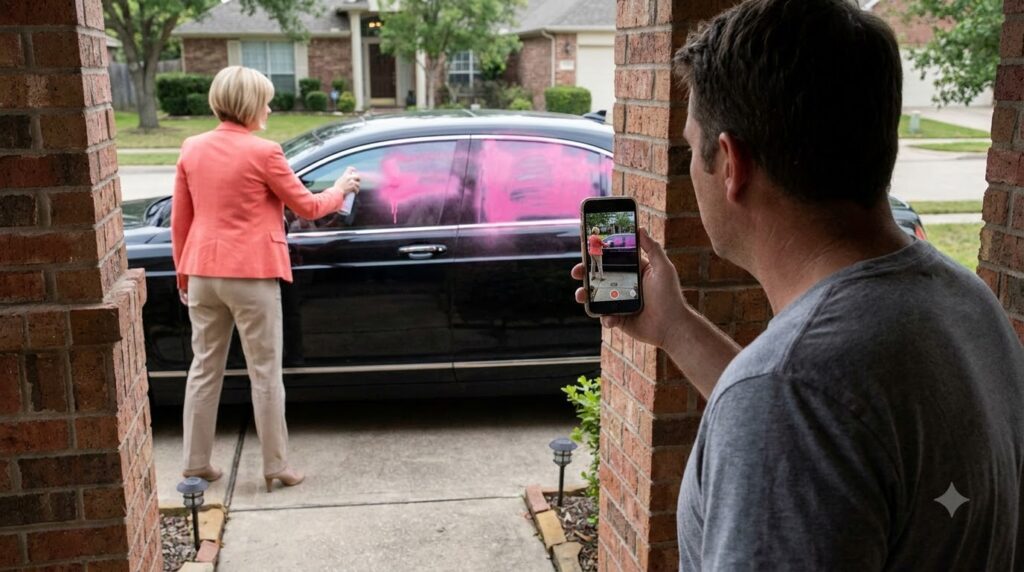
“I have the continuous shot from the moment you crossed the property line,” I said, keeping my thumb resting over the screen. “You didn’t reach into your blazer until I stepped out from behind the column. You walked up with nothing in your hands except the pink can.”
“Because I didn’t need to brandish the document at an empty car!” She pointed a trembling, manicured finger at my chest. “You lay in wait behind that brick pillar! You knew I was coming out to enforce the easement! You deliberately engineered a confrontation so you could record it and slander me!”
“I stood on my porch,” I said. “On private parcel land. While you brought industrial aerosol onto my driveway.”
Hayes turned the manila folder over. As he did, the movement dislodged a small, folded slip of paper tucked into the interior sleeve—a yellowed, smudged carbon receipt with jagged tear-lines along the top edge. He pulled it out with two fingers, holding it up against the blinding glare of the afternoon sun.
It was an order receipt from Quick-Print Solutions on County Route 9, dated three days prior. The itemized line read: Custom Rubber Stamp – Township Docket Header (1 Cst). Below it, printed in faded blue ink, was the customer name: E. Vance.
The decoy document didn’t just crack; it disintegrated on the hot asphalt between us. The red stamp wasn’t a historical artifact or an old archival relic from her days on the committee. She had commissioned the stamp herself forty-eight hours ago, explicitly to manufacture a legal defense for the vandalism she planned to carry out on my car.
Evelyn stared at the yellow carbon slip in Hayes’s fingers. Her mouth opened, then closed, her lips working silently against the dry heat. The rigid, imperious posture that had governed Meadowlark Lane for decades collapsed inward, her shoulders slumping inside the tailored coral blazer.
“Evelyn,” Hayes said, pulling his leather notepad from his breast pocket and clicking his pen. “I’m securing this folder and the aerosol can as evidence in a criminal property damage investigation. You need to step back to your porch right now.”
“You… you can’t confiscate my committee records,” she whispered, her voice stripped of its crisp authority, sounding frail and reedy against the distant hum of traffic on the highway. “The board owns those records.”
“The board didn’t order a forged municipal stamp at a commercial print shop, Evelyn,” I said, stepping down onto the driveway concrete, the heat radiating off the black paint of my sedan reaching my face. “And the board isn’t going to pay for six thousand dollars in custom glass restoration and body re-spraying.”
“I was protecting the neighborhood,” she muttered, her eyes fixed on the wet pink streaks drying into permanent, opaque scars across my windshield. “I was keeping the standards up. If I didn’t do it, nobody would.”
“You weren’t protecting anything,” I said, keeping my phone pointed directly at her as she took her first backwards step toward her lawn. “You were just damaging property you didn’t own.”
Across the street, a car door slammed shut. Neighbor doors were opening up and down the block, figures stepping out onto their front stoops into the heavy July air as the white-and-blue sheriff’s cruiser sat idling on the curb, its lightbar reflecting off the ruined glass of my sedan.