
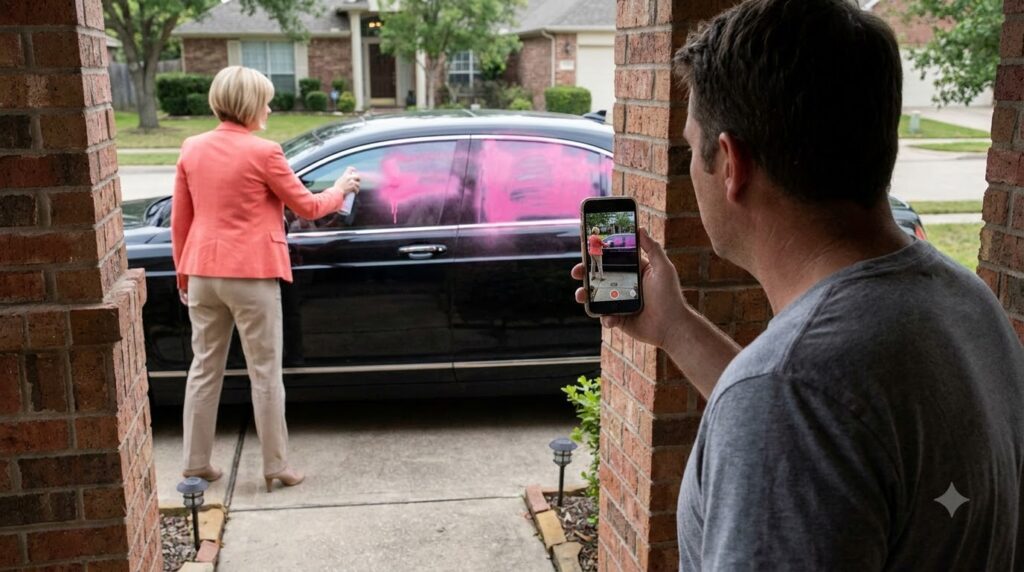
CHAPTER 3: THE SETUP AT THE COLUMN
“Oakridge County Sheriff’s Dispatch, what is the address of your emergency?” The tinny voice cut through the heavy afternoon air, vibrating against the speaker grid of my phone.
“Four-twelve Meadowlark Lane,” I said without taking my eyes off Evelyn. “I need a deputy en route for an active property damage incident. Non-violent, but the suspect is still on site.”
Evelyn didn’t run. That would have required admitting the reality of the street, and Evelyn Vance lived entirely within the legal fortress she had spent thirty years constructing out of covenants and lawn regulations. Instead, her spine snapped straight, her chin lifting as if she were addressing a rowdy floor at an annual homeowners’ meeting.
“I am not a suspect, Arthur,” she said, her voice rising to meet the phone speaker. “Dispatch, this is Evelyn Vance, former president of the Meadowlark HOA Architectural Committee. I am executing a lawful abatement action against an unauthorized commercial vehicle parked on a restricted easement.”
“Ma’am, please let the caller speak,” the dispatcher responded, the static crackling over the line. “Sir, is anyone injured?”
“No injuries,” I said. “The neighbor just sprayed oil-based aerosol paint across the windshield and side glass of my sedan. I have the entire act captured on video from five feet away.”
Evelyn’s eyes narrowed into thin slits. The spray can in her right hand dipped an inch, its plastic nozzle still wet with bright magenta paint that dripped onto the toes of her nude heels. She didn’t notice the stain. Her focus was entirely on the manila folder clutched under her left arm.
“He’s recording without consent!” she shouted toward the phone, taking a aggressive step toward the porch steps. “He hid behind his brick pillar like a coward! He baited me into this!”
“Ma’am, step back from the vehicle,” the dispatcher’s voice turned flat, professional, and entirely unimpressed by her committee credentials. “Unit 412 is approximately four minutes out. Sir, keep your distance and stay on the line.”
“I’m on my porch,” I replied, my voice dropping into the quiet, measured cadence I used when securing job sites. “I’m not moving.”
I didn’t need to move. The physical environment was already doing the work. The midday sun hit the sedan’s glass at a forty-five-degree angle, baking the fresh enamel directly into the factory tint. The chemical smell of solvent floated up through the porch railings—sharp, pungent, and impossible to mistake for anything other than deliberate sabotage.
Evelyn shuffled her feet, the gravel crunching under her soles. For the first time, a flicker of genuine calculation replaced the blind outrage in her eyes. She looked down at the manila folder in her hands, her thumb tracing the edge of the cheap inkjet printout. On the brass clip securing the top of the file, a small metal key tag rattled—a heavy, weathered brass disc stamped with the number 14.
It was an old postal box key tag. The kind used for private drop boxes at the commercial print shop down on County Route 9.
“You think you’re clever because you bought a camera,” she muttered, stepping sideways to block the driver’s side mirror from my angle. “You think a cell phone video overrides thirty years of community standards. The board holds a master easement on this entire apron. I have the signed authorization right here.”
“Then show it to the deputy when he pulls up,” I said.
I shifted my thumb slightly on the screen, adjusting the zoom to capture the brass tag dangling from her clip. The number 14 was unmistakable, scratched deep into the tarnished metal.
Three months ago, when the first anonymous citation had appeared under my wiper blade, I had noticed the same faint purple ink stain along the top margin—the distinctive mark left by the high-volume laser printers at the Route 9 copy center. The board didn’t use Route 9. The board used the municipal printing office in the township basement, where every official notice was embossed with a raised seal.
Evelyn had been running her own private postal box. She wasn’t just writing fake citations; she was receiving mail there, acting as a self-appointed gatekeeper, intercepting complaints before they ever reached Miller’s desk at the management office.
“This entire neighborhood is deteriorating because people like you refuse to follow the rules,” she said, her voice dropping into a tight, raspy cadence. She tapped the manila folder against her hip, the papers rustling in the dry heat. “You park here. Then the people at four-eighteen start leaving their boat on the grass. Then the renters at four-twenty-two stop mowing their back lot. It starts with one vehicle, Arthur. It always starts with one vehicle.”
“It starts with the deed, Evelyn,” I said. “And my deed says private parcel up to the curb line.”
Down the block, the low, mechanical rumble of a Ford Police Interceptor engine rounded the corner of Meadowlark Lane. The white hood gleamed under the streetlights, its roof lightbar dark but its grill lights flashing silent yellow warnings as it slowed down beside the curb.
Evelyn didn’t turn around immediately, but her posture stiffened. She pulled the manila folder tighter against her coral blazer, covering the brass key tag with her palm, while the pink aerosol can dangled from her fingers like a piece of evidence she suddenly realized she couldn’t hide.
The cruiser’s door opened with a heavy, metallic latch sound, and a pair of black leather boots planted themselves firmly on the hot asphalt.








