
CHAPTER 5: THE VERTICAL LENS
Deputy Hayes held the paper against the hood of the patrol car, his thumb smoothing down the crease right over the red ink seal. The midday heat radiating off the engine block made the air between us shimmer.
“Arthur,” Hayes said, his tone shifting into that flat, procedural drone police officers use when they are trying to back out of a civil swamp. “This resolution bears a township clerk docket stamp. Docket 18-B. If the board filed an administrative abatement lien under township ordinance four years ago, they have self-help remedies for access clearance.”
“Look at the stamp alignment, Deputy,” I said, stepping off the bottom porch stair onto the gravel margin. The dust beneath my boots felt bone-dry. “Look at the ink on the docket line.”
Evelyn didn’t move an inch. Her posture remained rigid, her chin tilted at the precise angle of a woman who believed the entire legal system had been constructed specifically to validate her driveway boundaries. “The document is on file at the clerk’s office, Hayes. He can challenge the lien in municipal court on Monday. In the meantime, the abatement stands.”
“The document is a decoy,” I said, pointing my phone lens down toward the folder held in Hayes’s hands. “She bought that seal at an antique auction or ordered a custom rubber stamp online. Township clerk seals don’t use double-spaced typewriter font on the docket line. They haven’t used typewriter keys since nineteen ninety-eight.”
Hayes hesitated. His thumb lifted off the paper, his eyes narrowing as he leaned closer to the red ink.
“That’s absurd!” Evelyn’s voice cracked, a high, sharp sound that sliced through the hum of the cicadas in the maple tree. “I am a former officer of the association! I have maintained the legal archives for Meadowlark Estates since the subdivision was chartered!”
“Which is exactly where you got the old letterhead,” I replied, keeping my voice steady, transactional, and devoid of the anger rising in my chest. “You took blank archival bond paper out of the committee safe when your term ended. You’ve been typing your own resolutions in your kitchen for three years.”
“You’re fabricating!” she snapped, reaching out as if to snatch the folder back from Hayes. “Deputy, he’s defaming me! He’s trying to evade a lawful easement penalty by accusing me of a forgery!”
Hayes blocked her hand with a slow, heavy sweep of his forearm. The movement wasn’t violent, but the weight of his leather sleeve carried the full, unyielding authority of the county sheriff’s department.
“Evelyn, step back,” Hayes said quietly. He didn’t look up from the page. “Arthur… if this document is fraudulent, that’s a state offense for tampering with public records. But if I dispatch a unit to verify a docket number on a Saturday afternoon, and the clerk’s office is closed until nine A.M. Monday, I can’t impound her or arrest her on the spot for property damage without a supervisor’s sign-off.”
Evelyn let out a short, triumphant breath. The pale, thin smile returned to her mouth, tight and merciless. “You hear that, Arthur? The law doesn’t run on your phone camera. You can sit on your porch all weekend and watch the paint cure on your windshield.”
The trap felt suffocating. The decoy document had done its job: it had created just enough procedural doubt to freeze Hayes in his tracks, pushing a clear-cut act of criminal vandalism into the slow, agonizing gears of Monday morning bureaucracy.
“She doesn’t get to walk away with the evidence, Deputy,” I said, my finger tapping the screen to lock the focus directly on her face. “You haven’t checked the video yet.”
“I don’t need to check the video to see the paint, Arthur,” Hayes muttered, rubbing the back of his neck where the sun had turned his skin a deep, leathery red. “I see the paint. The issue is whether she acted under color of board authority.”
“Watch the first thirty seconds,” I insisted, turning the screen toward him. “She didn’t just spray the glass. Watch what she does right before she pulls the trigger.”
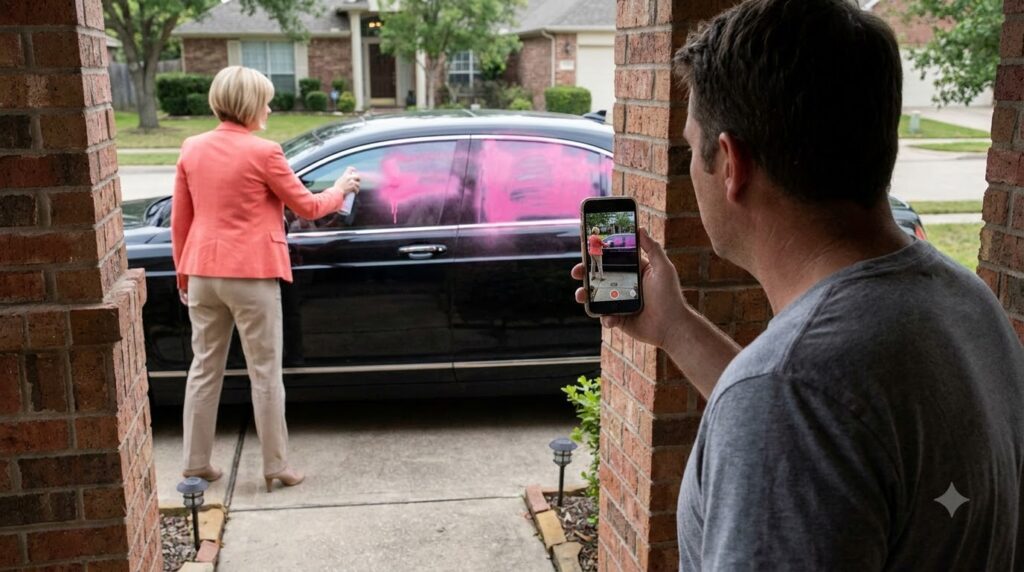
Hayes took a half-step toward me, leaning over the hood of the sedan. Evelyn’s hand twitched toward her side, her fingers clawing at the fabric of her coral blazer as if she wanted to reach out and smash the glass screen in my hands.
On the five-inch display, the high-definition footage played in real-time. The frame showed Evelyn stepping off her manicured lawn, checking both directions of the street, and pulling the aerosol can from a paper grocery bag hidden behind her hedge—a bag that was still sitting at the base of her mailbox thirty feet away.
“Look at her left hand,” I whispered, pointing to the bottom corner of the video playback. “She isn’t holding an official abatement order. She pulls a blank sheet out of her blazer, crumples it up, and drops it into her own trash bin before she ever touches my car.”
Hayes froze. His eyes tracked the movement on the screen.
“She didn’t bring the folder out here to execute a resolution,” I said, the words falling cold and heavy onto the hot concrete. “She brought the folder out here after I called out from behind the brick column. She went back to her porch, grabbed her decoy file, and walked back over to give you an excuse when you pulled up.”
Evelyn’s breath hitched. The pale composure on her face didn’t just crack—it shattered completely, leaving her mouth open in a soundless, desperate gasp as Hayes slowly turned his head to look at her.








