
CHAPTER 4: THE LINEITEM REVERSAL
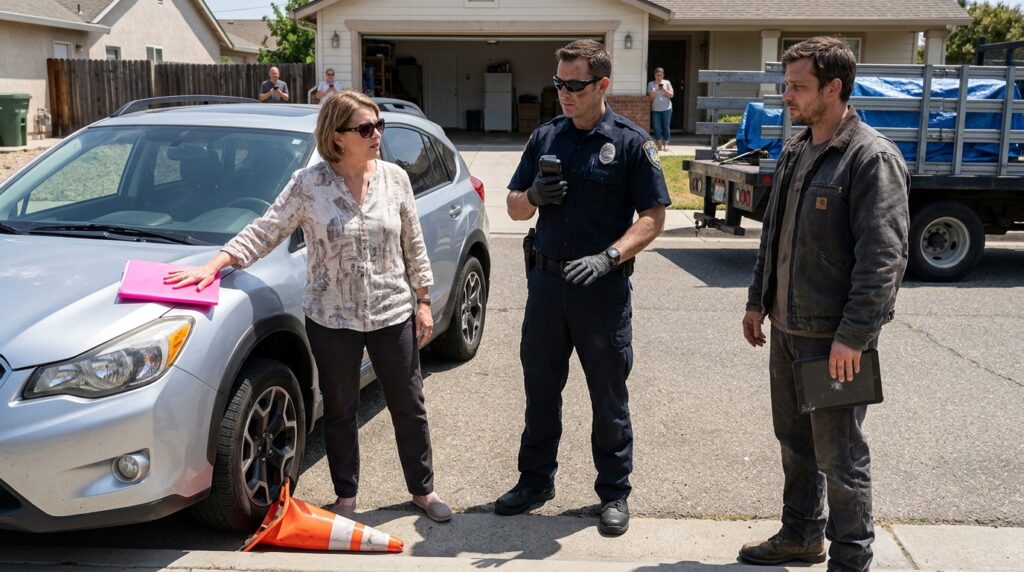
The scanner in Officer Davis’s grip emitted a brief, sharp beep that ended cleanly against the stone quiet of the driveway. A single vertical green line flashed across the device’s handheld face, reflecting off his dark lenses before his thumb released the trigger. He didn’t offer a direct commentary. He remained stationary for three full seconds, staring at the raw data layout populating his department terminal while the heat warped the silhouette of the massive commercial rig behind him.
Brenda did not drop her posture, but her hand twitched against the bright edge of her folder, her fingers inadvertently creasing the top page. A low murmur went through the group standing by Mr. Henderson’s fence line; one of the younger neighbors shifted his weight from the wood post, lowering his forearm from the rail as his phone screen swung toward the gutter.
“The registry code is active,” Davis said, his voice flat, dropping with the clinical weight of a field measurement. He didn’t tilt his hat back. He looked straight through the glare toward Brenda’s front bumper. “The city infrastructure log verified this right-of-way easement at eight-thirty this morning. The temporary weight exception code is signed by the district coordinator. It’s completely ironclad, ma’am.”
“That’s a regulatory oversight,” Brenda countered instantly, her voice cutting through the dry air with a sharp, transaction-driven velocity. She stepped closer to the hood of her crossover, her arm extending to track a line across the asphalt. “The local improvement fund owns the sub-base equity on this corner. Public works cannot override a standing district classification without a formal notice to the residential boundary committee. Look at the local agricultural code section on the margin here—”
“The code section on your page is an archived 2012 ordinance that was rewritten four sessions ago,” Davis interrupted, his hand dropping back to his leather utility belt with a heavy, final thud. He pointed a single gloved finger down at the cracked plastic cone pinned beneath her left chassis panel. “And this document isn’t a certified county order. The stamp on this margin belongs to an inactive district inspection office that hasn’t held jurisdiction over Elm Street since the deep-trench lines were integrated.”
Marcus watched the color drain from the exposed skin above Brenda’s patterned linen collar. The midday light caught the sweat sheen along her temples, her sunglasses sliding down her nose by a fraction of an inch as she pulled her pink folder back against her chest. The small purple ink oval on the paper—the micro-mystery she had used to freeze the loading lane—was completely exposed under the vertical glare of the noon sun. It wasn’t an authorization; it was a stale, unverified citation from an old parcel dispute.
“This is an administrative trap,” Brenda said, her voice dropping an octave as her fingers locked around the edges of the folder. She turned her head toward the porch watchers, her gaze searching for compliance along the sidewalk edge, but the crowd was no longer holding her alignment. Mrs. Gable had stepped down from her top riser, her smartphone held steady at chest level, her thumb actively scrolling as she recorded the space between Brenda’s bumper and the officer’s boot. “The neighborhood board explicitly flagged this parcel for structural review. If that delivery proceeds, the entire drainage baseline is compromised.”
“The baseline is clear, and the permit is valid,” Davis said, his tone tightening as he took a direct step into the narrow gap between the crossover’s side mirror and the flatbed’s steel rim. “Right now, your vehicle is straddling a permitted public loading zone during an authorized municipal window. That constitutes a Class C misdemeanor under the revised county transit code.”
Marcus stayed out of the officer’s path, his boots set firm behind his own property marker. He felt the cold texture of his tablet cooling in his palm, the screen blacking out as the timeout engaged. The truck driver let out a short, dry laugh from the cab window, his leather work glove tapping a steady rhythm against the exterior door panel. “Ten minutes left on my shift log, folks. Either the car clears the gutter or I call the yard for the obstruction surcharge.”
Brenda’s shoulder alignment buckled. She didn’t look at Marcus, and she didn’t look at the officer’s ticket book. She looked down at the crushed orange plastic beneath her front tire, her mouth moving in a silent, calculated count as the local social structure she had built over five years dissolved into the desaturated gravel of the right-of-way.
“I am going to file a formal grievance with the city coordinator’s office by two o’clock,” Brenda hissed, her fingers shaking slightly as she reached for her car door handle. “This entire block will be locked down under a civil property audit before the week is over.”
“You can file whatever paperwork you like at the courthouse, ma’am,” Davis replied, his arm extending toward her driver-side window as he reached for his belt terminal. “But if this vehicle isn’t out of the permitted loading lane within sixty seconds, I’m initiating a mandatory impound tow and logging a citation for willful public obstruction.”








