
CHAPTER 3: THE CIVIC INTERVENTION
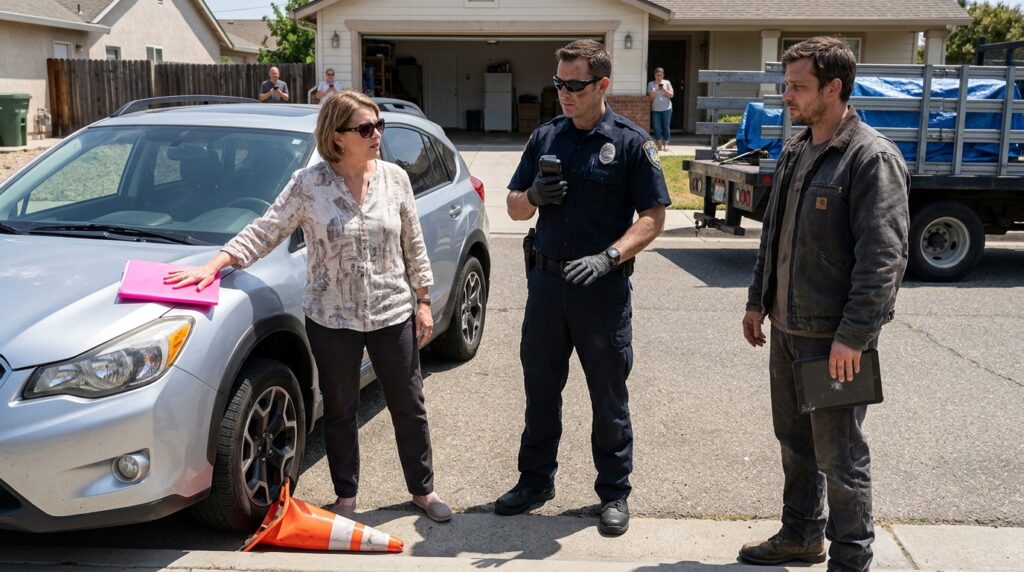
The high-pitched chirp of a short-band radio frequency cut through the dead air before the car itself rounded the corner. Brenda did not drop her phone, but her shoulder blades dropped an inch, a subtle shift in her rigid spine that Marcus caught instantly. She adjusted her sunglasses with her thumb, her knuckles white against the dark plastic frame as the white-and-blue municipal patrol cruiser crawled into the cul-de-sac.
The cruiser didn’t bounce on the cracked asphalt; it rolled with the slow, deliberate weight of a vehicle whose driver spent ten hours a day cataloging town boundaries. The tires stopped precisely six inches from the rear bumper of Brenda’s crossover. Through the heat distortion twisting off the hood, Marcus saw Officer Davis’s face behind the dust-streaked windshield. He wasn’t rushing. He sat in the air-conditioned cabin for exactly five seconds, entering a code into his mounted terminal, before clicking the heavy driver’s side door open.
The humidity hit the officer’s crisp uniform, leaving instant, dark half-moons under his shoulder straps. He adjusted his heavy leather utility belt with both hands, his thumbs hooking into the front loops near his holster as his boots took the weight of the pavement. He didn’t look at Marcus first. He didn’t look at Brenda. He looked at the flatbed truck’s rear gate, then at the orange cones, and finally at the left front tire of the silver crossover pinned against the buckled orange plastic.
“Afternoon,” Davis said. His voice was gravelly, dried out by the county line’s summer shift. He stopped at the neutral zone between the gravel driveway and the gutter. “We got a report through dispatch about an unrated commercial vehicle creating a public right-of-way hazard and a civil disturbance. Who owns the crossover?”
“I do, Officer,” Brenda said immediately. She stepped forward, her sandals clicking against the loose stones, her arm extending to offer the neon pink folder like a seasoned litigator. “Brenda Gantry, representing the Elm Street Neighborhood Improvement Coalition. This commercial operator is attempting to offload industrial equipment on a secondary residential street without an active engineering sign-off. As you can see by the layout, his flatbed is trapping local traffic and threatening the municipal sub-base.”
Officer Davis didn’t take the folder. He glanced at the blurred purple oval on the margin of her top document, his eyes lingering on the smudged date line for less than a second before moving to Marcus. “Warren?”
“The flatbed is here for a scheduled delivery,” Marcus said. He didn’t raise his arm. He held the cracked tablet flat against his thigh, his fingers wrapped around the rubber casing. “The right-of-way is cleared through the public works office. The cones were placed at dawn. Mrs. Gantry pulled her vehicle into the loading lane ten minutes ago to block the approach.”
“He doesn’t have an original hard copy, Officer,” Brenda cut in, her voice tightening, its pitch rising just enough to carry toward the two neighbors now leaning against Mr. Henderson’s chain-link fence. “He’s showing a digital screenshot from a cell phone app. This street is an active agricultural drainage corridor under a pending watershed freeze. The weight distribution of that flatbed is completely unauthorized.”
Davis turned his head slowly, his sunglasses tracking the line of the curb. He looked down at the crushed cone beneath her chassis, then took a single step toward the crossover’s driver-side window. “Ma’am, you’re straddling the concrete gutter line. This is a designated fire lane margin when a permitted vehicle is executing an offload. Did dispatch clear you to place a vehicle barrier here?”
“I am enforcing the standing easement restriction,” Brenda said, her fingers digging into the plastic folder until the cardboard inside bent. “The improvement fund paid for the culvert clearance. The city coordinator’s office promised a secondary review of this entire block’s zoning status. If that truck drops forty thousand pounds of steel on this grade, the drainage pipe will collapse.”
Marcus watched the officer’s hand drift down to his belt terminal. Davis wasn’t listening to the zoning argument; he was scanning the physical physics of the street. The truck driver had leaned his head entirely out of the cab now, his arm resting on the hot metal door panel. “Officer, I’ve got fifteen minutes on my log. If I have to haul this structural frame back to the county depot, it’s a civil line-item charge. I need a clear determination.”
Davis didn’t answer the driver. He turned back to Marcus, his face completely unreadable beneath the brim of his gray campaign hat. “Let me see the municipal authorization, Warren. The active screen, not a cached image.”
Marcus lifted the tablet, his thumb tapping the power button to wake the display. The screen flickered, the green city emblem glowing against the desaturated background of the dry lawn. He held the device steady at the officer’s eye level, ensuring the verified municipal timestamp and the encrypted QR code were fully visible in the direct glare of the sun. The hairline fracture across the glass split the digital seal down the middle, but the security border remained intact.
Davis reached down, his leather holster creaking as he pulled his department scanner from its bracket. The lens clicked as it caught the light, positioning itself two inches from the cracked tablet screen.








