CHAPTER 1: THE FIRST ENCROACHMENT
The air carried the faint, dry scent of iron and cooked asphalt, the kind of heat that made the horizon warp just above the roofs of the subdivision. Behind Marcus, the garage door sat halfway open, revealing the empty concrete floor where the specialized mechanical lifting frame for his son’s physical therapy was supposed to be anchored by noon. Every minute the flatbed spent idling out on the road cost money he had already counted twice against his insurance deductible.
The truck’s air brakes hissed, a violent release of pressure that caused Mrs. Gable’s porch dog down the block to start its rhythmic, hollow barking. Marcus kept his thumb pressed against the glass of his tablet, verifying the digital seal on the city-issued right-of-way permit. Four orange traffic cones, faded from seasons of sun and scratched along their bases, stood like small markers in the gutter, reserving thirty feet of public curb.
Then came the crossover.
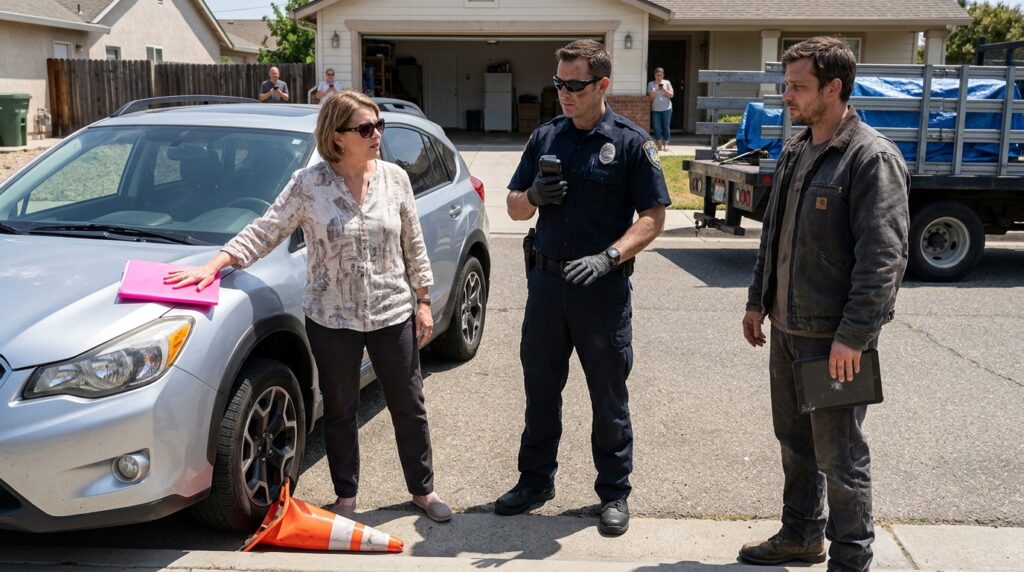
It didn’t slow down for the turn. The silver crossover swerved from across the lane, its tires catching the edge of the concrete gutter with a hard, metallic scraping sound that echoed between the houses. The vehicle jerked to a halt directly inside the cone boundary, its front bumper stopping less than three inches from the flatbed’s rear tires, effectively locking the commercial driver out of the approach angle.
The driver’s side door swung open before the engine had even settled into a silence. Brenda Gantry stepped onto the hot asphalt, her posture rigid, her chin tilted up as if she were addressing a courtroom rather than an empty driveway. She wore a patterned linen blouse that seemed too stiff for the humidity, and her oversized sunglasses hid everything but the sharp, pinched line of her mouth. In her left hand, she clutched a neon pink plastic folder like an executioner’s warrant.
“This street is a designated residential corridor, Marcus,” Brenda said, her voice dry, cutting through the low rumble of the truck’s engine without rising to a shout. She didn’t look at him; her eyes were fixed on the truck driver, who was already leaning his arm out of the cab window. “It is not a commercial loading zone for industrial freight. Move this vehicle immediately, or I am having the county dispatcher impound it for public obstruction.”
Marcus didn’t move from his spot on the gravel. He felt the cold weight of the tablet in his palm, the hairline fracture across the protective glass catching the glare of the noon sun. He didn’t look at the pink folder, nor did he look down the block where the click of front screen doors signaled that the first wave of witnesses was taking their places on the porch steps. He looked only at the space between Brenda’s front tire and the orange cone she had crushed beneath her right chassis panel.
“The space is permitted, Brenda,” Marcus said. His voice was sparse, leveled by the long weeks of hospital schedules and technical logistics. “The truck has two hours to offload the frame. Move the car.”
“The association bylaws are explicit about commercial weight limits on neighborhood asphalt,” Brenda replied, her pen tapping a fast, transactional rhythm against the plastic folder. She stepped directly into the path of the truck’s side mirror, her body posture blocking the driver’s clear view of the driveway mouth. “Your private family situation does not give you the right to degrade the infrastructure of this entire block. We have a standard here, and I intend to see it maintained.”
Marcus watched a crow drop onto the top of his mailbox, its black feathers sleek against the desaturated gray of the cedar post. The conflict wasn’t about the road, and they both knew it. Behind Brenda’s sunglasses lay the ledger of a woman who had spent five years treating the neighborhood boundaries as her personal property line.
He lifted the tablet, the screen glowing blue against his work jacket.