CHAPTER 2: THE PAPER BLOCKADE
The tablet felt heavy in Marcus’s hand, its cracked glass slick with the fine layer of road dust kicked up by the crossover’s tires. He didn’t offer the screen to Brenda a second time. Instead, he stepped laterally, angling his body to keep both Brenda’s front bumper and the commercial flatbed’s driver within his peripheral vision. The low, guttural vibration of the diesel engine hummed through the soles of his work boots, a constant reminder of the meter running against his savings.
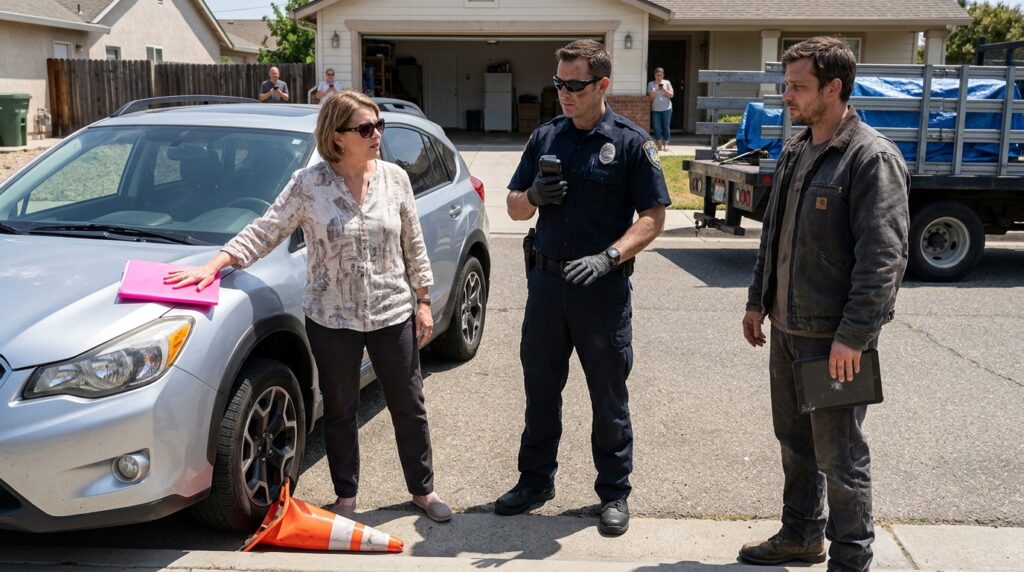
Brenda did not flinch back. Her fingers shifted against the neon pink plastic folder, the plastic crackling under the sudden pressure of her grip. A small smudge of purple ink was visible along the top margin of the paper tucked inside—the distinct oval of a notary stamp, though the edges were blurred, the text within the ring unreadable from where Marcus stood.
“A digital screen doesn’t override county classification, Marcus,” Brenda said, her voice dropping into a rhythmic, practiced cadence. She took a half-step forward, her leather sandal pressing into the dry grass at the very edge of his ditch line. “I have the environmental division’s watershed buffer brief right here. This entire easement lane is under a dynamic runoff freeze. No heavy axle loads are permitted within thirty feet of the primary culvert until the state inspector signs off on the low-grade soil compaction test.”
Marcus looked down at the pink folder. The paper she was flashing had the official county typeface, but the layout was wrong; the spacing at the header was too wide, and the municipal seal lacked the crisp indentation of a modern city document. It was an old form, weaponized with a fresh coat of jargon.
“The culvert is reinforced concrete, rated for twenty tons,” Marcus said, his tone flat, stripped of any emotional color. “The county engineer logged the certificate three months ago when they cleared the deep-trench line. If you have a watershed freeze, Brenda, it needs a certified case number from the district clerk.”
Brenda’s mouth tightened until her lips almost disappeared into a pale line. “The case number is pending the secondary review, which my committee requested forty-eight hours ago. Until that board meets, the status quo remains locked. The driver handles his vehicle at his own legal peril.”
Behind her, on the opposite side of Elm Street, the neighborhood was beginning to solidify. Mr. Henderson had walked down his concrete path, his hands shoved deep into the pockets of his faded shorts, his eyes drifting between the massive flatbed and the silver crossover. Two more residents from the corner house stood near the curb, their faces desaturated by the harsh noon glare, their posture hesitant but lingering. They weren’t stepping across the asphalt to join her, but their presence formed a silent, shifting wall. Brenda saw them out of the corner of her sunglasses, her shoulder alignment widening as she drew on the collective weight of the audience.
“You’re disrupting the drainage baseline for every property on this low ridge,” Brenda announced, her voice carrying across the dry lawns to ensure the observers caught the specific threat. “We spent three thousand dollars out of the local improvement fund to clear that concrete pipe last fall. We aren’t going to let an unauthorized commercial delivery crack the sub-base because one resident refuses to use the designated regional freight terminal.”
The flatbed driver cut the engine. The sudden drop in sound left a heavy, ringing silence in the street, broken only by the pinging of the cooling metal beneath the truck’s massive hood. He slid his window down another three inches. “Look, buddy,” the driver called out, looking directly at Marcus. “I’ve got forty minutes left on my log before I’m in violation of my shift limit. If the lane isn’t clear to drop the frame, I have to turn this rig around and return the cargo to the yard. That’s a seven-hundred-dollar split-delivery fee on your invoice.”
Marcus felt the dry heat rising from the gravel under his soles, the smell of sun-baked oil thick in his throat. He looked past Brenda’s shoulder toward the silver crossover. The vehicle’s front left tire was jammed hard against one of his faded orange cones, the plastic buckled under the weight of the metal rim. His child’s therapy frame was sitting on the wood-planked bed of the truck, twenty feet of structural steel wrapped in protective blue tarp, completely stagnant because of an expired form and a manufactured committee rule.
He didn’t look at the neighbors whose phone screens were now angled toward his driveway. He took three measured steps toward the street, his work boots crossing the boundary line into the public right-of-way, stopping exactly two feet from the crossover’s driver-side door.
“The invoice stays with the carrier until the delivery window closes,” Marcus said, his eyes locking onto the dark lenses of Brenda’s sunglasses. “And the window doesn’t close until I sign the log. If you don’t clear the lane, Brenda, we aren’t waiting for your committee review. I’m dialing the county dispatcher right now to log a civil interference report against your private insurance policy.”
Brenda’s pen stopped tapping against the folder. The silence between them grew dense, weighted by the heat and the friction of two unyielding baselines. She reached into her pocket, her fingers closing around her phone, her thumb flicking the screen on with a sharp, transactional click. “Go ahead and dial, Marcus. Let’s see who the city coordinator supports when they see the tonnage report on this residential street.”