
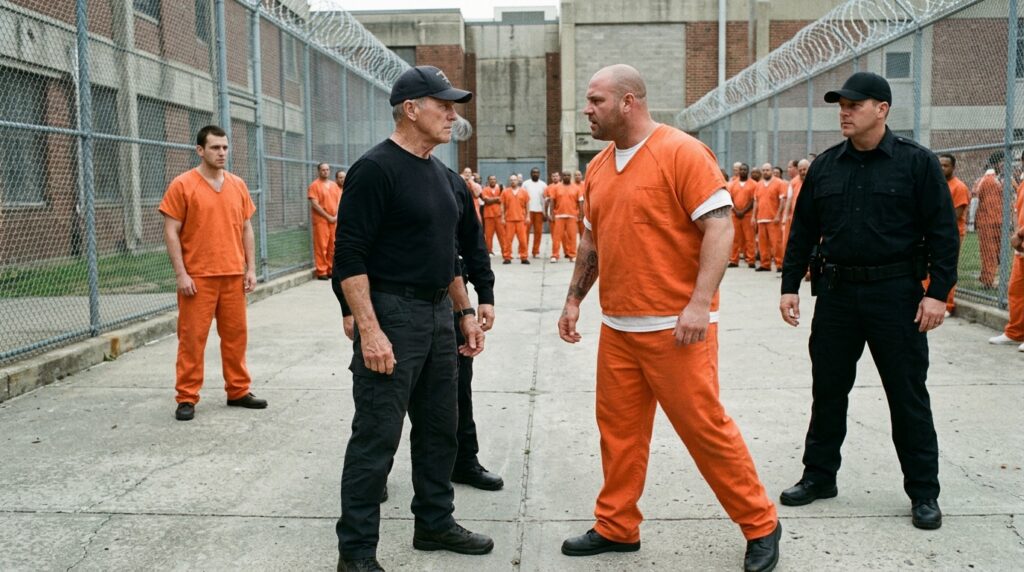
CHAPTER 4: THE CLOSED THRESHOLD
“The primary breaker just dropped,” the cellmate whispered from the dark.
The absolute blackness of tier C didn’t fall slowly; it slammed down like an iron shutter. The persistent, low-frequency thrum of the ventilation fans died instantly, leaving a vacuum of silence that allowed the distant, metallic scraping of sixty cell latches to echo up from the basement level. The smell of wet wool and boiled lard dissipated, replaced by the sharp, bitter sting of ozone coming from the auxiliary terminal boxes down the catwalk.
The veteran didn’t slide his back down the concrete wall. He stood perfectly still in the dead center of the floor space, his knees slightly flexed, his feet tracking the minute vibrations traveling through the cold iron floor plates. A standard power failure left the emergency secondary system online within three seconds. Six seconds had passed. The emergency lights remained dead, save for a tiny, rhythmic pulse of dull red illumination coming from the casing of the high-wall optical cluster above the tier door.
It wasn’t a standard blackout. It was an isolation protocol.
“They’re not using the central gallery stairs,” the cellmate muttered, his fingers clicking nervously against his slate stone in the dark. Scritch. “They’re coming up the service shaft behind the laundry chute. Three men. Heavy boots.”
The veteran reached down, his fingers brushing the coarse fabric of his trousers until they located the hidden ledger sheet from the laundry crate. He didn’t try to destroy it. He folded the waxed cardstock into a tight, dense square and jammed it into the hollow drainage pipe beneath the iron sink basin, locking it behind the rusted internal threading. If they were clearing his sector, they would search the body first.
A sudden, mechanical click sounded at their cell threshold. The heavy master bar didn’t slide with its usual warning rattle; the lock actuator dropped with a muted, hydraulic hiss. The door swung inward six inches, its iron frame scraping against the concrete lintel.
“Move,” the veteran said.
He slipped through the opening before the door could hit the bumper block. The catwalk was an empty lane of desaturated shadow, illuminated only by the faint, crimson pulse of the security lenses along the ceiling line. As his eyes adjusted to the narrow corridor, he noticed something that shattered the logic of the decoy manifest. The red light wasn’t a battery backup signal. It was an active optical sensor, its tiny glass aperture panning smoothly across the floor plates, tracking his precise physical displacement in real time.
At the end of the gallery, near the auxiliary security cage, three figures emerged from the steam-pipe corridor. They didn’t wear the standard bright nylon of the yard factions or the mismatched protective gear of the night guards. They moved in a tight, three-man tactical wedge, their bodies covered in matte-black impact suits without identifying insignia or state badge numbers. Their movements were clean, silent, and perfectly balanced—the unmistakable signature of active-tier contractors trained for close-quarters counter-insurgency.
The lead operator didn’t pause to offer an administrative warning. He brought a short, composite defensive baton up to his centerline, his weight shifting into a low, aggressive forward lunge designed to fracture the veteran’s collarbone before he could establish a guard.
Time expanded into a cold, clinical sequence of spatial calculations. The veteran didn’t step back into the narrow cell. He drove his center of mass directly into the operator’s leading hip, slipping his left forearm under the incoming weapon arm to intercept the kinetic force at the pivot point. The impact was dead, heavy, and metallic. He could smell the clean oil on the operator’s gear and the sharp, chemical scent of professional grade synthetic fiber.
With a compact, three-inch rotation of his shoulders, the veteran delivered a short counterstrike to the operator’s jaw, right where the helmet strap met the lower mandibles. The man’s head snapped back, his boots losing their tracking on the iron grating, his body dropping into the auxiliary railing with a muted, metallic ring.
The veteran didn’t follow the body down. He caught the fallen weapon before it struck the floor, his fingers wrapping around the checkered synthetic grip. But as he rolled his weight to face the remaining two operators, his eyes caught the tiny display screen mounted to the back of the lead operator’s tactical wrist unit.
The screen wasn’t showing a tactical map or a manifest of inmate names. It was displaying a scrolling waterfall of real-time biometric metrics: SUBJECT-01_HEART_RATE: 72_BPM. RESPIRATORY_DEPTH: OPTIMAL. COMBAT_EFFICIENCY: 94.2%. Below the data stream, a small, system-generated prompt was blinking in amber text: ALGORITHM UPDATE: CONVERTING BEHAVIORAL PROFILE TO DEFENSE-GRID-PREDICTIVE-LOGISTICS.
The realization hit him with the weight of a physical blow. The prison wasn’t a disposal site. His former handler hadn’t sold his location to a gang for retribution or profit. The entire facility was a functional laboratory—a highly organized, deniable testing ground where legacy special operations assets were systematically pitted against engineered stress environments to train an automated, predictive behavioral system for private military applications. Every yard fight, every calculated counterstrike, and every hidden manifest was a piece of proprietary data being fed into the ceiling lenses.
The remaining two operators didn’t advance. They held their defensive line, their weapons lowered slightly, their eyes fixed on the veteran as the red optical sensors along the ceiling line ceased their panning and locked onto his chest with a synchronous, mechanical hum.
At the far end of the tier gate, the iron security door opened with a heavy, administrative hiss. Standing in the threshold, framed against the sudden, brilliant white light of the main corridor, was the unauthorized man from the laundry detail—the one who had worn the silver naval screening pin. He wasn’t in denim anymore. He wore a crisp, dark civilian suit, and in his hand, he held a small, black interface tablet that showed the identical biometric feed.
“The simulation is complete, Commander,” the man said, his voice echoing cleanly down the dead silent shaft of concrete and iron. “Your data has just initialized the next generation of the grid. Let’s talk about your second deployment.”








