
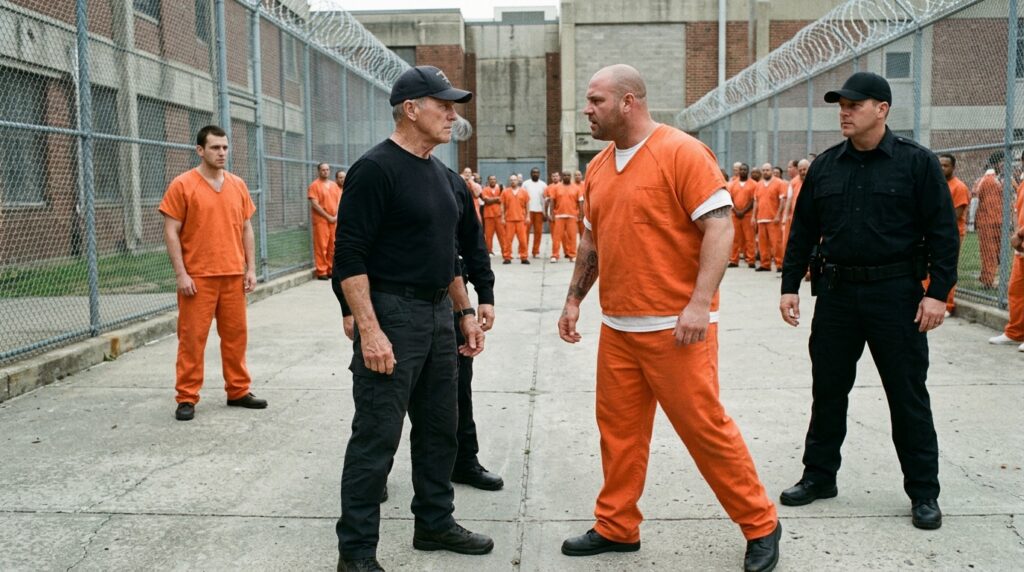
CHAPTER 2: THE FRICTION COUNT
“Keep moving, old man,” the guard barked, his fingers twitching against the plastic casing of the chemical iron canister. “He didn’t give you permission to look at the laundry bins.”
The veteran didn’t alter the length of his stride by a fraction of an inch. His heels struck the concrete floor with a heavy, predictable rhythm that resonated off the narrow iron-reinforced walls of the intake corridor. His mind was already cataloging the anomaly. The silver pin—three-sixteenths of an inch across, the anchor fluke slightly blunted from a bad stamping run in 2021—was only issued to the regional processing officers at the amphibious training command in Coronado. It wasn’t a civilian trinket. It wasn’t something a street-level dealer traded for two cartons of menthols in the lower tiers.
“Who’s the man on the laundry detail?” the veteran asked, his voice remaining flat, keeping below the echo threshold of the vaulted corridor ceiling.
“That’s nobody you owe money to,” the guard said, pushing a heavy steel door inward. The hinges screamed, a dry metal-on-metal scrape that vibrated through the floorboards. “That’s tier four business. Tier four stays out of your mouth if you want to keep breathing this air.”
The door clanged shut behind them, locking out the dim yellow sodium glare of the yard tunnels. The transition into cellblock C brought a different kind of pressure—the desaturated, cold dampness of underground stone that had spent fifty years absorbing the sweat of six hundred men. The vertical iron bars lining the main gallery were thick with layered, industrial gray paint that had begun to split and bubble away from the rusted structural metal beneath. Every vertical lane was a tight choke point. Every corner smelled of damp laundry, cold lard, and the sulfurous sting of cheap institutional coal burned in the auxiliary heating pipes.
The guard led him up the second tier catwalk, where the iron grating underfoot vibrated with the collective low hum of the cells. It was the afternoon lockdown count. Men stood at their grates, their faces reduced to pale slivers behind the rusted crossbars, their eyes tracking the veteran’s black long-sleeve shirt like hawks watching a strange predator move through an established thicket.
“Cell eighty-four,” the guard said, pulling a heavy brass key from his duty belt. He dropped it into the mechanical lock with a sharp, heavy thud. “Get inside. Hands on the back wall until the bar drops.”
The veteran stepped into the space. It was four paces deep, two paces wide. The walls were rough-cast concrete, green with moisture bloom near the floor where the plumbing lines leaked into the foundation. A single iron bunk was bolted directly into the stone, its canvas mattress support sagging like an old hammock.
Sitting on the lower edge of that iron frame was a small man with graying hair cut down to the scalp and arms covered in old grease scars from a motor pool detail. He didn’t look up when the door slammed shut. He didn’t move his hands from his knees. Between his thumb and forefinger, he was holding a small, flat piece of slate, rhythmically drawing the edge against the iron corner of the bunk frame.
Scritch. Scritch. Scritch.
The sound was tiny, sharp, and perfectly metered. To an untrained ear, it was the nervous tic of an old convict wearing down the hours. To the veteran, the interval was exactly twelve hundred milliseconds—the standard timing signature for a manual radio check in a contested operational theater.
“The yard was loud today,” the cellmate said without stopping the slate. The gray dust fell from his thumb, settling into the cracks of his scarred skin like dry earth.
“The yard is always loud when people don’t know who owns the lane,” the veteran replied, standing near the opposite wall. He didn’t sit. He didn’t drop his baseball cap. His eyes scanned the corners of the cell—the weld points on the bunk, the drainage grate in the corner, the tiny gap where the ventilation pipe entered the concrete ceiling. There were no wires, no hidden cameras, but the air felt too thick, like a room where the atmospheric pressure was being adjusted from the outside.
“The big man from tier two will be out of the infirmary by tomorrow evening,” the cellmate said, his voice dropping into the low register of weaponized silence. The slate scraped one more time, then stopped. He turned the stone over, revealing a single, rough number scratched into the dark surface: 043-A. “He has friends in the laundry detail. People who handle the heavy crates that come through the rear dock from the supply depots.”
The veteran looked at the number. 043-A was the prefix for deniable logistics manifests—the paperwork used by the naval special warfare command to move unlisted equipment across borders without triggering maritime customs logs. It was the code for his old kit.
“Where did you see that manifest?” the veteran asked, his posture shifting into a tight, calculating stance.
“It came in on the bottom of a soap crate this morning,” the cellmate whispered, his eyes finally lifting to meet the veteran’s with a cold, pragmatic clarity. “Signed by someone using your old field name. The gang isn’t trying to kill you because you walked their yard, old man. They’re trying to kill you because your old people just sold them your location, and they’ve already paid for the delivery.”
From the end of the tier corridor, a heavy iron clanging began—the three-beat warning for the evening mail call, the sound of a guard’s baton striking the rusted gallery rails with deliberate, warning force.








