
CHAPTER 8: THE UNYIELDING WEIGHT OF AN IRON WATCHBAND
The heart-pine planks beneath Miller’s feet hummed with a low-frequency vibration that didn’t come from the June thunder. It was the grading machine outside, its six-cylinder diesel plant screaming as the driver forced the tracks through the collapsing culvert. Inside the pier house, the shadows had stretched until they touched the edges of the room, leaving only a pale, gray circle of light around the counter window where the silver-plated pocket watch lay face down on the wet wood.
“The logbook,” Vance said, his voice dropping into a register that was completely devoid of its former legal polish. He didn’t reach for his coat pockets anymore. He stood perfectly still against the cedar roof support, his eyes tracking the dark, wet line of Miller’s forearm where the iron watchband had left a deep, gray impression in the skin. “It’s forty years of dead mud, Miller. It won’t stop the concrete.”
Tommy didn’t use the brass key to clear the lockbox. He didn’t have the time. He used the sheared edge of the steel scraper left by the broad man, driving the heavy metal wedge into the seam of the floorboards until the ancient oak split with a sound like a pistol shot. From beneath the gray insulation and the nesting of marsh mice, he pulled a canvas-bound ledger, its corners reinforced with tarnished copper rivets that had turned the deep green of river stone.
Miller took the book with his right hand. His fingers closed around the coarse cloth, feeling the internal shift of the heavy vellum pages inside.
He didn’t open it to verify the signatures. He knew the ledger by its weight alone. He’d carried the same text across three rivers in seventy-two before the county had even built the asphalt road to the pier. On the inside cover, written in the dark, permanent graphite of an old procurement officer, was the original plat map for the valley—the one that showed the state channel didn’t terminate at the deep-water slip, but split into five separate, protected legacy parcels deeded forever to the men who had signed the riverine manifest.
The real estate syndication hadn’t bought the land; they had simply deleted the memory of the fence lines from the county server.
“You can’t upload it, Miller,” Vance whispered, his hand finally coming away from the cedar post, his dry leather shoes making a light scratching sound as he moved two inches closer to the broken door. “The terminal box outside is dead. The wire is in the mud. There isn’t a digital signal within five miles that can verify that vellum before the five o’clock lockout.”
Miller looked through the salt-crusted window pane. The grading machine had cleared the culvert, its yellow steel blade lifting three inches as it aligned itself with the old porch timbers. The driver was a young man from the upper county, his eyes hidden behind plastic safety goggles, his hands moving across the hydraulic controls with the rhythmic boredom of a laborer who had been told there was nothing left in the house but old furniture.
Miller didn’t reach for his pockets. He reached for his wrist.
With a slow, deliberate twist of his thumb, he unlatched the heavy iron links of his watchband. The metal had been welded together in a repair shop in Subic Bay forty-five years ago, using the sheared links of an auxiliary anchor chain from an operational utility boat. It didn’t have a modern latch; it had a threaded steel pin that required the unyielding pressure of two scarred fingers to release.
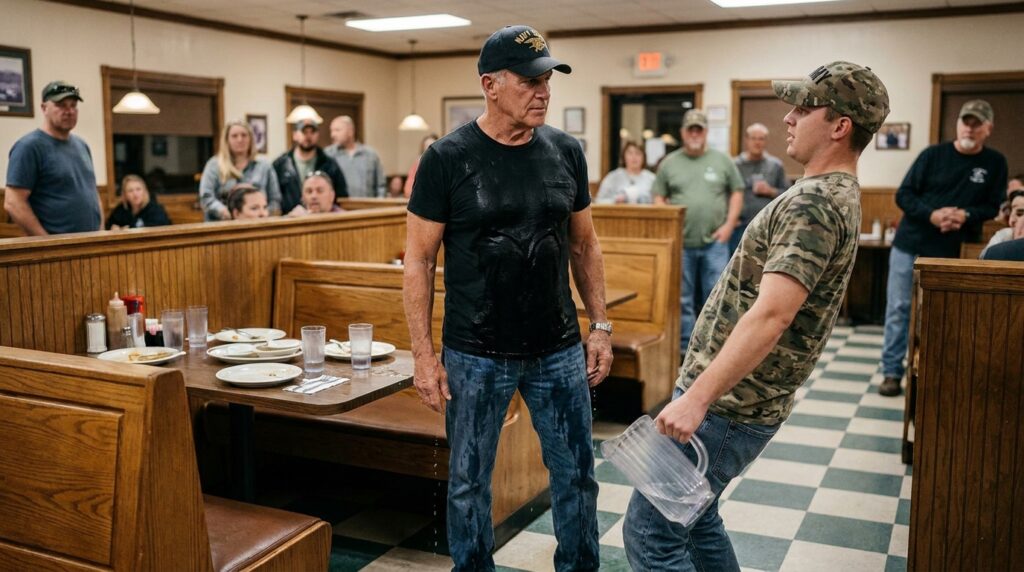
He didn’t drop the watchband into his pocket. He walked past Vance, his stride heavy and even, his soaked black Navy SEALs T-shirt dripping river water onto the broad man’s discarded scraper. He stepped out onto the porch into the freezing weight of the downpour.
The grader was ten yards away, the steel treads churning the gray silt into a thick, bubbling paste that smelled of sulfur and hot oil. Miller didn’t look at the driver’s face. He stepped down off the bottom stair, his work boots sinking four inches into the mud, and walked directly toward the exposed side panel of the machine’s engine bay.
The main ground cable for the electrical override was visible through a gap in the rusted zinc shroud—a thick, braided copper wire that ran from the generator directly to the hydraulic starter.
Miller didn’t use a tool. He jammed the iron watchband straight through the shroud opening, wedging the heavy links between the live copper post and the unpainted steel of the main block frame.
The arc-flash was instantaneous, a brilliant, blue-white explosion of pure electrical heat that turned the falling rain into a sudden cloud of white steam. The diesel plant didn’t choke; it seized. The massive iron pistons halted mid-stroke as the main electrical bus melted into a single, solid lump of slag inside the casing, the starter motor exploding with a sharp ping of flying bronze teeth.
The grader stopped six inches from the first cedar piling of the porch.
The sudden silence that followed the engine’s death was louder than the thunder had been. The driver sat motionless behind the glass panel, his hands still frozen on the levers, his mouth open as the smoke began to pour from beneath the warped zinc hood in a thick, black column that smelled of scorched insulation and boiled glycol.
Miller stood in the mud, his right hand blackened by the graphite soot of the flash, his iron watchband completely gone—fused forever into the steel frame of the county machine. He didn’t look back to see if Vance was behind him on the porch. He turned toward the highway, where the June rain was already washing the salt dust from his cap, his posture straight, unyielding, and completely reconciled with the time.
The valley registry was locked now. Not by a server up in the city, but by three tons of dead iron sitting square in the middle of the only road that led to the water.








