
CHAPTER 2: THE MECHANICS OF A HUMAN HINGE
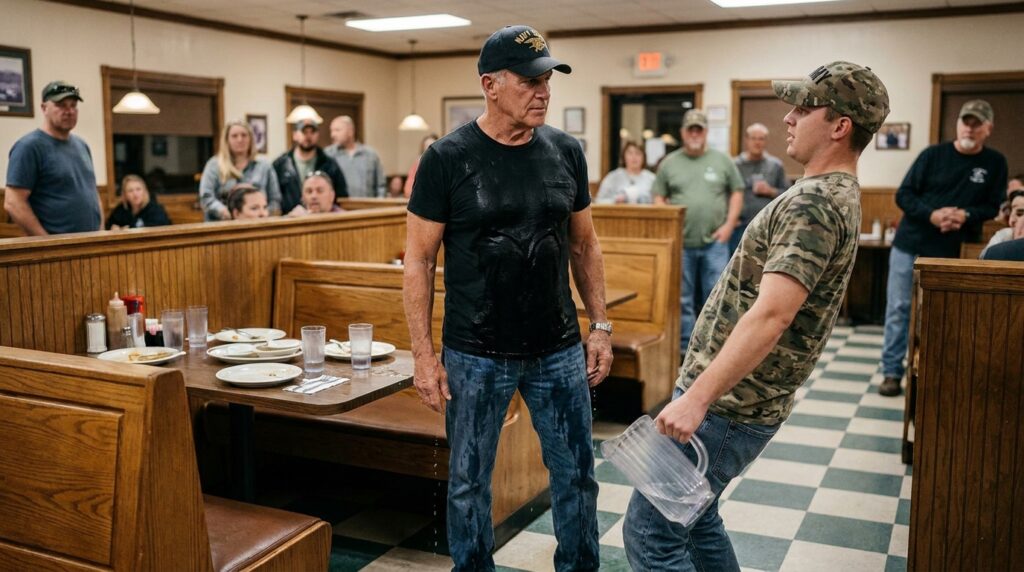
“You should think twice before disrespecting someone you don’t know,” Miller said.
The words came out flat, dry as old bone, carrying the grit of a man who had spent forty years swallowing the silt of tidal flats and diesel exhaust. His voice didn’t rise above the low hum of the refrigeration unit behind the counter, but it had the strange, heavy property of an iron wedge driven into a splitting log. The boy under his palm stopped thrashing. The wet camouflage fabric of his shirt creaked under the tightening knot of Miller’s fingers, the synthetic threads groaning against the older man’s calloused skin.
Miller didn’t look down at the kid’s face. He knew what he’d find there: the watery, panicked blue of a small-town boy who had mistaken the absence of a fence for the absence of a guard dog. Instead, Miller’s eyes remained locked on the grease-stained counter window where the cook, an old man named Arnie with a missing middle finger, had frozen with a metal spatula held three inches above the flat-top grill. The yellow yolk of an egg broke on the steel, sizzling in the sudden, absolute silence of the room.
The boy tried to shift his weight. His left boot—the cheap import with the synthetic laces—slipped on the wet linoleum, the rubber sole scraping with a high-pitched shriek that made a woman in the second booth flinch. The movement was structural, an unguided attempt to clear his hip and find leverage for his free hand.
Miller tightened his grip three millimeters. He didn’t use force; he used positioning. He pressed his left thumb into the soft tissue just behind the boy’s collarbone, finding the nerve cluster by touch alone, a habit old enough that his fingers moved without consulting his brain. The boy’s entire left side went slack, his jaw dropping open as his breath hitched in his throat.
“I’m done,” the boy muttered. The performative heat had left him, replaced by the sour smell of cold sweat and damp cotton. “I’m done, I understand.”
“You don’t understand anything yet, son,” Miller murmured. He didn’t let go. His gaze drifted to the floor where the plastic water jug had stopped rolling. Near the base of the booth, where the grey linoleum met the rusted iron baseboards, a small piece of metal caught the light. It was a copper eyelet, torn clean from the boy’s right boot during the brief, violent friction of the block. The metal was too bright, too new—not the standard issue used by the supply depots or the surplus stores down by the canal. It had the precise, machine-stamped edge of something ordered in bulk from a commercial distributor.
Miller’s left foot shifted, his heavy work boot coming down over the copper eyelet with a dull click, burying it beneath three hundred pounds of leather and bone.
Behind them, near the entrance where the air-conditioning unit rattled against the glass pane, the boy’s two companions stayed rooted to the rubber welcome mat. They were twenty, maybe twenty-one, their hands tucked deep into the pockets of oversized hoodies that smelled of stale tobacco and two-stroke engine oil. They had entered the diner like wolves, teeth showing, screens active on their phones to capture the small-town glory of an old man being drenched in a booth. Now, their shoulders had rounded, their bodies adopting the universal lean of men who had suddenly realized the exit was too far away and the floor was too slick for a run.
“Pick up the jug,” Miller said, his eyes never leaving the two by the door.
The boy beneath his hand didn’t move fast enough. Miller released the collar with a slight, downward shove that sent the kid stumbling forward two paces, his hands catching the edge of the laminate table to keep his face out of the spilled gravy. The boy’s cap—the one with the crisp, unblemished ARMY lettering—had fallen into the puddle of ice water, the stiff brim soaking up the grease-clouded moisture until the fabric turned the color of wet liver.
The kid reached down, his fingers trembling as they closed around the handle of the empty plastic jug. His movements were clumsy, his joints stiff from the sudden adrenaline dump that had left his skin pale beneath the sunburned bridge of his nose. He didn’t look at his friends. He didn’t look at the family two rows over who were now staring into their plates as if the ceramic could protect them from the remaining tension in the air.
“Out,” Miller said.
The word was a small weight, but it cleared the aisle. The boy didn’t look back to see if his cap was still in the water. He kept his head down, his shoulders hunched, his boots clicking in a ragged, uneven rhythm as he hurried toward the door. His two companions didn’t wait for him to reach the mat; they broke toward the gravel lot first, their hands finally coming out of their pockets to shove the glass door open with a frantic clatter of brass bells.
The door swung shut, the hydraulic arm at the top groaning as it caught the frame and sealed the room against the humid June air outside.
Miller didn’t sit back down. He stood in the aisle, the front of his black Navy SEALs shirt clinging to his ribs, dark with the water that was still dripping from his chin onto his boots. The skin of his forearm was red where the boy’s shin had struck it, a thick, raised welt that would turn the color of oil stains by midnight, but the underlying bone didn’t throb. It was just another piece of the frame that had survived the winter.
He turned toward the counter. Martha was still holding the glass coffee pot, her knuckles white against the black plastic handle. The steam rose between them, smelling of burnt chicory and old tin.
“You need a towel, Miller?” she asked, her voice thin, lacking its usual sharp edge.
“No,” Miller said. He reached into his pocket and pulled out two crumpled five-dollar bills, dropping them onto the wet linoleum next to his plate. The paper soaked up the water instantly, the dark green ink turning the shade of river moss. “Keep the change for the floor.”
He didn’t wait for her to answer. He turned toward the door, his boots tracking dark, wet circles across the linoleum, his hand already reaching for the rusted brass handle before the rest of the room could find its tongue.








