
CHAPTER 4: THE MOTOR POOL BACKALLEY CONFRONTATION
The white light of the truck’s high-beams leaked through the rusted gaps in the concrete bunker door, slicing the dark interior into bright, vibrating bars of dust. Outside, the engine purred with a smooth, synchronized mechanical rhythm—the signature of a pristine, fleet-maintained command vehicle, not a standard tactical truck.
Vance pushed his thumb against my chest, his grip firm as he guided me toward the shadowed pocket behind the massive, disused generator block. The iron block was cold against my shoulder blades, smelling of old, petrified lubricants and flaking primer. We didn’t breathe. Every scuffle of leather against the grit-strewn foundation felt amplified ten-fold within the narrow pillbox.
“They’re not here to talk,” Vance breathed, his lips barely moving against the side of my ear. His fingers shifted down to the ground iron bar in his left hand. “The local network hub logs everything in real-time. The moment we tapped that terminal, a silent alarm tripped at the provost marshal’s office—or straight to the major’s desk. They can’t let us walk out with those ledger entries.”
The heavy steel door scraped against the gravel outside as it was pushed inward from the top hinge we had disabled. A flashlight beam split the dark, casting a brilliant, bouncing circle across the gray Pelican case and the empty field desk.
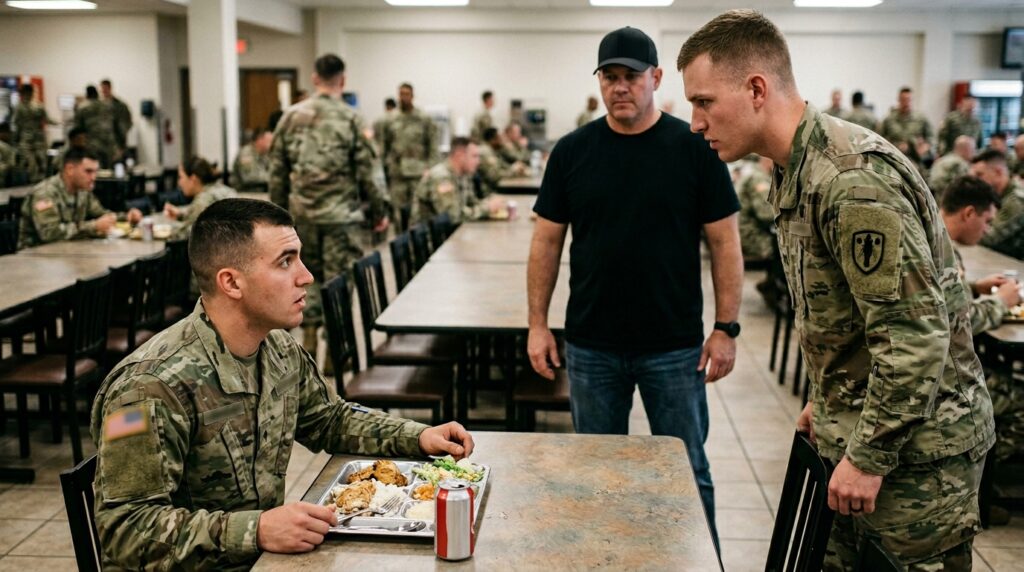
“Terminal’s warm,” Miller’s voice cut through the dark, tight and professional. The theater from the cafeteria was completely stripped away now. He wasn’t playing the role of a disgruntled peer anymore; he was an operative cleaning a spill. “The mirror data key is missing from the slot. They didn’t just look; they copied.”
“They didn’t go out the front,” a second voice answered from the threshold—deeper, carrying the distinct inflection of an older man who spent his days in air-conditioned command suites rather than the motor pool. “The canal trail is clear. They’re still in the footprint.”
Vance didn’t hesitate. He took two steps out from behind the generator block, his boots making no more noise than a shadow, and pushed his weight against the structural release valve on the side of the ancient fuel cell. A heavy, dark stream of unrefined heating oil glided out across the concrete floor, slicking the path between the field desk and the door frame within three seconds.
“Go,” Vance hissed, shoving me toward the emergency vent hatch behind the generator—a narrow, square portal designed for coal intake forty years ago.
I scrambled through the iron opening, the rusted frame biting through the sleeve of my camouflage uniform and scraping a jagged white line across my forearm. I dropped four feet into the soft, rain-soaked silt of the drainage ditch outside, the smell of rotten vegetation and brackish runoff filling my nose. Behind me, inside the bunker, a sharp, metallic crash echoed as someone’s boot slid on the oil-slicked concrete floor, followed by a heavy curse and the dull thud of an iron bar connecting with a fiberglass case.
I didn’t look back to see if Vance followed. I kept my head below the level of the canal bank, my knees pumping through the thick weeds until I reached the gravel expanse behind the third-tier maintenance bays. The air here was desaturated, stained by the yellow sulfur lamps of the distant perimeter fence.
A single vehicle sat idling at the edge of the gravel lot, its low-beams cutting a pair of dusty yellow tunnels through the rising mist. It was a dark, unmarked pickup truck with government plates. The driver’s side door was unlatched, swinging open just an inch.
I kept my hand on the cargo pocket containing the box of nine-millimeter rounds and the copper key, my heart hammering a rhythmic cadence against my ribs as I approached from the blind spot behind the vehicle’s rear quarter panel. I reached through the gap in the window, my fingers finding the cool plastic of the glovebox latch. It popped with a soft click.
Inside, beneath a stack of clean vehicle logs, sat a manila folder with a fresh, blue-ink stamp: Administrative Separation – Non-Judicial Punishment.
I pulled the top sheet out under the faint glow of the dashboard light. My name tape was printed at the top. The charges weren’t about stolen night-vision gear or a training incident at the concrete canyon. The document described a systematic pattern of psychological instability, culminating in the intentional sabotage of logistics equipment and the theft of small-arms ammunition from the company cage. It was signed by the battalion commander, dated for the upcoming Monday—the exact morning the deployment loaders were scheduled to arrive.
The whole thing was already written. The mystery wasn’t a secret black-market ring operated by corrupt soldiers like Miller; it was an official command policy. The unit hadn’t lost forty crates of night-vision devices to common thieves; they had diverted them to fund an unvetted, off-the-books tracking program in the eastern sector, using the untraceable sales to bypass the congressional budget cuts. I wasn’t being framed because I was a witness; I was being used as the pre-planned accounting write-off for the missing equipment.
“You should have stayed at your table, ghost,” a voice said from the shadow of the truck’s tailgate.
Miller stepped into the dull illumination of the low-beams. He wasn’t carrying a weapon in his hand, but his right arm was tucked casually behind his hip, his shoulder slightly dropped in a classic retention stance. His face was pale under the sulfur light, his mouth set in a hard, pragmatic line that looked entirely like my own mirror reflection.
“The major signed those papers three days ago,” Miller said, his voice flat as the idling engine between us. “It doesn’t matter what you found in that bunker. The manifests are already locked in the primary cloud at the department level. You’re a line item that doesn’t balance anymore, Miller. If you walk out that gate, you’re just a deserter with a pocket full of stolen property.”
I looked down at the paper in my hand, the crisp white sheet fluttering slightly in the cold desert wind. The physical evidence I held—the key, the box of rounds, the manifest print-outs—meant nothing within a machine that possessed the legal authority to rewrite my identity before the sun came up. The tactical victory Vance and I had fought for in the generator room was an illusion. The infrastructure of the base was already closing around me like a rusted trap.
“Where’s Vance?” I asked, my voice dropping into the same flat, transactional tone Miller used.
Miller didn’t answer. He just took one slow step forward, his boot grinding a piece of loose limestone into fine white powder against the oil-spotted gravel.








