
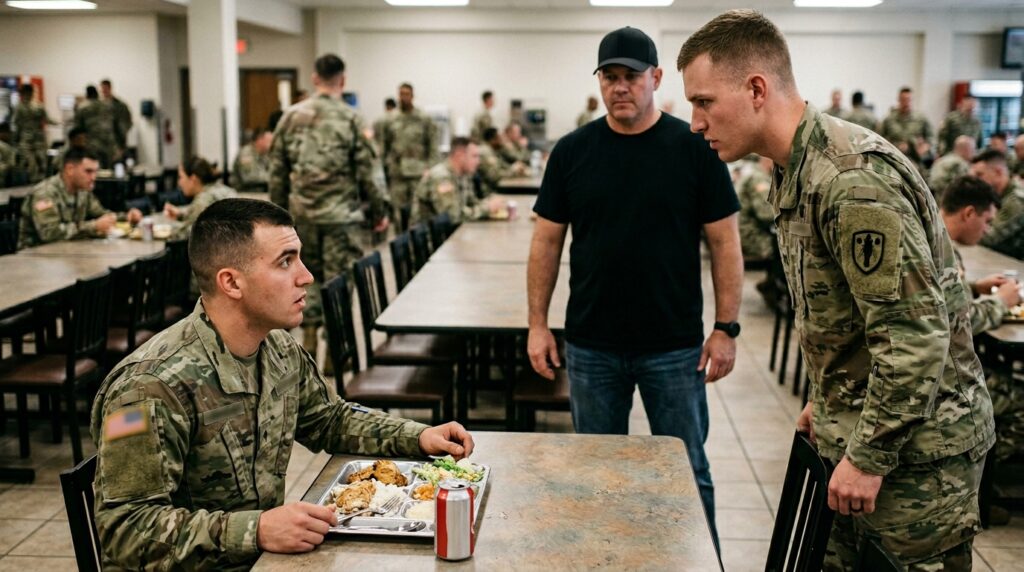
CHAPTER 1: THE FRICTION OF ALIGNMENT
“I’m just trying to finish my meal, what’s your problem?”
The words left my mouth flat, devoid of the heat he wanted. My thumb stayed pressed against the condensation on the soda can, feeling the precise point where the aluminum buckled under the small pressure of my grip.
Miller didn’t move. He stood tall enough to block the fluorescent light humming directly above the table, casting a long, desaturated shadow over my lukewarm Salisbury steak. His camouflage utility uniform was stiff with heavy starch, a perfect contrast to the faded, grease-stained hem of my own collar. He leaned in just enough for me to smell the stale wintergreen tobacco on his breath, his knuckles whitening as he planted them on the edge of the laminate table.
“Your problem is you think you’re a ghost, Miller,” he said, his voice dropping an octave to keep from carrying across the concrete floor of the dining facility. “You think because you came back from the sandbox with a clean file and a closed mouth, the rest of the platoon doesn’t see what you’re doing. You missed formation by two minutes yesterday. You didn’t sign the log at the arms room. You’re fraying at the edges, and it’s going to get someone hurt.”
It was a beautiful lie. The arms room log hadn’t been checked since the winter inspection, and everyone in the third squad knew it. This wasn’t about two minutes or a signature. It was about the training incident at the concrete canyon thirty days ago—the one where the lieutenant broke protocol and three trucks ended up with cracked axles that never made it into the official maintenance reports. They wanted to know if I had saved the digital manifests on my personal drive.
“Step back, Miller,” I muttered, my eyes tracking the small, jagged scar just below his left earlobe. I calculated the distance between my plastic fork and his throat, then dismissed it. The cost was too high. The Uniform Code of Military Justice was a machine designed to grind down the first man who swung.
“Make me.”
The space between us suddenly vanished, but it wasn’t my move. A heavy, oil-scented mass wedged itself directly into the interaction lane.
A black t-shirt, thick with the smell of diesel and dry earth, filled my vision. It was Vance, the civilian maintenance contractor who spent his days rebuilding the hydraulic lifts in the logistics warehouse. His solid, forty-five-year-old frame didn’t bounce when Miller’s chest hit his shoulder. Vance didn’t look at me, and he didn’t look at Miller. He just kept his arms slightly extended, palms open but unyielding, a human wedge separating the active duty heat.
“Back off, both of you,” Vance said. His voice had the dry, gravelly rattle of a man who had retired twenty years ago as a master sergeant and no longer cared about the bars on a man’s chest or the rank on his sleeve. “This floor is wet. If either of you slides on it, the commander’s going to have my boys cleaning up the paperwork until midnight. Take it outside the gate.”
Miller stared at the back of Vance’s grease-stained cap for three seconds. The silence between them was purely transactional; Miller was weighing the optics of pushing past a civilian base employee in a room full of thirty silent witnesses who were currently pretending to study their phones. Slowly, Miller stood up straight, his hands leaving the table with a sharp, sticking sound.
“He’s all yours, old man,” Miller spat, casting one final, freezing glance down at my tray. “But the logbook doesn’t lie. Check your locker before shift tomorrow, ghost.”
He turned on his heel, his boots clicking in a rhythmic, military cadence against the gray floor tile until the double doors of the facility swung shut behind him.
Vance didn’t move until the doors stopped vibrating. Then, without looking down at me, his hand reached into his back pocket and pulled out a small, heavy plastic object, dropping it into the center of my tray right into the gravy. It was a broken digital data key from the logistics office—the specific model used to authorize the release of sealed tactical gear from the secure storage bunkers. It was scorched around the copper contacts, as if someone had tried to burn the serial numbers off with a lighter.








