
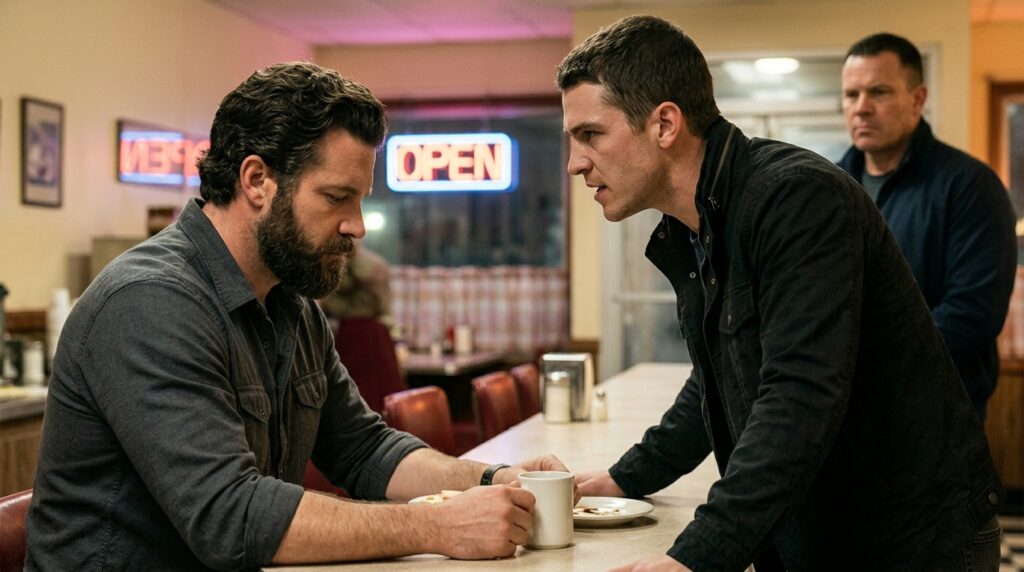
CHAPTER 3: THE HIGHWAY EXCHANGE
The diesel outside didn’t idle; it vibrated through the floorboards like a low-frequency hum in a failing turbine. The vibration traveled up through the cast-iron base of the diner stools, shaking the cold residue of Elias’s coffee until tiny concentric rings rippled across the grease-skinned surface.
Deputy Miller didn’t draw. His fingers remained wrapped tightly around the grip of his sidearm, but his shoulder blades went rigid under his khaki uniform. He was listening to the air brakes. The sharp hiss of pneumatic pressure outside signaled something heavy—something that didn’t belong to the county fleet.
“Get out,” Elias said. The words weren’t a plea. They were an assessment of weight.
“I don’t leave a crime scene when I’m the one holding the ink, Elias,” Miller spat back, though his gaze flicked toward the neon-streaked window. A white commercial transport truck, long and salt-crusted from the state interstates, was backing into the lot with a rhythmic, mechanical beep. Its mudflaps were caked with the gray mud of the Oakhaven industrial flats. “The sheriff told me to expect an escort if things went sideways. He didn’t say anything about an iron-sided hauler.”
Elias moved. His boots made no sound on the checkerboard linoleum as he bypassed the groaning kid and reached down to scoop up the small, tarnished metal token with the number 114 stamped into its brass face. It was cold against his split thumb. He slipped it into his palm, his fingers curling tightly around the edges until the ridges bit into his flesh.
He didn’t look back at the older partner who was now motionless, his breath coming in shallow, desperate gasps that smelled of iron. Elias walked straight past Miller, his shoulder brushing the deputy’s canvas coat. The scent of damp wool and gun oil lingered in the narrow gap between them. Miller didn’t swing his gun around. The transactional logic of the room had shifted; the threat wasn’t inside anymore.
The diner door whined on its rusted hinges as Elias stepped out into the midnight air. The temperature had dropped, turning the limestone dust from the quarry into a gritty, freezing fog that hung over the pumps. The diesel truck had stopped near the edge of the asphalt verge, its engine rattling like a sack of nails. The driver didn’t get out. The cab windows were tinted dark enough to look like blocks of solid obsidian under the single amber mercury lamp.
A man stepped out from the shadow of the garage bay adjacent to the diner—not the driver, but someone who had been waiting in the unlit office where the old tractors were left to rot. He wore a heavy rubberized slicker that crinkled with every movement, his face hidden beneath a grease-stained ball cap. He carried a clipboard with a rusted zinc clip.
“The sheriff said there’d be two packages to load,” the man in the slicker said. His voice was completely devoid of local inflection—flat, corporate, mid-western. He looked past Elias toward the glass front of the diner, where Miller was now visible, standing by the counter like a wax figure. “He didn’t say anything about you being on your feet.”
“The packages are broken,” Elias said, stopping ten feet from the transport truck’s massive rear door. The smell of raw fuel and burnt rubber was thick here, clinging to the back of his throat like a film. “And the paper they brought has a Vanguard stamp on it. That’s a corporate liquidation asset line, not a county warrant.”
The man with the clipboard paused. He didn’t reach under his slicker. Instead, he adjusted his grip on the zinc clip, the paper rustling softly in the freezing draft. “Vanguard owns the lease on the county line, friend. They own the road you’re standing on, they own the well under the diner, and they own the debt on Miller’s cruiser. The sheriff is just the asset supervisor. If he told you this was a local matter, he was lying to keep the price down.”
Elias looked at the side of the truck. In the dim amber light, he could see where the old lettering had been ground off with an angle sander, leaving jagged, bright silver whorls on the rusted sheet metal. Beneath the fresh black primer, the faint ghost-image of a serial code was still visible: CORP-LOG-04.
“The syndicate sold the contract,” Elias muttered, the truth settling like lead in his stomach. The realization didn’t bring anger; it brought the cold, analytical focus of a protector whose perimeter had just grown five times larger. “They didn’t retire me. They liquidated the division.”
“The syndicate doesn’t exist anymore,” the man in the slicker replied, his tone conversational, almost polite. He tapped his pen against the board. “The debt was restructured three months ago after the compliance audit. Old liabilities are being cleaned out by territory. We aren’t here for a feud, Elias. We’re here for the physical audit. The sheriff was supposed to handle the local discrepancies before the rail corridor transition, but he’s old. He thinks in terms of graves, not balance sheets.”
The passenger door of the diesel truck opened with a dry, pneumatic hiss. A sharp metallic click echoed from the interior of the cab—the unmistakable sound of a heavy bolt sliding home in a steel receiver.
Elias didn’t wait for the muzzle flash. He lunged laterally, his boots grinding into the coarse gravel as he hit the rusted fender of Miller’s parked cruiser just as a high-velocity round tore through the diner’s plate-glass window behind him. The sound of the explosion was flat and compact, swallowed instantly by the vast, empty night of the highway.
Inside the diner, the neon sign died with a loud, spitting pop, plunging the room into the absolute gray of the mountain fog.








