
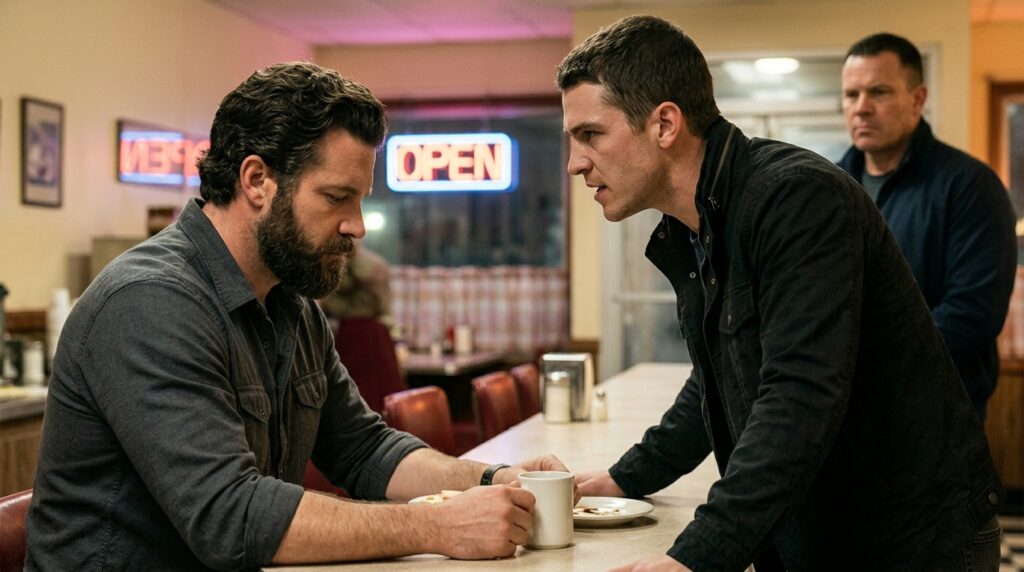
CHAPTER 2: THE SEDIMENT OF DECEIT
The headlightless chassis ground against the deep gravel outside, the sound low and heavy like teeth chewing on dry bone. Elias didn’t blink. He kept his feet planted in the narrow aisle between the blood-speckled linoleum and the laminated booths. Beneath his boots, the older man’s breathing had devolved into a wet, rhythmic rattling, each exhale bubbling through a fractured jaw.
Elias knelt. The movement was stiff, his knees popping with the distinct crack of ungreased machinery. He didn’t look toward the glass door where the shadows were shifting. Instead, his wrapped fingers reached into the internal pocket of the car coat. The coarse wool rasped against his split knuckles as he tore the folded yellowish paper free.
The smell of old iron and damp cellar rot clung to the document. In the dim, red-and-blue strobe of the exterior neon, the ink looked almost black. It was a standard vehicle registration, but the header didn’t carry the crest of this municipality. It was stamped with the seal of Oakhaven County—fifty miles east, a place where the refineries had turned the soil into sour sulfur.
The name on the registry wasn’t the younger kid currently choking on his own saliva by the stools. It was registered to a holding company: Vanguard Land Management LLC.
A shadow cut the neon glare through the diner’s front pane. A man stepped onto the concrete apron, his boots leaving damp, grey paste on the threshold. He wore a dark canvas jacket, a standard-issue leather utility belt, and a tan Stetson pulled low enough to shade his eyes from the interior fluorescent glare. Deputy Miller.
Miller didn’t draw his weapon. He didn’t have to. His right hand rested casually on the butt of his sidearm, his thumb hooked over the retention strap with the lazy familiarity of someone who owned the county roads. He looked at the older man on the floor, then at the kid, and finally his gaze settled on Elias and the yellow paper gripped in his wrapped fingers.
“You make a hell of a mess for a man who doesn’t exist, Elias,” Miller said. The deputy’s voice had the dry, rhythmic drag of a locust in August. He didn’t sound angry; he sounded tired, like an accountant looking at a column of figures that refused to balance.
“They brought the mess with them,” Elias said. He didn’t rise from his knee. He stayed low, using the edge of the booth as a partial shield against Miller’s line of sight. “They’re using Oakhaven plates. Registered to a corporate outfit.”
Miller took a slow step into the diner, his heels clicking against the checkerboard tiles. He didn’t look at his fallen townspeople; he looked at the silver pocket watch sitting on the counter by the cooling coffee. “A lot of things are registered to corporate outfits these days. The rail yard. The limestone quarry. Even that stool you’ve been warming for three weeks. The world gets small when people start buying up the dirt under your fingernails.”
“They weren’t sent by the syndicate,” Elias noted, his voice flat, testing the weight of the assertion. He watched Miller’s eyes. “The old people I worked for didn’t use local paper. They didn’t hire kids who telegraph their weight before they swing.”
Miller reached out with his left hand, picked up the frozen silver watch, and turned it over in his palm. His thumb grazed the deep scratch across the casing. “The old people you worked for don’t have a vote anymore, Elias. Things change. People die. Structures get re-evaluated. The sheriff wants this county clean before the state inspectors come down to certify the new rail corridor. An old ghost sitting in a corner booth looks like a stain on the ledger.”
The younger kid on the floor made a sharp, gurgling sound, his fingers clawing at the base of a diner stool. Miller didn’t look down. He just pushed the silver watch into his jacket pocket.
“The sheriff didn’t send these two to talk,” Elias said. His eyes dropped to the floor, tracking a dark trail of fluid creeping from beneath the older attacker toward Miller’s boot. Beside the pool lay a small, tarnished metal token that had slipped from the kid’s pocket during the struggle—a rusted key tag stamped with the number 114.
“No,” Miller agreed softly. “They were supposed to put you in the back of that unlit truck and dump you over the county line where the lime pits are. Clean. Professional enough for government work. But you had to go and remind everyone why you were expensive in the first place.”
Miller shifted his weight, his leather belt creaking under the tension. His hand remained on his holster, his fingers twitching slightly against the leather. “Now I’ve got two broken citizens in a public establishment and a cook who’s going to have to testify to the circuit judge about who broke them. That makes my night very long, Elias.”
“Then let’s shorten it,” Elias said. He began to stand, his eyes never leaving the deputy’s shoulder alignment. The kitchen towel around his knuckles was already turning a muddy rust color where his own blood was seeping through. “Tell me what’s in room 114.”
Miller paused, his face hardening into a desaturated mask under the flickering neon. The lazy cadence of his posture vanished, replaced by the rigid stillness of a predator that had just realized the track it was following ended behind its own shoulder. He didn’t answer with words; instead, his thumb flipped the leather retention strap on his holster with a sharp, metallic click.
The front door behind Miller didn’t open, but the glass rattled as a second vehicle pulled into the lot, its heavy diesel engine vibrating through the floorboards of the diner, shaking the grease-filmed windows until the silence tore completely.








