
CHAPTER 6: THE RUPTURED PERIMETER
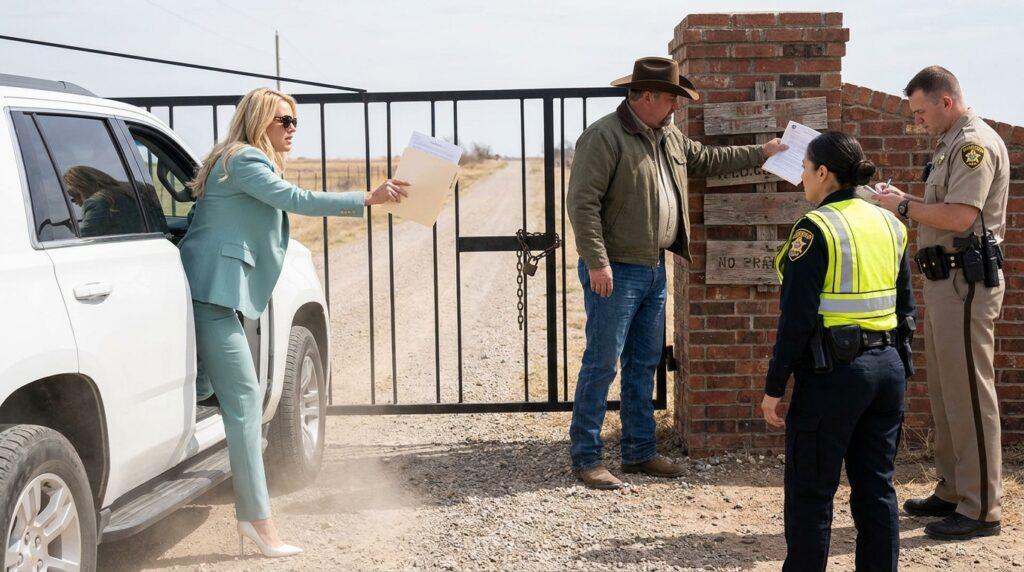
“Unlock the chain, Vance,” Deputy Miller said. His tone hadn’t sharpened; it had flattened into the procedural density of a county machine that had already run the calculation. He handed the water-stained 1985 paper back over the top rail, his thumb leaving a damp smudge on the charcoal-gray fiber. “The system shows the eighty-two grant as active. If you don’t drop the padlock, I’ll clear it with the bolt cutters from the cruiser.”
Thomas didn’t reach for the paper. He let it drift down into the dry switchgrass at the base of the pillar, the wind catching the edge until it lodged against a broken piece of old flint. Beside him, Evelyn Sterling took a single, short step forward, her white high heels grinding a limestone pebble into fine, flour-like dust. The gold-embossed corners of her folder caught the glare of the noon sun like a signaling mirror aimed toward the driver of the cement mixer.
“The staging schedule is already forty minutes behind, Deputy,” Evelyn said, her voice dry, clipped, and completely free of conversational filler. “The concrete is already setting up in the drum. Every ten minutes we idle here costs the association six hundred dollars in logistical penalties. We need the lane cleared now.”
Thomas looked past her, his eyes locking onto the massive, revolving drum of the mixer. The wet mortar inside groaned—a heavy, gravelly slide of sand and lime that vibrated through the frame of the truck and shook the caliche soil between their boots. The driver was watching through his side mirror, his hand resting on the air-brake valve.
“Ramirez,” Thomas said, shifting his gaze to the county officer. Her heavy leather gear box creaked as she stood her ground on the property line, her eyes scanning the structural dynamic between the white SUV and the iron gate. “Look at the back of the metal marker signs bolted to the brick. Not the paper in the folder. The steel.”
Officer Ramirez frowned, her brow furrowing beneath the sweat-rimmed band of her uniform hat. She didn’t look at Evelyn, and she didn’t ask Miller for permission. She stepped around the white bumper of the SUV, her boots sinking an inch into the soft clay of the drainage ditch, and walked to the dark red-brick pillar. The permanent county access plate was bolted into the mortar with heavy four-inch lag screws, the galvanized coating long since peeled away by thirty years of valley humidity to leave dark trails of rust staining the stone.
She reached behind the plate, her gloved fingers feeling the rough, un-faced side of the steel backing.
“There’s a number stamped into the zinc,” Ramirez said. She leaned closer, using the tip of her tactical pocket knife to scrape away a thick crust of dried mud-wasp nests from the lower margin. “It’s not an index code. It’s an original county board filing number. 1985-Court-Rev-042.”
Deputy Miller paused, his plat map folder half-closed against his chest. “The migration team didn’t index the court minutes from the eighties, Ramirez. They only scanned the primary deeds. If it’s not in the portal, it doesn’t exist for the field unit.”
“It exists on the iron,” Thomas said. He took his hand out of his jacket pocket. He didn’t point the pliers at them, but the crosshatched steel handle was visible, caught in the low sunlight. “My father didn’t file the paper with the clerk because the county judge told him the court order was self-executing once the highway route shifted. The board ordered the road closed to public staging forty-one years ago. The development company didn’t buy an active easement; they bought an unmapped dead entry because their legal team didn’t check the physical markers.”
Evelyn’s face didn’t go pale; it went rigid, the corporate posture locking like un-cured cement. She turned sharply toward Miller, her fingers gripping the folder until the leatherette material buckled. “This is an administrative stalling tactic. A pencil mark on a piece of field iron doesn’t overturn a certified deed entry in the municipal database. Deputy, execute the clearance order.”
“I can’t clear a lane that has an unverified court revocation code stamped on the physical marker, ma’am,” Officer Ramirez said. She stepped back into the center of the road, her hand resting naturally on the top of her utility belt, her eyes locking onto Evelyn’s sunglasses. “If the board revoked the infrastructure access in eighty-five, this isn’t a county road easement. It’s a private residential tract under agricultural protection. If that mixer crosses the latch line, the driver is operating a commercial vehicle on private property without a title.”
The rumble of the cement mixer changed frequency—a sudden, sharp release of air pressure hiss as the operator shifted the transmission out of gear. The driver leaned out of the cab window, his face dark with grease and sun, his voice carrying over the sound of the drum.
“Hey! If this isn’t a legal county drop, I’m pulling the truck back to the highway shoulder,” the driver shouted. “The company insurance doesn’t cover property damage claims on unrecorded private lines. If the drum locks up because we’re sitting in a ditch, that’s on your association, lady.”
Evelyn turned toward the truck, her voice rising for the first time, losing its corporate polish. “You stay in the lane! The contract explicitly states—”
“The contract doesn’t cover a lawsuit from a landowner with a county sheriff standing next to his gate,” the driver yelled back. He slammed the cab door shut, and the heavy truck began to slowly reverse down the limestone road, its massive tires churning the gravel into a thick cloud of white dust that settled over the teal pantsuit and the white luxury SUV.
Evelyn stood in the middle of the receding dust, her folder clutched against her chest, her white heels completely grayed by the limestone powder. The pincer movement had failed; the structural authority had flipped against her at the very edge of the iron, leaving her to face the immediate cost of the delayed mixer alone in the valley glare.








