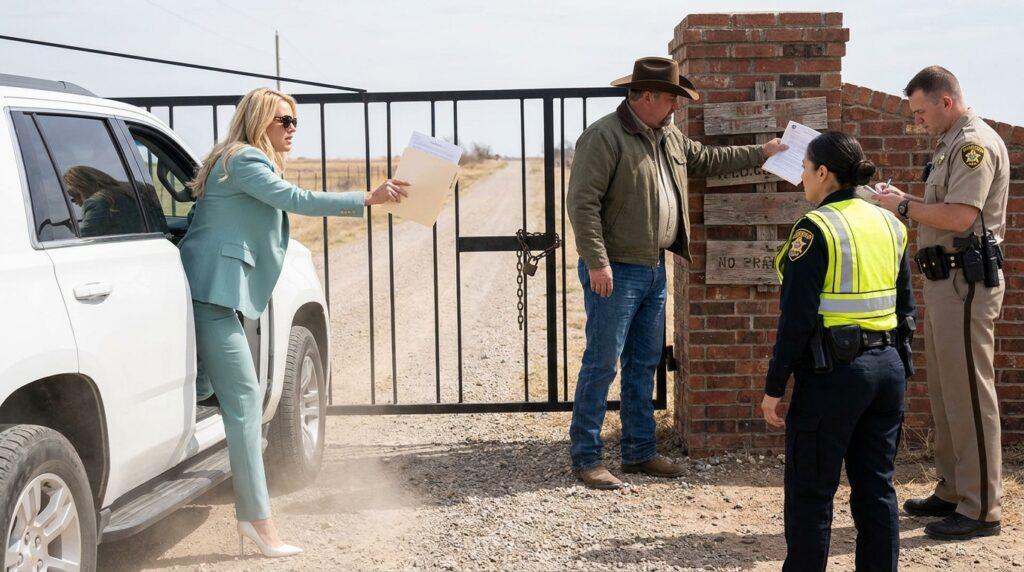
CHAPTER 3: THE CORPORATE PERIMETER
“Your family’s name doesn’t change the grade of the valley, Mr. Vance,” Evelyn Sterling said.
She didn’t look up from her end of the conference table. The room smelled of fresh drywall, chemical carpet adhesive, and the sharp, sterile scent of ozone from a hidden air purification system. It was the temporary sales office for the Whispering Pines subdivision—a modular double-wide trailer set on concrete blocks just inside the cleared ridge line, its exterior disguised by synthetic stone veneer. Through the tinted double-paned glass, the skeleton of three two-story framing jobs rose like clean white ribs against the gray cedar hills.
Thomas sat in a low-backed vinyl chair that creaked under his weight. He hadn’t taken off his olive ranch jacket. The hem of his canvas coat left a thin smudge of white limestone dust along the pristine composite trim of the boardroom table. Between them lay the industrial-grade dark teal folder, open to reveal a crisp, multi-layered blueprint map dated July 1974.
“The county planning survey is clear,” Evelyn continued, her fingers tracing a faded blue line that sliced directly across the western boundary of the Vance ranch. Her short blonde bob was perfectly arranged, her sunglasses now resting on the table beside a designer glass water bottle. “The seventy-four allocation designated Blackwood Road as an arterial connector for regional water management. When the county incorporated the district, those utility parameters were transferred into the municipal charter. We aren’t asking for an extension of favor. We are notifying you that the contractor is bringing the trenchers through by Wednesday morning.”
Thomas kept his hands on his knees, his thumb rubbing the crosshatched steel grip of the fencing pliers hidden inside his coat pocket. The cold tool was a heavy counterweight to the artificial chill of the air conditioner humming overhead.
“The seventy-four plan required a county bond election to fund the acquisition,” Thomas said, his voice flat, retaining the slow, gravelly rhythm of the lower bottoms. “The bond failed in November of that year. The county never took the deed out of my father’s name, and they never paid the three hundred dollars an acre the commissioners court had agreed on. You’re building your drainage infrastructure on a line that only exists in a dead binder.”
A middle-aged man sitting to Evelyn’s left shifted his weight, making the cheap particle-board desk groan. He wore a crisp short-sleeved shirt with a local utility district patch sewn onto the sleeve, though the fabric lacked the grease stains of an active field inspector. His clipboard was stacked with un-stamped regulatory forms.
“The utility corridor code doesn’t require active compensation if the primary easement serves a critical watershed stabilization purpose, Mr. Vance,” the man said, pointing an unblemished finger at a section of the blueprint marked with yellow highlighter. “The Phase Two retention system drains directly into the Blackwood Creek tributary. If we don’t lay the twenty-four-inch concrete culvert beneath your gravel lane, the runoff from the upper asphalt will wash out the state highway approach within three seasons. The county judge has already reviewed the emergency hydrology assessment.”
It was a structured pincer movement, executed with clean paper and calculated legal terminology. Evelyn didn’t monologue; she simply waited for the utility worker to finish his delivery, her face a mask of professional certainty. She knew the exact pressure points—the reality of the property taxes Thomas hadn’t yet cleared for the fiscal year, the cost of an environmental litigation defense, and the physical isolation of the old ranch house at the end of the road.
“We are prepared to offer an administrative easement fee,” Evelyn said, sliding a typed, one-page document across the faux-grain surface. The paper was heavy, clean, and carrying a figure that would clear two of Thomas’s notes at the co-op before sundown. “Five thousand dollars for a permanent infrastructure right-of-way, limited to subsurface installation. The road surface will be restored to standard gravel specification within fourteen working days. You sign the waiver today, and the association drops the municipal receivership motion.”
Thomas looked down at the paper. The ink was dark, the corporate seal of Whispering Pines pressed into the bottom corner with machine-cut precision. It was a false flag—a tactical bribe designed to seal a structural vulnerability before he could verify the true depth of their authorization. If they truly held the legal title under the 1974 charter, they wouldn’t be offering five thousand dollars to a man they were trying to evict from his own lane.
“My father always said you don’t sell the dirt that catches the water,” Thomas said. He rose from the chair, the heavy canvas of his jacket catching the corner of the table with a dull rasp. He didn’t touch the paper. He didn’t look back at the blueprint. “The gate stays locked until the sheriff tells me otherwise.”
Evelyn’s mouth tightened into a thin, pale line, the corporate composure slipping just enough to reveal the hard, tactical edge underneath. “The sheriff works off recorded documents, Mr. Vance. By Wednesday morning, the papers won’t be in your favor.”
Thomas walked out of the double-wide trailer, the heavy door clicking shut behind him, the intense Texas heat hitting his face like a physical blow as he stepped onto the gravel staging lot.