CHAPTER 4: THE STRONGBOX IN THE FLOODPLANE
The Ford’s heavy door scraped against the caliche earth as Thomas swung his legs out. The heat in the tack room was dense, smelling of dry rot, parched leather, and the sweet, lingering musk of old alfalfa. Dust motes hung like suspended grit in the narrow shafts of yellow sunlight piercing the cedar gaps in the wall.
He didn’t waste time turning on the generator. He walked straight to the back corner behind three heavy, oil-stiffened rain slickers hanging from rusted iron railroad spikes. His boots sank into the dry dirt floor until his heel clicked against the edge of the second foundation timber.
Thomas dropped to his knees. His palms scraped over the rough, gray cedar floor planks, feeling for the uneven seam his father had cut with a dull hand saw forty winters ago. He wedged the flat tip of his fencing pliers between the boards and pried up. The wood groaned, a dry, high-pitched scream of old nails giving up their grip, before the section cleared the joist.
In the dark hollow beneath the dirt line sat the box. It was heavy, military-surplus steel painted an olive drab that had long since cracked into a thousands tiny, geometric scales. A notched brass dial lock secured the front, pitted by river-bottom dampness.
Thomas pulled the square-headed iron key from his pocket. The key slot was jammed with dried mud-wasp nests. He used the sharp wire-cutter notch of his pliers to clean out the barrel, digging out the hard, gray clay until the steel was clear. He inserted the key. The internal levers were stubborn, seized by thirty years of rust and forgotten grease, requiring the full leverage of his thumb to turn. The cylinder gave way with a heavy, ungreased mechanical thud.
He lifted the lid. The interior smell was sharp—vinegar-sour ledger paper and the heavy, sweet scent of gun oil.
Inside lay three items: a wrapped bundle of blue-line survey field notes from 1971, a spare cylinder for an old single-action Colt, and a long legal document bound by three copper rivets that had turned green with oxidation. Thomas lifted the document, the stiff, parchment-grade paper crackling loudly in the small room.
Across the top header, typed on a mechanical ribbon that had been struck so hard the letter O had cut clean through the page, were the words: Grant of Right-of-Way and Supplemental Infrastructure Access. The date was October 12, 1982.
His eyes tracked down the lines, his pulse tightening against his throat. It wasn’t an unsigned proposal. There, at the bottom of the second page, was the bold, angular signature of his father, Arthur Vance, witnessed by a notary public whose stamp had faded to a ghost-gray circle. The legal description was unmistakable: a thirty-foot wide corridor following the exact center-line of Blackwood Road, extending from the highway asphalt to the western draw.
For value received and municipal considerations, the text read, the Grantor does hereby convey to the County Road District and its corporate assigns a perpetual easement for public transit and utility management, contingent upon the allocation of annual agricultural tax credits under Subsection Nine.
Thomas sat back on his boot heels, the paper heavy between his thumbs. This was the document Evelyn Sterling’s team had been searching for. The 1974 planning map wasn’t their legal engine; it was their cover story. They had known this 1982 agreement existed, but they hadn’t been able to find the executed copy because it had never been entered into the county’s digital master files during the migration. His father had bartered away the perimeter of the ranch forty years ago to save the herd during the dry spell of ’82.
He held the evidence of his own family’s compromise. Under the terms of this page, the Whispering Pines subdivision didn’t need an emergency injunction. They didn’t need a corporate bribe. If this document was valid, Evelyn’s bulldozers had every legal right to tear the limestone road into a ditch line by Wednesday morning, and Thomas was nothing more than an unauthorized gatekeeper blocking a public easement.
He began to slide the document back into the tin folder, his fingers catching a smaller, thin scrap of paper that had been pinned behind the third page with a rusted paperclip. It was a single sheet of county letterhead, dated three years later—September 14, 1985. The text was short, only four lines, signed by the chairman of the county commissioners court, but the ink had run during a long-forgotten roof leak, leaving the final two lines a smeared, blue-gray cloud.
Thomas held the paper up to the sun gap in the wall. He could make out the words Revocation of Allocation and the name Blackwood, but the operational clause—the specific reason why his father had kept this secondary notice hidden behind the primary grant—was completely illegible, buried under the water stain.
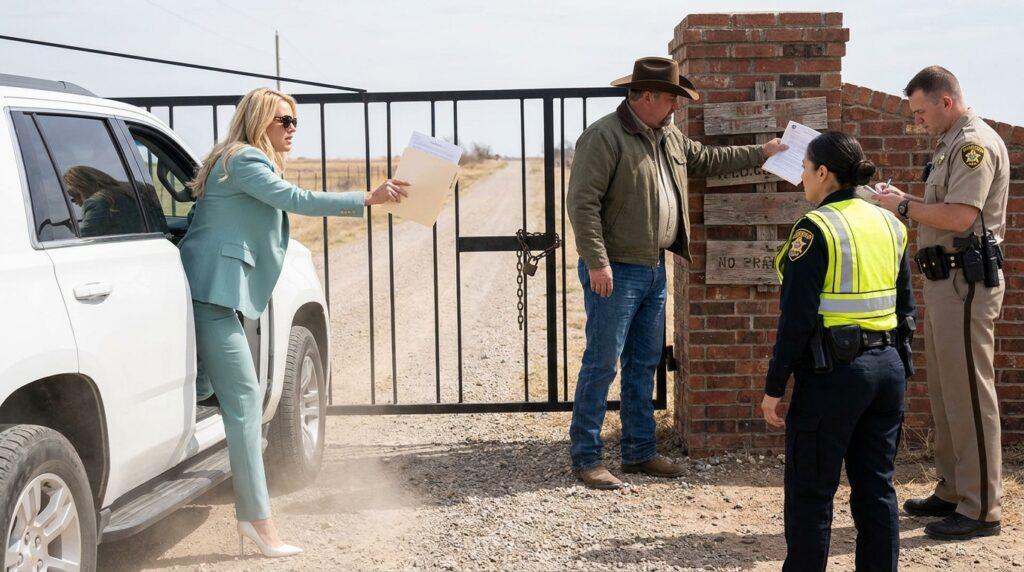
The sound of a heavy diesel engine brake echoed through the valley, coming from the direction of the state highway. The trucks were already moving down the approach. Thomas folded both documents, shoved them deep into the inner pocket of his canvas coat, and stood up, his pliers clinking against the square key in the dark. He had the decoy in his pocket, but the truth was still locked beneath the stain.