CHAPTER 2: THE WEIGHT OF THE WATERLINE
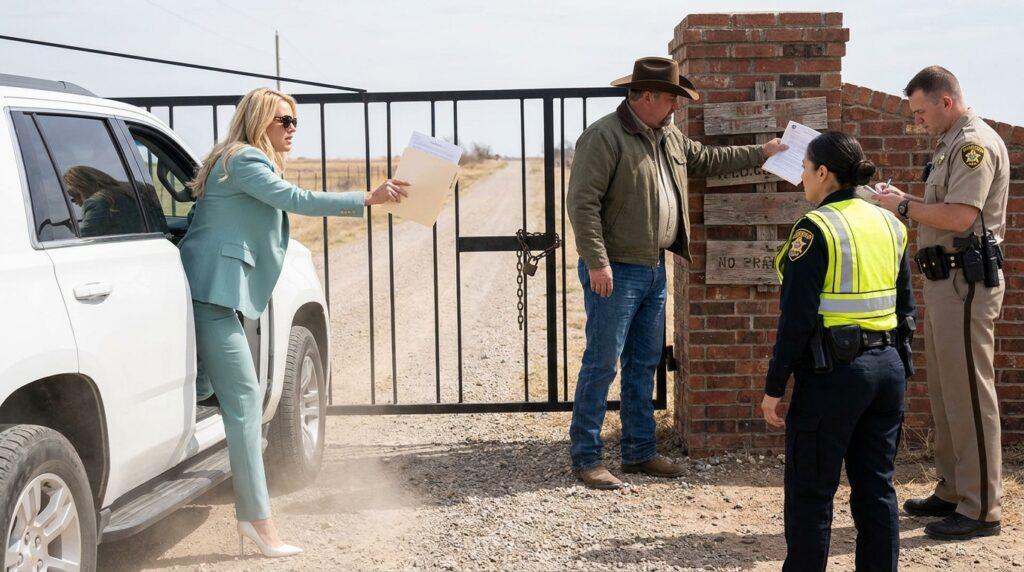
The white SUV didn’t turn around. It reversed down the narrow limestone throat of Blackwood Road, its tires crunching over the loose rock with a heavy, rhythmic hiss that sent up a low screen of white dust. Thomas Vance didn’t watch the red tail-lights disappear past the scrub oak bend. He kept his eyes on the padlock. The brass was cold, pitted from three decades of humid river-bottom air, but the tumblers had cleared with a distinct, dry snap that stayed in his ears long after the diesel idle of the bulldozer faded down the highway.
He walked toward the mailbox at the edge of the asphalt. The cedar post was gray, split by forty years of Texas sun, leaning five degrees to the north where the ditch line had eroded during the floods of ’15. The galvanized steel box was rusted through at the floor, its hatch hanging by a single aluminum rivet that rasped like a dull saw against the housing whenever the wind came out of the south.
Thomas reached out, his thumb catching the small brass latch. A tiny, circular stamp near the hinge caught the low noon light—a double-struck county seal, the star blurred as if the machine had slipped during the pressing. His father had put this box up the year the county surveyor first drew the straight blue lines across the old valley plat.
Inside sat a lone envelope. The paper was heavy, legal-grade stock, unaffected by the humidity that had curled the edges of the grocery circulars from three weeks ago. It didn’t have a stamp. It had been slipped in by hand, the corporate crest of the Whispering Pines Development Corporation embossed in dark teal ink across the flap.
Thomas slid his thumb under the seal. The paper tore with a clean, stiff resistance.
Notice of Intermittent Infrastructure Assessment, the header read. The font was small, modern, and clean, the kind of print that didn’t belong within ten miles of the river road. Pursuant to Section Four of the Regional Water and Access Realignment Code, notice is hereby given that the private crossing known as Blackwood Road contains utility access points essential to the stabilization of Phase Two hydrology. Failure to clear right-of-way within forty-eight hours will result in automatic municipal receivership under the County Drainage Act of 1978.
He read the lines twice, his eyes adjusting to the glare off the white limestone road. His father’s debts weren’t listed here, but they were written between the margins. When the old man had passed in the winter, he hadn’t left a clean ledger. He had left seven miles of un-mended cedar fencing, three notes at the local co-op that were six months past due, and an unrecorded line of credit with the land bank that seemed to grow by three percent every time the creek rose. The development corporation knew the numbers. Evelyn Sterling hadn’t just looked at a planning map; she had spent three months in the county records basement, measuring the exact depth of the financial mud Thomas was trying to walk through.
He folded the letter into a tight square and jammed it into the pocket of his olive ranch jacket. His fingers hit the fencing pliers. The cold steel felt grounding against his thigh.
A red dirt bike hummed somewhere along the western ridge—the sound thin and high-pitched, like a horsefly trapped against a screen door. That was the boundary line. On the other side of that ridge, the developers had already laid two miles of black poly-pipe for the subdivision’s main sewage line, the huge plastic tubes sitting in the grass like giant earthworms waiting to be buried. If they couldn’t cut through Blackwood Road, their gravity-fed drainage system would terminate forty feet short of the county main, leaving five hundred luxury homes without a functional utility drop.
Thomas turned back toward his truck, a battered ’98 Ford with a dashboard cracked by twenty summers of high heat. The driver’s side door didn’t close unless he lifted it by the handle, the hinges groaning as the latch caught the striker plate. He sat in the worn vinyl seat, the smell of old horse blankets, stale tobacco, and dry dust rising from the floorboards.
He reached into the glove box. Beneath a stack of yellowed vehicle registration receipts and three spare flashlight batteries lay a small, black iron key with a square head. It was the key to the small green strongbox his father had kept under the floorboards in the tack room—the box that hadn’t been opened since the day the old man’s heart had given out in the south pasture.
The steering wheel was hot beneath his palms as he cranked the engine. The starter whined three times before the V8 caught, a puff of blue smoke rising from the tailpipe into the live oaks. He didn’t drive down toward the gate to see if Evelyn’s crew had returned with a deputy. He shifted into first, the transmission clunking hard under the floor, and drove toward the old barn, his mind tracking the legal language of the notice against the physical layout of the creek bed.
The corporation wasn’t trying to buy the road. They were trying to call it something else—a drainage easement, a utility corridor, a municipal necessity. If they changed the name of the dirt beneath his feet, they didn’t have to pay for the right to cross it. They just had to wait for the forty-eight hours to run out.
As the truck climbed the limestone bench toward the house, Thomas looked out at the fencing along the western draw. The barbed wire was slack, two strands dipping into the wild switchgrass where a fallen mesquite limb had snapped the cedar stays three weeks ago. He had planned to fix that fence before the weekend, but now the wire looked less like a barrier and more like a line of old iron waiting to be pulled out by a machine that didn’t care about the name Vance.