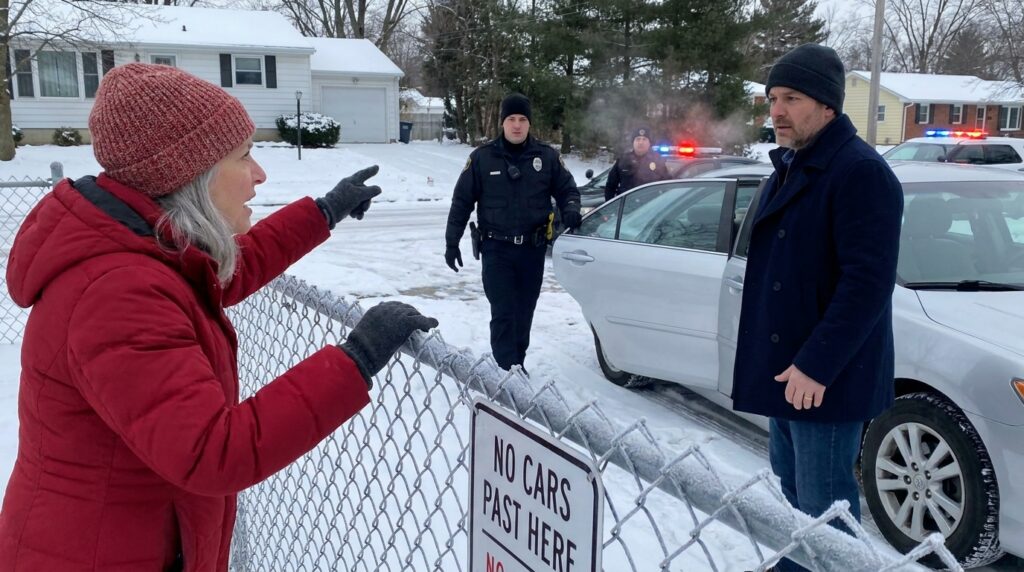
CHAPTER 7: THE GROUND BENEATH THE ICE
The tread of the silver sedan’s front tires bit into the unplowed slush past the gate post, the heavy rubber crunching down through three inches of crust until it hit the solid bed of crushed limestone underneath.
Mark didn’t press the accelerator. He let the engine’s idle pull the car forward inch by inch, the vehicle moving through the exact twelve-foot corridor Arthur Higgins had staked out thirty years ago. The side mirror passed four inches from the open chain-link gate. On the passenger seat, the laminated yellow folder rested flat, the red county seal catching the final amber rays of the setting sun filtering through the pine boughs.
Behind him, the mechanical hum of the police cruiser’s engine shifted as Officer Miller placed the patrol car in park. In the rearview mirror, Mark watched Officer Jenkins drop the wire cutters back into his belt holster. Jenkins didn’t kick the fallen plywood board; he nudged it with the toe of his boot so it lay flat against the snowbank, out of the lane’s path.
Officer Miller walked slowly to the edge of the open gate. He didn’t step onto Brenda’s lawn, nor did he enter Mark’s gravel path. He stood precisely on the neutral strip where the public street met the private easement, his heavy winter coat squared against the wind.
Brenda hadn’t moved from the bottom step of her porch. Her gloved hands still held the yellow plastic folder against her red coat, but her shoulders had dropped, the rigid, sharp posture that had held her upright through the afternoon dissolving into the quiet gray dusk. She looked down at the freshly exposed dirt pit near the fence post, where the rusted iron rebar pin sat bare, its stamped crosshair holding the boundary line without a sound.
Mark brought the sedan to a stop beside his rear detached garage, killed the ignition, and pulled the handbrake.
The engine died with a soft shudder. The silence that followed was instant and absolute, the kind of deep, heavy winter quiet that only settles over northern suburban streets after a storm. Mark sat in the cold cabin for a long moment, his gloved hands resting on the steering wheel, his breathing slow and steady.
He opened the car door and stepped out into the freezing air. The gravel crunched under his boots—firm, stable, unyielding.
Officer Miller walked up the cleared edge of the driveway, his boots leaving clean, dark imprints in the slush. He stopped five feet from Mark, his hands resting naturally on his belt.
“We’re filing a formal report on the 911 dispatch, Mr. Vance,” Miller said, his voice quiet, carrying no heat, only the dry, administrative weight of his office. “It’ll record the property line verification and the presence of the grandfathered easement. If there are any further attempts to obstruct this right-of-way or post unauthorized municipal notices, call dispatch directly and cite Incident Report 402.”
Mark nodded, his face calm beneath the brim of his beanie. “Thank you, Officer. I appreciate you taking the time to look at the plat.”
“The plat made it simple,” Miller said, looking back toward the fence where the red light of his cruiser painted the white snow. “The iron in the ground doesn’t lie. Most people forget that before they call us out here.”
Miller turned and walked back down the lane toward his patrol car. As he reached the fence gate, he paused, looking across the lawn at Brenda.
“Mrs. Higgins,” Miller called out, his voice firm across the snow. “Make sure that fence gate stays secured back against the post so it doesn’t swing into the lane during the plow run tonight.”
Brenda didn’t answer with words. She gave a single, small nod, her gloved hand reaching out to touch the wooden handrail of her porch step.
Miller climbed into the cruiser, the door closing with a heavy, airtight thud. The emergency lights cut off, plunging Maple Drive back into the soft, blue-gray twilight of winter. The cruiser backed out slowly, its tires singing softly against the wet asphalt as it turned onto 4th Street and disappeared into the snow.
Mark walked to the front of his car, picked up his trowel and wire brush from the hood where Miller had left them, and walked over to the open gate.
Brenda was still on her porch step, watching him through the gathering shadows.
Mark knelt by the corner post, took the orange-handled trowel, and carefully pushed the cleared clay and gravel back over the iron pin. He didn’t pack it down with his boot; he laid the dirt back gently, covering the rusted crosshair and the faded surveyor’s ribbon, protecting the steel from the frost that would harden the earth before morning.
“The pipe I have in the shed is six-inch perforated PVC, Brenda,” Mark said without looking up from the ground. “It’s heavy-duty, rated for vehicle loads. We’ll trench it two feet deep along the fence line on Saturday. The water won’t touch your foundation again.”
Brenda stood on the wooden step for three long seconds. The wind caught her gray hair, lifting it away from her lined face.
“Arthur always said you had your father’s hands for earthwork,” she said quietly, her voice thin, carrying no fight left in it, only the flat truth of the cold air.
“My father built things to last, Brenda,” Mark said, standing up and brushing the frozen dirt from his gloves. “Arthur did too.”
He turned and walked back toward his rear garage, his boots making a steady, measured rhythm on the stone path. Behind him, the chain-link gate remained open, the twelve-foot easement clear and unobstructed, holding the line between two properties under the quiet, falling snow.