
CHAPTER 1: THE BOUNDARY AT MAPLE DRIVE
“Move that car now, it does not stay on my property!”
The voice hit the windshield like thrown gravel, sharp and high against the low thrum of the idling V6 engine.
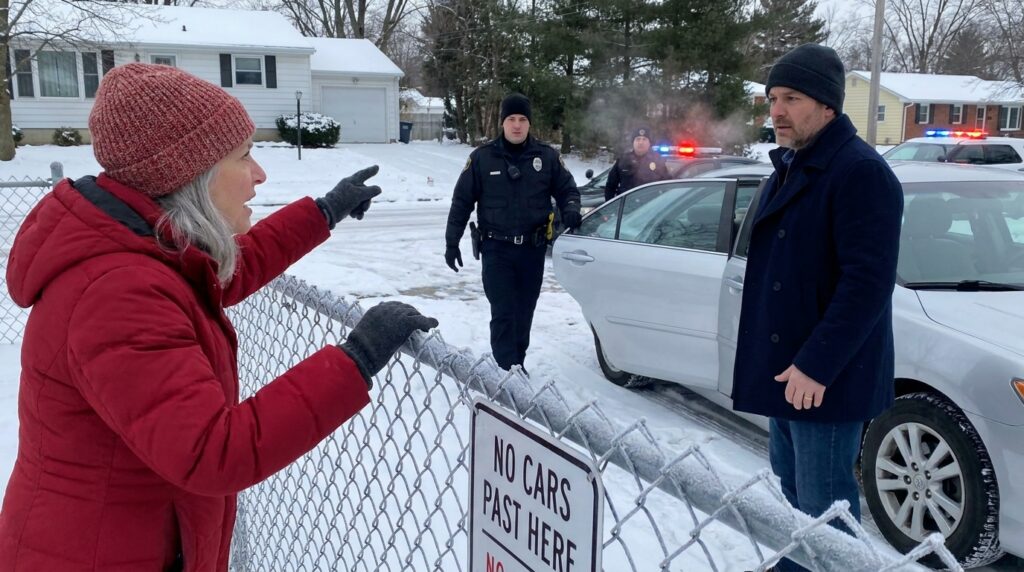
Mark Vance didn’t turn off the ignition. His heavy leather work gloves remained wrapped around the steering wheel of the silver sedan, the leather stiffened by the three-degree air settling over Maple Drive. Through the sweep of the wipers, the world was reduced to shades of gray, white, and a single violent slash of crimson.
Brenda Higgins stood on the frozen dirt lane, framed by the cold zinc of the chain-link fence. Her red winter coat was a beacon in the storm, the dark fabric of her snow pants caked with slush near the boots. Her gloved fingers were threaded through the wire mesh, pulling the gate taut, her body positioned dead center in the only tire ruts that cleared the snowbank.
Wired to the top rail of the fence was a square of raw plywood, the black paint fresh enough that the fumes cut through the smell of pine and diesel exhaust.
NO CARS PAST HERE.
Mark let out a slow breath, the air rising in a thin plume inside the cold cabin. He shifted into park, pulled the handbrake until the ratchets clicked six times, and opened the driver’s door. The arctic air hit him instantly, biting at his clean-shaven jaw and pinning the navy fabric of his coat against his chest.
“Brenda,” Mark said. His voice was low, flat, carrying the dry rasp of a man who spent his days looking at framing squares and concrete footings rather than arguing across property lines. “It’s four in the afternoon. The plow is coming down the main road in an hour. Step aside so I can get the car to the rear garage.”
“You don’t have a garage past this line!” Brenda snapped. She didn’t let go of the chain-link. Her gray hair poked out from under a red-and-black knit beanie, her lined face pinched tight with a satisfaction that looked almost ceremonial. In her left hand, clutched against her chest like an armor plate, was a thick yellow plastic folder and a metal clipboard. “This lane is listed on my tax assessment as Private Parcel 4B. You’ve been driving over my drainage bed for six years, Mark. It ends today. Read the board.”
“I don’t need to read the board,” Mark said, stepping down onto the packed gray ice. He didn’t rush his movement. He took three deliberate steps toward the front bumper, his work boots crunching into the frozen slush. He stopped four feet short of the gate—far enough to keep his frame clear of the mesh, close enough that she had to tilt her head back to meet his eyes. “This driveway is a deeded easement, Brenda. You don’t have the legal authority to close it.”
“I have the deed right here!” She slapped the clipboard with her gloved palm, the sound like a gunshot in the quiet, snow-muffled street. “City code says non-conforming access points can be revoked by the primary titleholder if structural damage is present! Look at the curb, Mark! Look at the asphalt!”
Mark’s eyes didn’t drop to the curb. He knew every crack in the asphalt better than she did; he’d cold-patched three feet of it himself two summers ago when the municipal water crew left it rutted.
Instead, his gaze settled on the edge of the plywood sign. Beneath the rough hand-lettering, half-tucked behind the top wire of the gate, was a fresh piece of official white paper, secured with heavy blue painter’s tape. The red seal of the County Registrar caught the faint amber glow of the streetlamp turning on overhead.
Mark reached into his coat pocket for his gloves, his knuckles white against the dark leather. “What did you tape to my fence gate, Brenda?”
“It’s not your fence,” she said, her voice dropping into a razor-thin smile as she reached for her coat pocket and pulled out a ringing smartphone. “And you’re about to find out whose street this really is.”








