CHAPTER 2: THE COLD IRON AT THE GATE
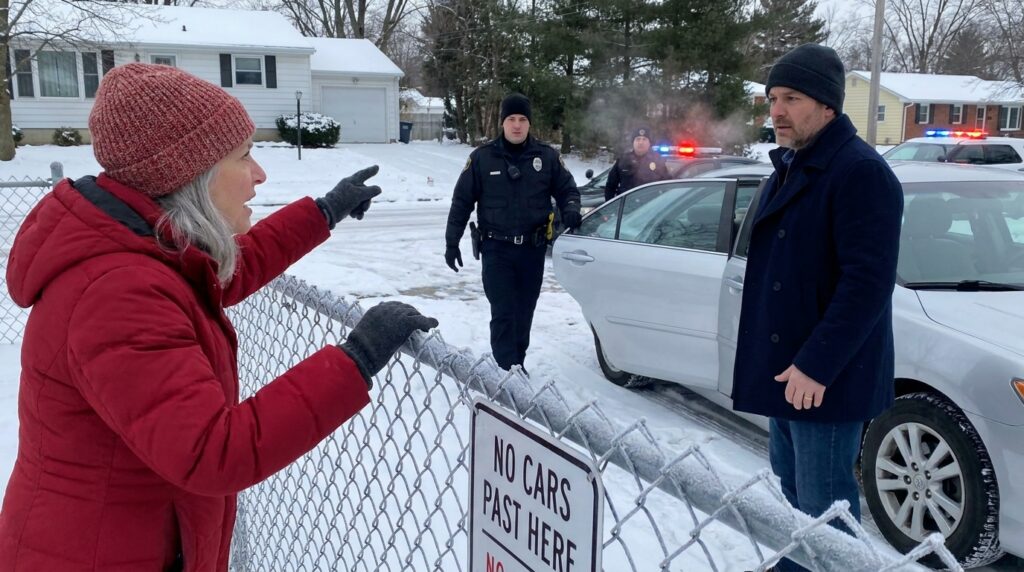
Brenda didn’t wait for a response. She pressed the smartphone to her ear, her gloved thumb smudging the glass screen. “Yes, dispatch? I need a unit at 412 Maple Drive. Immediately. I have a party actively trespassing on my private driveway parcel, refusing to clear the right-of-way, and obstructing municipal property lines.”
Mark stood motionless in the snow. He didn’t shout. He didn’t reach for his own phone. Decades of working construction had taught him that when a structure was shifting under pressure, you didn’t kick the framing; you inspected the load-bearing points.
His eyes stayed fixed on the paper taped beneath the plywood board.
The red seal of the County Registrar wasn’t a photocopy. It was embossed, the heavy paper crimped and stiffened by cold, bleeding slightly where snow hit the top edge. But it wasn’t a trespass warrant. Mark knew the typeface of the city building inspector’s office—12-point Courier, printed on dot-matrix or cheap laser stock from the municipal basement.
“He’s standing right at my gate,” Brenda continued into the receiver, her voice rising half an octave to ensure it carried over the engine idle of Mark’s sedan. “He’s making threats, dispatch. He’s claiming he owns the land.”
Mark stepped closer to the chain-link mesh. The zinc was freezing, coated in a micro-thin glaze of clear ice that cracked under his leather work gloves as he touched the top rail.
“You called code enforcement three weeks ago, didn’t you, Brenda?” Mark asked, his voice steady, low enough that the phone mic wouldn’t pick it up cleanly.
Brenda lowered the phone an inch, her eyes narrowing beneath the brim of her red beanie. “I filed a formal complaint regarding heavy vehicle degradation of residential sub-grades. This lane was never rated for three-ton commercial vehicles.”
“This is a 2014 silver sedan,” Mark said, tapping his knuckle against the door frame of his car. “It weighs thirty-four hundred pounds. My work truck stays at the yard on Industrial Parkway.”
“It’s the precedent!” she hissed, snapping the phone shut and slipping it back into her pocket with a final, decisive movement. “You drive your tools in here. You had a gravel delivery last May. You’ve compromised the drainage bed that feeds my retaining wall.”
“That gravel went into my drainage trench,” Mark said. “The one your husband helped me dig in 1998.”
A flicker of something dark and sharp passed across Brenda’s lined face—a brief fracture in the rigid armor of her red coat—before her jaw set hard again. Her late husband, Arthur, had been a surveyor for the county before his lungs failed him six years ago. He was the man who had walked the boundary line with Mark, holding the prism pole while Mark drove the three-foot steel rebar pins into the clay with a sledgehammer.
“Arthur isn’t here,” Brenda said, her voice dropping into a cold, flat register that matched the grey sky above them. “And the county records don’t care about memory. They care about title chains.”
Mark reached toward the taped paper on the gate. He didn’t tear it—he knew better than to touch evidence on an disputed boundary—but he tilted his head to read the bottom line exposed beneath the blue painter’s tape.
NOTICE OF INTENT TO VACATE UNAUTHORIZED EASEMENT – PRELIMINARY FILING 402-B.
It wasn’t an order. It was a preliminary filing receipt—a clerk’s stamp acknowledging that Brenda Higgins had paid seventy-five dollars at the county courthouse to start a civil review process. She had taken the receipt, taped it to a piece of plywood, and presented it as a police-backed eviction.
“You paid the clerk on Tuesday,” Mark said quietly. “You didn’t get an injunction. You got a filing number.”
“It’s an official record!” she snapped, gripping the fence mesh tighter until the dark fabric of her gloves bulged through the links. “And until a judge tells me otherwise, this gate stays locked!”
Down at the corner of Maple and 4th, the low, rhythmic thrum of an engine cut through the muffled quiet of the snowfall. It wasn’t the city snowplow.
A flash of blue and red light reflected off the icy power lines overhead, painting the gray snowdrifts in rhythmic, mechanical pulses. The police cruiser turned onto the street slowly, its tires crunching heavily over the unplowed slush, heading straight for the gap in the fence where Mark’s silver sedan sat idling.
Brenda straightened her back, adjusted her clipboard, and stepped right up to the edge of the gate line, her red coat standing out against the white landscape like a flare.
“Now,” she whispered across the wire, her breath rising in a sharp white plume. “Tell the officer about your easement.”
Mark didn’t move away from his car door. He reached inside, popped the latch on the glove compartment, and pulled out a thick, faded yellow folder bound with a rubber band. He didn’t open it yet. He just held it in his gloved hand, feeling the familiar weight of the laminated cardstock inside—the original plat map Arthur Higgins had signed twenty-eight years ago.
The cruiser’s brakes squealed softly as it pulled to a stop behind the silver sedan, its emergency lights flashing against the frozen chain-link.