CHAPTER 4: THE RED LIGHT ON THE PLX
Officer Miller took the laminated yellow folder across the top rail of the fence. His leather gloves made a dry, rasping sound against the stiff plastic coating.
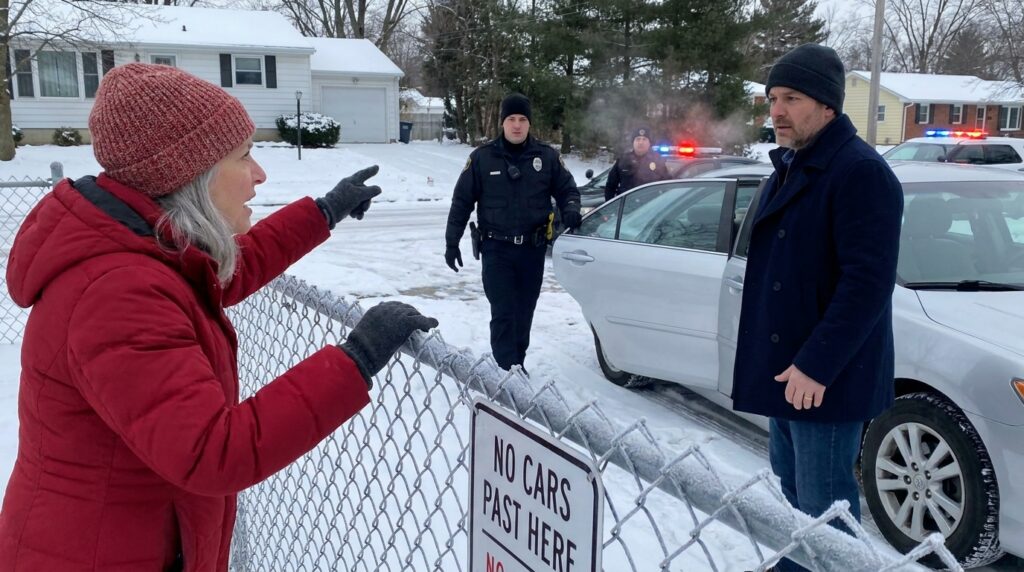
Behind them, Officer Jenkins shifted his boots in the snow, his eyes scanning the windows of the neighboring houses along Maple Drive. A curtain twitched at number 408. Someone was watching from behind double-pane glass, but no one stepped out into the bitter air.
Miller unrolled the plastic document, holding it up so the strobing red-and-blue wash of the patrol car lights illuminated the black ink lines. The paper inside was yellowed at the margins, preserved beneath a clear, heavy-gauge heat laminate that had kept out twenty-eight winters of moisture.
“State Plat Map 96-C,” Miller read aloud, his voice clipped and neutral. His thumb rested over a bold black square marking the rear lot. “Deed Book 412, Page 88. ‘A perpetual non-exclusive right-of-way for ingress, egress, and utility maintenance over the northern twelve feet of Lot 4B.'”
“That was recorded before the 2004 municipal zoning update!” Brenda interjected, her boots crunching as she shuffled sideways along the fence line, trying to peer over Miller’s forearm. “You can’t rely on a 1996 filing when municipal code 14-B establishes weight limits for unpaved sub-grades! The city engineer’s office stamped my review request on Tuesday!”
“She’s right about the stamp, Officer,” Mark said, taking a step closer. The wind caught the open door of his silver sedan, making the metal latch groan against the ice build-up on the frame. “The city gave her a filing stamp. But look at the bottom right corner of that plat map. Below Arthur Higgins’s signature.”
Miller tilted the document down, angling it toward the headlights of his cruiser.
There, pressed into the thick paper before it had been encased in plastic, was an embossed circular seal. It wasn’t the city planning commission’s mark. It was the seal of the County Board of Commissioners, stamped in heavy, raised iron lettering, accompanied by a handwritten notation in faded black ink: Permanent Covenant Run with the Land—Grandfathered Partition Exemption.
“The weight restriction notice she taped to the gate is a decoy,” Mark continued, his voice firm, level, unhurried. “Section 14-B applies to newly dedicated public alleys. It doesn’t touch grandfathered private access covenants recorded under county partition acts. She used a city clerk’s intake receipt to make it look like an enforcement order.”
Brenda’s hands shook where they held the clipboard against her coat. “The drainage bed is cracking, Mark! The water runs down from your garage roof and freezes against my basement wall! Every time you drive over that dirt, you pack the clay down further, and the runoff has nowhere to go!”
Mark looked at her for a long second. The anger wasn’t there; what remained was the cold, unyielding reality of the earth beneath them.
“I offered to install an underground French drain along the property line three years ago, Brenda,” Mark said. “I bought the perforated pipe. I bought the washed stone. You told me if I set one foot on your side of the chain-link with a shovel, you’d call the sheriff.”
“Because you were trying to alter the boundary line!” she cried, her voice echoing down the silent, snow-choked street. “You wanted to lay pipe across Parcel 4B so you could claim adverse possession after ten years!”
Officer Miller raised his left hand, palm outward, taking two deliberate steps toward the center of the gate lane. His body position subtly blocked Brenda’s view of Mark.
“Ma’am,” Miller said, his tone dropping an octave into absolute authority. “Step back from the fence.”
Brenda blinked, her mouth opening slightly. “Officer—”
“Step back from the fence, ma’am,” Miller repeated, his hand remaining up. “Right now.”
She hesitated for a split second, her eyes darting to Officer Jenkins standing near the patrol car, then back to Miller’s face. Slowly, reluctantly, her boots dragged through the slush as she took two paces back into her snowy yard.
Miller turned his full attention to the wooden sign wired to the gate. He reached up, took hold of the plywood board, and gave it a firm tug. The rusted wire creaked under the tension, the blue painter’s tape holding the municipal notice tearing down the middle as the paper fluttered in the cold wind.
“Mr. Vance,” Miller said, looking over his shoulder at Mark. “Where are the physical survey pins for this easement located?”
Mark reached into his coat pocket and pulled out a small, heavy brass wire brush and an orange-handled trenching trowel.
“Six inches past the corner post,” Mark said, pointing his gloved finger at the base of the galvanized fence post buried in the snowbank. “Right under the frost line.”