CHAPTER 4: THE ACCESS BARRIER
The high-tensile steel of the gate post groaned against the frame of Marcus’s truck as he shifted into reverse. The tires spun briefly in the loose roadbed gravel, kicking up a spray of gray stones that rattled against the undercarriage. When he cut the ignition, the valley air didn’t fill with the natural hush of twilight. Instead, the low, mechanical grinding of a heavy flatbed engine idled just forty yards north, its cooling fan cutting through the dark like a blunt saw.
Marcus stepped out into the dry, swirling dust, his work boots instantly finding the edge of the access gate. It wasn’t just a notice pinned to the timber this time. Two massive, pre-cast concrete barrier segments—the standard three-ton interlocking blocks used by state highway crews—sat dead center across the secondary approach lane, completely bridging the gap between the corner cedar posts. Wrapped twice around the throat of the iron hinges was a thick, oxidized chain, secured by a heavy brass padlock.
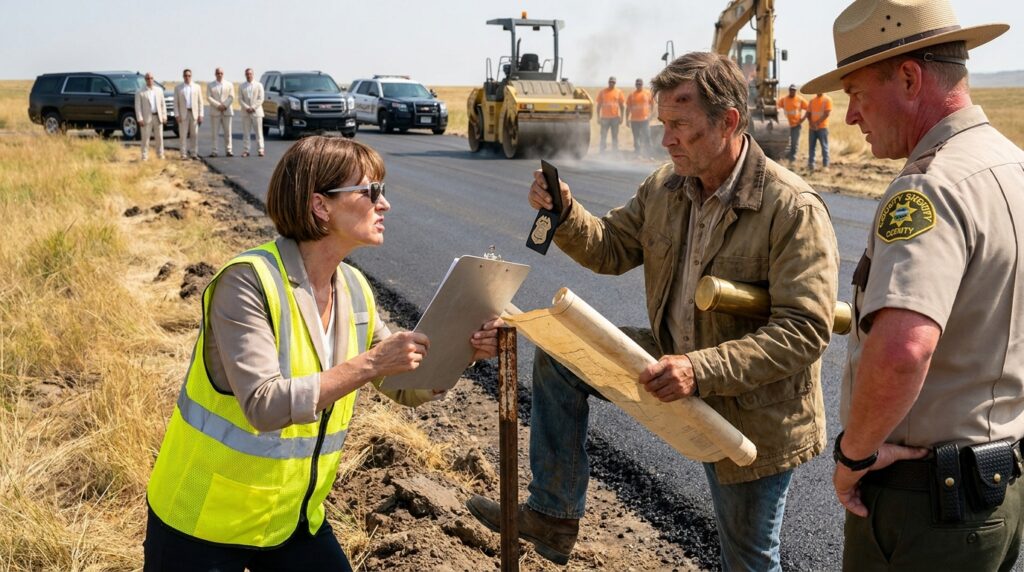
Victoria Vance stood just beyond the concrete obstacle, her silhouette back-lit by the auxiliary floodlights of a waiting coalition utility truck. The harsh, white glare caught the crisp edges of her high-visibility vest, turning the dust particles around her into a shimmering web. She wasn’t holding her gold pen now; she had a laminated municipal enforcement order clipped to a new, larger clipboard, her fingers locked rigidly over the top margin.
“You’re outside your boundaries, Marcus,” she called out, the tone sharp, clinical, entirely stripped of the casual condescension she had carried the previous afternoon. “The coalition’s field supervisor filed an emergency access restriction with the county coordinator two hours ago. The secondary gate is officially closed to private agricultural traffic to ensure site stabilization during the drainage shift.”
Marcus didn’t touch the chain. He leaned against the concrete block, his fingers tracing the rough, abrasive aggregate texture of the industrial stone. Pinned beneath the padlock was a small, lead-sealed inventory tag. He leaned closer, his eyes catching the stamped identification number: BLM-REG-04. It was a federal surplus marker from the land management office two counties over—not a piece of municipal property, and certainly not something a local development coalition had the authority to requisition. The trap wasn’t just physical; it was an explicit administrative locking mechanism designed to isolate his home before he could return to the county seat with the ledger evidence.
“This gate services the northern well-house,” Marcus said, his voice level, flat, matching the hard iron chill of the chain beneath his hand. “If the cattle lose access to the lower trough because the pump line is blocked by three tons of unapproved highway stone, your coalition’s liability moves from a civil property dispute to a felony agricultural interference charge.”
“The water line was factored into the environmental adjustment,” Victoria said, stepping closer until her white designer sneakers touched the base of the concrete barrier. She didn’t look down at the lead federal tag. Her eyes were fixed entirely on Marcus’s jacket pocket, where the edge of the county vault envelope peeked through the fabric. “The county supervisor confirmed the temporary easement at four-fifteen. We aren’t violating your land; we’re stabilizing the public corridor. If your livestock are inconvenienced by the safety perimeter, you have the option to relocate them to the southern fields.”
“The southern fields are dry limestone,” Marcus replied, his index finger lightly pressing the lead seal of the inventory tag, noting the fresh, unweathered crimp marks on the wire. “Which you already knew when you signed the Apex addendum sheet.”
Victoria’s gold pen tapped once against the clipboard, the sound micro-tense in the graying light. “The coalition handles local development infrastructure, Mr. Sterling. Whatever corporate names you think you found in the basement archives don’t change the physical reality at this boundary line. The machinery stays. The barriers stay. By noon tomorrow, the regional investors will be on-site to verify the site clearance. I suggest you spend your night packing your records, because the county enforcement detail will be handling the final perimeter check.”
She turned sharply, her canvas vest rustling as she stepped into the passenger side of the utility truck. The heavy commercial vehicle shifted into gear, its dual wheels churning through the pasture grass as it backed toward the main road, leaving Marcus alone in the glare of the stationary floodlights.
Marcus stood by the locked iron rail, his thumb sliding over the cold brass of the padlock. The decoy secret had escalated into a total physical blockade, verified by a county supervisor’s signature that shouldn’t have been legally possible without a regional land coordinator’s sign-off. The system had failed exactly where it was supposed to protect him. He reached into his truck bed, his hands finding the heavy, oil-chilled steel handle of a rusted bolt cutter, his jaw setting as he calculated the precise timing of the investor arrival. The lines were drawn, the false authority had locked the gate, but as the high-pitched hum of the automated floodlights vibrated through the pasture fence, Marcus knew he wasn’t looking at a neighborhood dispute anymore—he was looking at an organized regional fraud that had just trapped itself inside his jurisdiction.