
CHAPTER 2: THE PAPER LINE
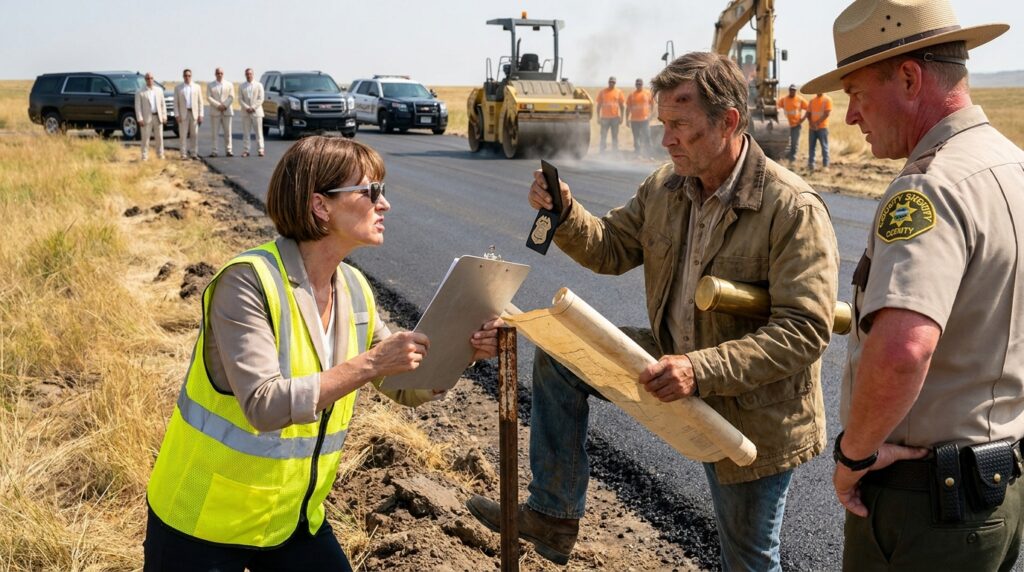
“You can take that notice off my gate, Victoria, or you can watch the wind carry it down the highway.” Marcus didn’t lower his arm. His fingers remained wrapped around the handle of his cold coffee mug, his forearm resting against the splintered top rail of the cedar post. The white boundary envelope she had jammed beneath the iron latch fluttered like a trapped moth, its crisp, heavyweight bond paper catching the grit drifting from the ditch.
Victoria Vance adjusted the strap of her leather boots, stepping back onto the strip of packed earth the excavator had left behind. The heels sank slightly into the wet clay, but she kept her chin tilted up, her silver sunglasses reflecting the wide, desaturated stretch of Marcus’s upper pasture. “It’s an official summons of non-compliance, Marcus. The Valley Development Coalition doesn’t drop warnings in the dirt. You’ve got forty-eight hours to clear the secondary access road for the aggregate trucks, or the daily assessment fines start locking against the deed.”
“The coalition doesn’t hold a charter for the western section,” Marcus said, his voice carrying the dry, rhythmic cadence of a man accustomed to reading federal land grids. He reached out with two fingers, pinched the edge of the envelope, and slid it free from the latch. The paper was stiff, over-engineered. On the back, pressed into the thick stock, was the blue ink emblem of the municipal planning board. He didn’t look down at it, but his index finger traced the raised border of the seal. Something about the texture felt wrong—the ink was too thick, the ridge of the stamp slightly offset, like an old brass plate pressed too hard into modern paper. “This acreage sat under the 1904 homestead patent before your valley subdivision was even a blueprint for timber salvage. My grandfather didn’t sign a right-of-way then, and I haven’t signed one now.”
“Your grandfather didn’t have three hundred households downstream trying to keep their basements from flooding every time the northern ridge sheds water,” Victoria countered. She stepped closer, the gold tip of her pen clicking against the aluminum clipboard with a sharp, mechanical snap. “The board held a public forum at the civic center last winter. Seventy-three percent of the registered valley residents signed off on the infrastructure map. We aren’t asking for your permission anymore, Mr. Sterling. The easement is classified as a public safety necessity. The machinery stays until the culverts are set.”
Marcus turned the envelope over in his hand. The blue seal was still wet enough to leave a faint, dark smudge across his thumb. The date stamped within the circle read October 14, 2024, but the legislative prefix code beneath it belonged to the old municipal charter—the one dissolved by the county court back in the winter of twenty-two. It was a tiny discrepancy, an institutional scar that would have gone unnoticed by anyone who hadn’t spent twenty years auditing regional land surveys for the Bureau of Land Management. The coalition wasn’t executing a public utility line. They were using an obsolete regulatory ghost to force a physical path through his fence.
“A safety necessity,” Marcus murmured, his eyes tracking past her shoulder toward the three-man grading crew. The workers were leaning against the tracks of the idling excavator, their shovels planted in the raw clay, watching the boundary line with the dull, passive interest of day laborers caught between two different bosses. “If this was a standard valley runoff channel, your engineers would have followed the creek bed through the section line half a mile south. The grade is lower there. The flow is natural.”
“The section line is restricted,” Victoria said instantly. Her response was too fast, the rhythm of her speech clipping the end of his sentence. She pulled her clipboard against her chest, her fingers shifting across the legal papers beneath the clip. “The environmental assessment flags the southern creek as a protected wetland habitat. This ridge is the only viable path that doesn’t trigger a federal review. We have the permits, Marcus. We have the engineering stamps. What you have is an empty barn and a patch of weeds you haven’t farmed in ten years.”
“The southern creek isn’t a wetland,” Marcus said softly, his thumb pressing again into the irregular ink of the forged seal. He knew every square yard of the local topography; he had drafted the federal geological survey for the entire basin during his second year as regional coordinator. The southern section was dry scrub oak and fractured limestone—completely unregulated. The only reason to avoid it was if someone needed a high, dry access road that could bear the weight of commercial construction rigs without alerting the state transport inspectors.
Victoria stepped back onto the gravel lane, her sneakers crunching aggressively against the stones. “The grading crew works from dawn until four, Mr. Sterling. If that tractor or any of your grandfather’s old machinery is within twenty feet of the trench line when the first shift starts tomorrow morning, the county deputy will be out here with a removal order. I suggest you spend your evening looking for a lawyer who understands municipal eminent domain, because this line is already drawn.”
She didn’t wait for his answer. She turned and walked toward her black SUV parked by the secondary gate, her white vest cutting a bright, artificial path through the gray dust of the road.
Marcus stood by the gate post until the rumble of her vehicle faded into the low, constant hum of the valley highway. He looked down at his thumb, at the small blue smudge of ink that shouldn’t have been there. The paper was a decoy, a carefully constructed layer of administrative weight designed to make a private overreach look like the unyielding will of the state. He slid the envelope into his jacket pocket, his hand brushing against the weathered leather gloves he hadn’t used yet. The valley thought he was an absentee owner returning to bury his past under the old trees, but as he walked back toward the dark interior of the house, his mind was already mapping the layout of the county records office three towns over.








