
CHAPTER 1: THE TORN LINE
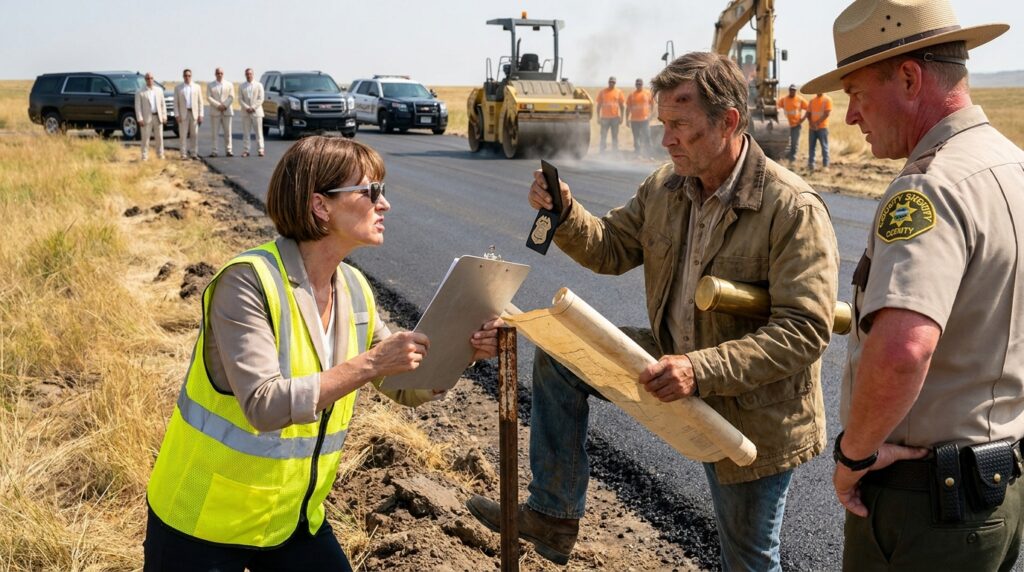
The dust hit Marcus first—a dry, alkaline cloud that tasted faintly of iron and pulverized limestone. It hung thick over the western pasture, settling into the canvas folds of his old field jacket and coating the windshield of his parked truck. He did not step away from the vehicle immediately. Instead, he stood by the driver’s side door, his boots resting on the unyielding gravel of the approach road, watching the long arm of the hydraulic excavator swing over his fence line. The bucket dropped with a heavy thud, the steel teeth dragging through the sod, exposing a jagged wound of red clay and ruptured roots.
Three meters out from the excavation site, Victoria Vance stood with her feet planted firmly in the weeds, completely unaffected by the diesel exhaust rolling from the machine’s manifold. She looked exactly like the corporate descriptions Marcus had received in his Washington briefs: an authority-faker silhouette wrapped in a crisp, high-visibility mesh vest that looked pristine enough to have been unboxed ten minutes ago. Her oversized designer sunglasses caught the sharp afternoon glare, turning her gaze into two blank, silver mirrors. In her right hand, she clutched a heavy aluminum clipboard, her thumb rhythmically clicking a gold pen against the metal edge.
Marcus walked toward the boundary line, his movement unhurried. He carried a stained ceramic mug, the coffee inside long since gone cold. With every step, the texture of the ground changed under his soles—from the compacted gravel of his own road to the loose, unstable clods of displaced topsoil pushed aside by heavy rubber tracks. He didn’t look at the workers in their bright orange shirts; he kept his eyes on the stakes. They were driven every five paces, a line of aggressive plastic markers carving a path straight toward the old timber barn.
“You’re cutting the historical line,” Marcus said. His voice was flat, matching the gray desaturation of the dry summer grass. He didn’t raise it over the rumble of the idling engine.
Victoria didn’t flinch. She turned her head slightly, her sharp bob haircut shifting in a single, rigid motion. She lowered the sunglasses just far enough to reveal the cold calculation in her eyes, her lips instantly forming a sharp, dismissive line.
“This community voted for development, Mr. Sterling,” she said, her voice carrying the transactional weight of someone who spent her life weaponizing municipal sub-clauses. “Your little patch of dirt isn’t above the collective progress of this valley. The Valley Development Coalition approved the drainage corridor three weeks ago. The timeline doesn’t pause for outdated family sentimentality.”
Marcus looked down at the deep trench. A thick, severed oak root protruded from the clay side wall, its fibers weeping sap into the dirt. A minor discrepancy caught his eye—a faint glimmer of old iron wedged deeper into the exposed bank, far below the level of the new plastic stakes. It was the top of a buried iron surveyor’s pin, ancient and rusted, completely ignored by the grading crew.
“I suggest you check the county registry,” Marcus replied quietly, his posture remaining perfectly still against the split-rail fence. “Before you let that excavator dig another inch into this topsoil.”
Victoria let out a short, dry laugh, her gold pen pointing directly at his chest. “We are well past the registry, Marcus. By Monday, this trench will be lined with concrete, and the county will have its easement. If you have an issue with the coalition’s authority, you can file an appeal at the regional office next month. Until then, stay behind the markers.”
She turned back to the machinery, waving the aluminum clipboard to signal the operator. The engine roared, a cloud of black smoke erupting into the clean sky. The bucket rose again, its shadow falling directly across Marcus’s boots.








