Chapter 2: The Red Notice That Changed Everything
By noon, the story had traveled through nearly every street in Suncrest Palms, a retirement community outside Phoenix.
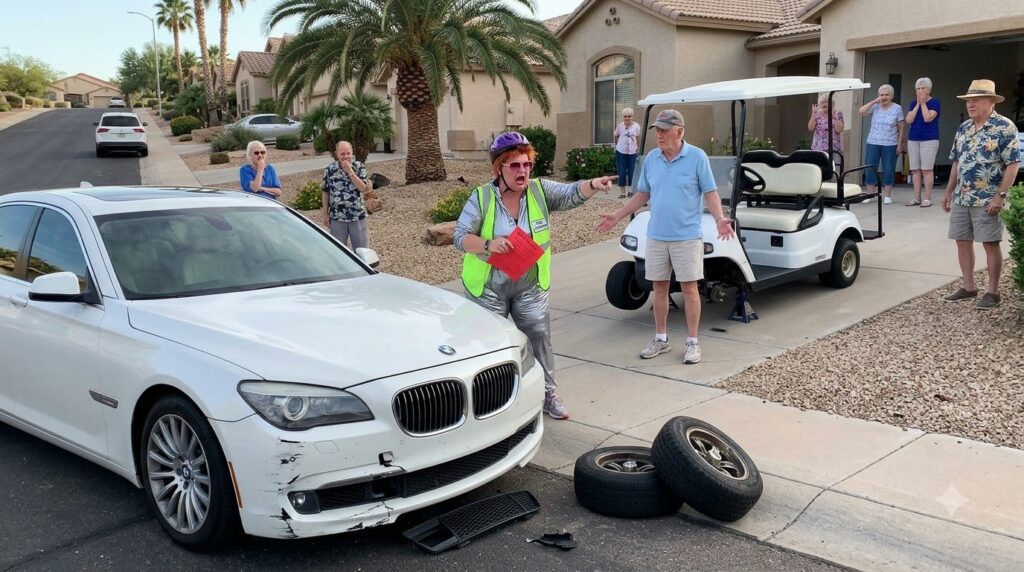
The damaged BMW was impossible to miss.
Karen had parked it in her driveway, but the missing grille insert and scratched bumper were visible from the sidewalk. A temporary piece of black tape covered part of the broken trim.
She had already posted a message on the community’s private social media page.
According to her version, Walter had deliberately endangered neighborhood property by leaving unsecured golf cart equipment on a sloping driveway.
She conveniently omitted the part where she had removed the wheels herself.
She also announced that the HOA would investigate the incident and that Walter might face additional fines.
Walter read the message twice.
He felt a familiar tightness in his chest. Not fear exactly, but the exhaustion of dealing with someone who seemed determined to make every ordinary disagreement a battle.
His wife, Margaret, had passed away three years earlier. Since then, the golf cart had become more than transportation. It had helped him remain connected to the community they had spent so many years building their lives in.
He had no intention of surrendering that independence because Karen wanted another registration fee.
Instead of responding online, Walter took photographs.
He photographed the damaged golf cart, the jack stands, the missing wheels, the red confiscation notice, and the scrape marks leading down the driveway.
Then he called Frank.
Frank arrived twenty minutes later, still wearing his Hawaiian shirt.
He had something Walter had not expected.
A video.
Frank had been recording the scene on his phone before Karen removed the second wheel. His camera had captured her pulling it away, shouting about the missing HOA sticker, and deliberately pushing both wheels downhill.
The footage showed the two impacts against the BMW.
It also captured Karen’s final demand that Walter pay for the damage.
Frank watched the recording again, shaking his head.
“She really thought she could do whatever she wanted,” he said.
Walter nodded.
But the video was only the beginning.
Frank also reminded him that Karen had not been authorized to remove anything from his golf cart. The vehicle was privately owned, and Walter had never given her permission to touch it.
The following morning, Walter visited the HOA management office.
The community’s property manager, Denise Parker, was a professional woman in her early sixties who had worked with several retirement associations. She had heard rumors about Karen’s new registration program but had never seen the original authorization.
When Walter showed her the red confiscation notice, Denise frowned.
She examined the document carefully.
It carried the HOA logo, Karen’s signature, and a reference to a community rule requiring all golf carts to display a registration sticker.
But something was missing.
There was no board resolution number.
No date of approval.
No reference to an actual amendment in the governing documents.
Denise opened the association’s electronic records and searched the meeting minutes.
She found several discussions about golf cart safety and neighborhood traffic. There had been a proposal to create a voluntary registration program.
It had never been approved.
The board had discussed a possible twenty-five-dollar administrative fee, but the proposal had been postponed after several homeowners objected.
Karen had apparently decided to implement it anyway.
Denise printed the relevant meeting minutes.
Then she examined Walter’s confiscation notice again.
The document claimed the HOA could remove wheels from any golf cart belonging to an unregistered owner.
There was no such provision in the bylaws.
Denise’s expression became increasingly serious.
She explained that the HOA could establish certain community rules through the proper procedures, but that did not give its president unrestricted authority to seize or dismantle privately owned vehicles.
Walter listened quietly.
He had spent years assuming that the HOA’s decisions were legitimate because they arrived on official-looking letterhead.
Now he was discovering that an official logo did not necessarily make an order lawful.
Denise agreed to preserve the association’s records and arrange a meeting with the board.
Before Walter left, she asked whether he had proof of the wheel removal.
He gave her Frank’s recording.
Denise watched the footage in silence.
When it ended, she leaned back in her chair.
“Mr. Bennett, I think we have a much bigger problem than an unauthorized sticker.”
For the first time since the incident, Walter felt that somebody in authority was actually listening.
But Karen had no intention of backing down.
That afternoon, she sent Walter another letter.
This time, she demanded $3,800 for the BMW repairs and threatened to place a lien against his home if he refused to pay.
She had also included an additional $500 administrative penalty for what she called deliberate interference with HOA enforcement.
Walter placed the letter beside Denise’s meeting minutes.
The contrast was extraordinary.
One document described rules that had never been approved.
The other showed that Karen had removed his property without permission.
And now she was threatening his home.
Walter picked up the phone.
He was ready to stop asking her to be reasonable.