Chapter 5: The Wheels Came Back, but the Damage Was Permanent
Three weeks after the clubhouse meeting, the HOA board announced a special session to present the findings of the independent review.
Attendance was so high that chairs had to be brought in from the recreation room.
Karen arrived without her usual confidence.
Her BMW had been repaired, but the work had not been paid for by Walter.
The insurance investigation was still underway, and she had been advised not to discuss the claim publicly.
She sat near the front with her arms folded.
The board president, an older gentleman named George Palmer, began by summarizing the findings.
The registration program had never been properly approved.
The fees collected under it were disputed.
The collection and storage of residents’ personal information had not followed an established privacy policy.
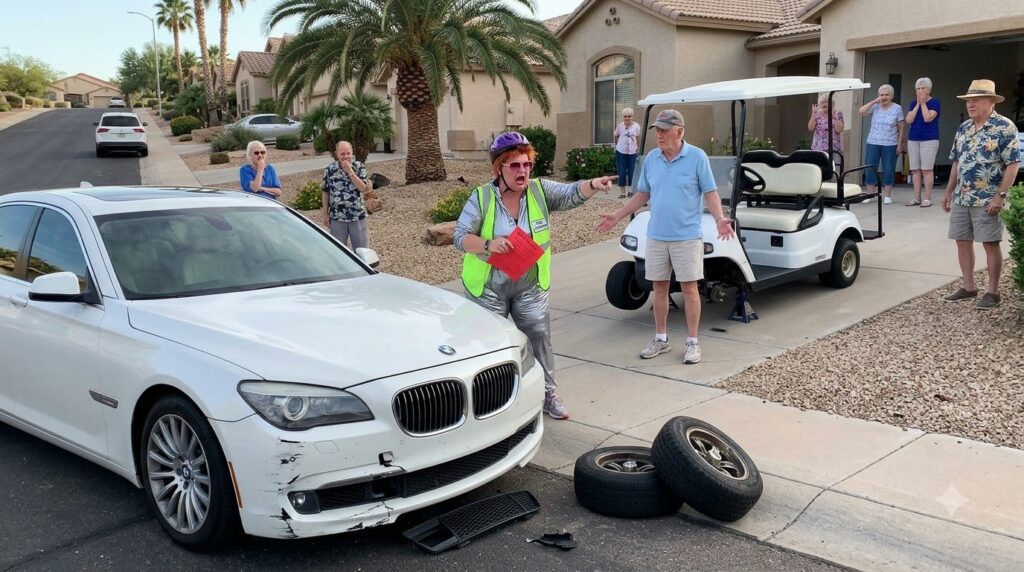
And Karen had removed property from Walter’s golf cart without authorization.
The board also confirmed that Frank’s video had been preserved as evidence.
George explained that the association would not pursue Walter for the BMW damage.
In fact, the board had formally rejected Karen’s request to use HOA funds to cover her repair bill.
The association would instead review the disputed fees and determine how much money needed to be returned to residents.
Karen interrupted several times.
She insisted that she had acted in the community’s best interests.
She argued that someone needed to enforce rules, especially in a retirement community where safety was important.
George listened.
Then he reminded her that enforcing legitimate rules was different from inventing new ones.
A president was elected to serve the homeowners, not to control them.
The board moved to a vote.
Karen was removed from her position as HOA president.
The vote was nearly unanimous.
She remained a homeowner and could attend future meetings like everyone else, but she no longer had authority to issue enforcement notices or access the association’s financial records without authorization.
The board also voted to review the disputed fees, establish a formal privacy policy, and require all future rule changes to follow the governing documents.
The residents applauded.
Not because they enjoyed watching someone lose a position, but because they finally believed their concerns were being taken seriously.
Walter sat quietly beside Frank.
He felt no desire to celebrate Karen’s embarrassment.
He had wanted his property left alone. He had wanted the rules followed. He had wanted to be treated like an adult who had spent decades working, paying taxes, and taking care of his own home.
That should never have required a battle.
After the meeting, Denise approached him.
The association had arranged for a mechanic to inspect the golf cart and reinstall the two front wheels. The repair costs would be addressed separately through the appropriate process.
Walter thanked her.
A few days later, his golf cart was back on all four wheels.
He drove it slowly down his driveway for the first time since the incident.
Frank was waiting near the sidewalk with his miniature remote-controlled golf cart.
He pressed a button, and the little vehicle rolled forward a few feet.
Walter laughed.
For the first time in weeks, the neighborhood felt normal again.
But the story did not end with Karen’s removal.
The financial review eventually confirmed that residents had paid thousands of dollars in unauthorized charges. The association began issuing refunds where appropriate and adopted a requirement that every fee be supported by a recorded board decision.
The disputed registration spreadsheet was secured and reviewed for proper handling of personal information.
Karen was also left responsible for addressing the consequences of her own conduct.
Walter’s attorney sent a separate demand concerning the unauthorized removal of the golf cart wheels and the damage to the vehicle.
The parties eventually reached a settlement covering the documented repair expenses.
The insurance dispute over the BMW proceeded independently, and Walter never agreed to pay for Karen’s bumper.
Karen continued living in Suncrest Palms.
She still drove her white BMW.
She still attended neighborhood events.
But something had changed.
When she walked into the clubhouse, people no longer rushed to ask her opinion. When she announced a new rule, homeowners asked to see the board approval. When she complained about someone’s driveway, they requested the written provision.
Her authority had depended on people assuming that she knew what she was doing.
Now they knew better.
One Saturday morning, Walter parked his repaired golf cart beside the clubhouse.
He was carrying a small grocery bag and a newspaper.
Ruth Callahan approached him, smiling.
She told him that she had received a refund for one of the disputed fines. She also thanked him for standing up to Karen.
Walter shrugged.
He had never considered himself particularly brave.
He had simply refused to accept that someone could take his property because she wore an HOA badge.
Ruth looked at his golf cart and smiled.
“I’m glad you got your wheels back.”
Walter glanced toward the street.
For a moment, he remembered the two wheels rolling downhill, Karen’s sudden panic, and the sound of her BMW bumper cracking.
He couldn’t help smiling.
“Me too,” he said. “Although I think those wheels had a more expensive afternoon than they expected.”
Frank, who had just arrived, burst out laughing.
The three of them stood beside the clubhouse, enjoying the warm Arizona sunshine.
Across the parking lot, a few residents were discussing the upcoming HOA election.
This time, they were carefully reviewing the candidates’ proposals before making their choices.
Walter watched them for a moment.
The incident had cost him time, money, and peace of mind. It had also exposed how easily an ordinary neighborhood association could become a source of intimidation when nobody questioned the person in charge.
But it had taught the community something worth remembering.
A title did not make someone right.
A badge did not grant unlimited authority.
And a homeowner’s right to privacy, dignity, and fair treatment did not disappear simply because another resident had been elected president.
Walter climbed into his golf cart and turned the key.
The motor hummed.
All four wheels were firmly attached.
He drove home along the quiet residential street, passing the houses, palm trees, and familiar driveways that had been part of his life for eleven years.
Behind him, the clubhouse remained busy.
For the first time in a long while, the people of Suncrest Palms were making their own decisions.
And nobody needed Karen’s permission to enjoy their neighborhood.