Chapter 4: The Money Nobody Was Supposed to Question
The independent review began the following week.
At first, the board expected to find a handful of unauthorized fines and perhaps some careless paperwork.
Instead, the investigation uncovered a troubling financial pattern.
Over the previous eighteen months, Karen had collected registration fees, inspection charges, and administrative penalties from dozens of homeowners.
The money had been deposited into the HOA’s operating account.
Some of the charges were legitimate expenses.
Others had no corresponding authorization in the board minutes.
The association’s treasurer, a retired accountant named Harold Simmons, was particularly concerned.
He had approved monthly financial reports without realizing that the individual charges had been created under an unapproved enforcement program.
He had trusted the president’s explanations.
Now he wanted to know exactly where the money had gone.
The investigation found that approximately $6,400 in disputed fees had been collected from residents.
Not all of that money had been spent improperly, but the association could not identify a valid authorization for the charges.
The board suspended Karen from financial oversight responsibilities and hired an outside accounting firm to examine the records.
Karen responded by sending angry emails to the board.
She claimed that the investigation was politically motivated.
She insisted that the registration program had been intended to protect older residents from dangerous golf cart traffic.
But her explanations became increasingly difficult to defend.
There was another problem.
The original proposal for the registration program had included a requirement that all golf cart owners submit proof of insurance and vehicle information.
Walter had refused because the HOA had never explained how the information would be stored or who would have access to it.
He had been concerned about handing over personal details without a clear reason.
During the review, the board discovered that Karen had maintained a spreadsheet containing residents’ names, home addresses, golf cart identification numbers, and copies of insurance documents.
The spreadsheet had been stored on a shared personal computer.
Several people had access to it.
There was no written privacy policy governing the information.
This discovery changed the mood of the investigation.
What Karen had presented as a safety program had also become an uncontrolled collection of residents’ personal information.
Several homeowners were alarmed.
Walter thought of Margaret.
She had always believed that a home should be a place where people could feel safe, not somewhere they had to worry about being watched, recorded, or pressured by neighbors.
He wondered how she would have reacted to the idea that an HOA president had been collecting private information without properly explaining why.
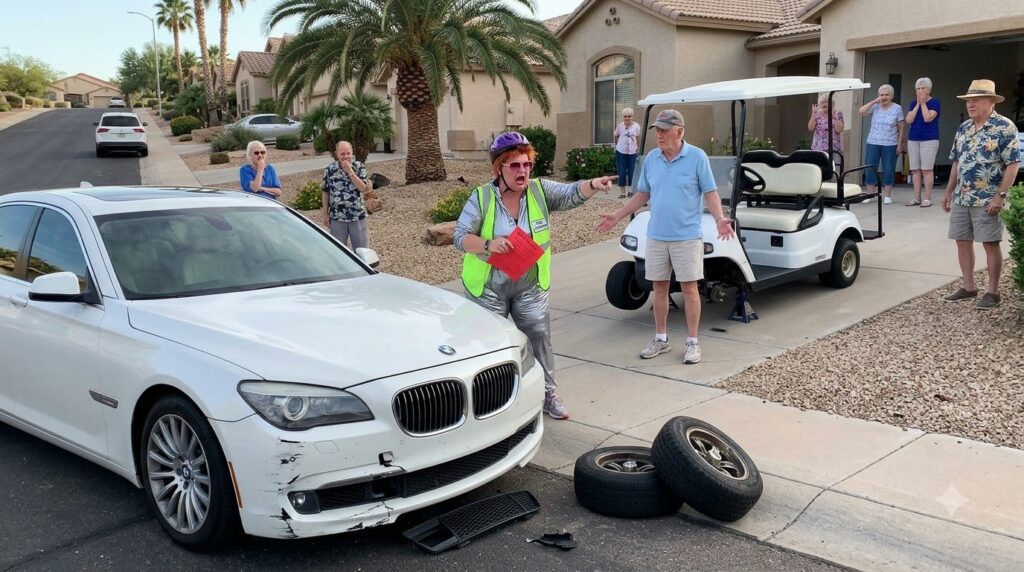
Meanwhile, Karen’s BMW repair demand remained unresolved.
Walter’s attorney, a local property lawyer named Susan Reynolds, sent a formal response.
The letter stated that Walter denied responsibility for the damage and disputed Karen’s demand for payment.
It included Frank’s recording, photographs of the removed wheels, and the HOA meeting minutes.
Susan also explained that Karen had personally handled the wheels and deliberately pushed them downhill.
Her position as HOA president did not automatically make her actions those of the association, nor did it give her the right to remove property from Walter’s vehicle.
The demand for $3,800 was rejected.
Karen’s next move was even more surprising.
She contacted the association’s insurance carrier and reported that Walter’s golf cart had caused damage to her BMW.
She described herself as an innocent vehicle owner whose car had been struck by improperly secured equipment.
However, the carrier requested the original video.
Once the adjuster watched Frank’s recording, the claim became considerably more complicated.
The footage showed that Karen had removed the wheels and initiated their movement.
The insurer reserved its position while investigating the circumstances.
Karen was no longer simply arguing with Walter.
She was dealing with a formal investigation, a skeptical board, a possible financial audit, and an insurance company that had questions about her version of events.
For the first time, her threats were not intimidating anyone.
They were being documented.
Then came another discovery.
During the financial review, Harold found an email from Karen to the management office.
It had been sent several weeks before the golf cart incident.
In it, Karen had written that she wanted the registration program implemented before the next quarterly board meeting because she expected several residents to object.
She had also described Walter as the homeowner most likely to challenge her.
The email ended with a sentence that made Harold stop reading.
She had written that if residents were forced to comply first, they would eventually accept the new rules.
It was not an innocent misunderstanding.
Karen had known that the program had not been approved.
She had simply decided to impose it anyway.
And now the board had evidence that her actions were deliberate.