
CHAPTER 4: THE ULTIMATE REALITY OF THE GEARS
The cabin smelled of damp pine and dry rot, a slow decay that Arthur had spent ten years trying to stay ahead of with a wire brush and linseed oil. The yellow eviction notice sat on the oilcloth table, caught in a sliver of late afternoon sun that made the typed case code look like a brand.
Arthur didn’t pack a suitcase. A sovereign protector didn’t prepare for a retreat; he fortified the perimeter. He walked to the old iron water heater in the utility closet, its cylindrical flank covered in patches of orange scale. His knuckles, swollen and stiff from the pharmacy triage, throbbed with a dull, rhythmic ache as he grabbed the heavy pipe wrench. It took three sharp, jaw-clenching strains against the rusted threads to break the seal on the false base plate.
The plate came away with a dry scrape, releasing a small puff of rust dust that tasted like iron filings on his tongue. Inside lay the real architecture of his isolation. Not a weapon, but a small leather-bound ledger, its pages white and crisp, completely free of the dust that coated everything else in the cabin.
Arthur opened it under the low-wattage bulb.
His breath caught, a cold rattle in his throat. He expected the old names from thirty years ago—the Brooklyn dock foreman, the union treasurers, the federal marshals who had handed him his new life under a tarp in the back of a government sedan. Instead, the ink on the final pages was fresh, written in a cramped, modern cursive he didn’t recognize. The entry dates skipped across the last three years, ending exactly two weeks ago. Next to every date was a cash amount, a initials code, and a name that made the small-town layout of this valley click together like the teeth of a trap: Miller.
The realization didn’t hit him with a burst of heat; it settled like frost on a radiator.
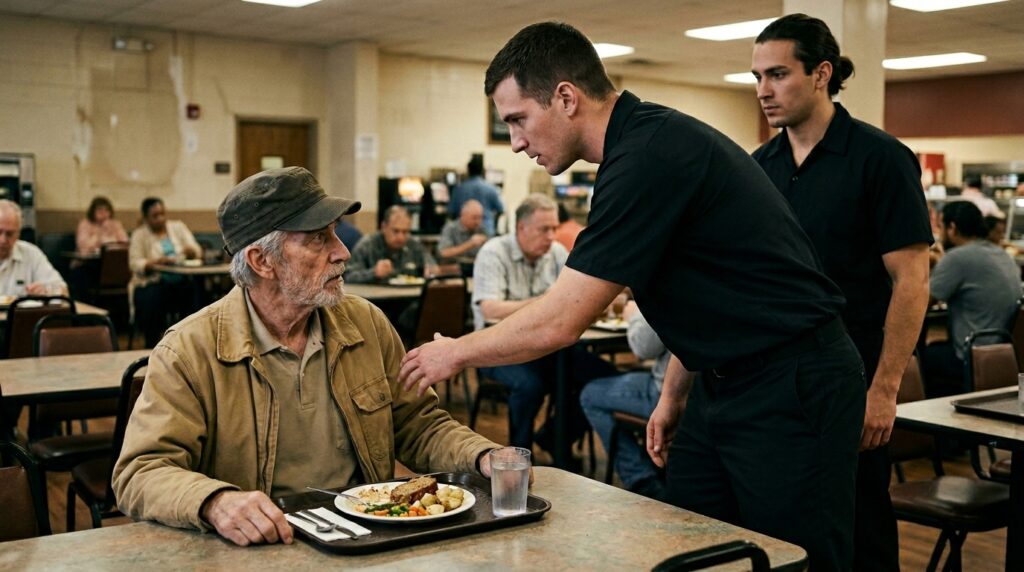
The witness protection program hadn’t forgotten him. They had been selling him. For three years, someone within the regional office had been taking regular payments from the gravel pit corporation to slowly leak his coordinates, using Sheriff Miller as the local collection agent. The confrontation at the cafeteria hadn’t been an isolated probe to verify if an old man could still throw a punch; it was a calibrated stress test orchestrated by the corporate interests to ensure the old man was fragile enough to be removed without a messy legal trail. The federal code on the eviction paper wasn’t a threat from his past—it was a file number from an active, ongoing enterprise.
A floorboard creaked on the porch outside. The sound was faint, a subtle shift in the cabin’s timber that only a man who lived in total silence would notice.
Arthur closed the ledger, slid it into the internal pocket of his tan jacket next to the silent brass watch, and stepped back into the main room. He didn’t turn off the light. He stood in the shadows beside the heavy oak door frame, his body dropping naturally into the low, defensive posture that had saved him in places this town had never heard of.
The front door didn’t rattle. It swung open slowly, the hinges giving off a single, sharp note of friction.
Sheriff Miller stepped across the threshold, a heavy mag-lite flashlight in his left hand, his right hand resting flat against the leather retention strap of his holster. The smell of woodsmoke and old wool came with him, cut by the sharp stench of hot brake pads from the driveway.
“You didn’t sign the paper, Arthur,” Miller said into the dark room. He didn’t raise the light yet. He stood in the frame, his silhouette broad and heavy against the gray dusk. “The trucks are at the crossroads. They don’t like to idle. Fuel costs money.”
“The ledger was under the tank, Miller,” Arthur said from the shadow of the pantry.
The Sheriff’s posture went rigid. The casual, small-town authority faded from his shoulders, replaced by the stiff, predatory alertness of an animal that realized the brush wasn’t empty. He didn’t draw the weapon, but his fingers twitched against the leather strap.
“You shouldn’t have looked for that,” Miller said, his voice dropping an octave, losing its administrative tone. “That wasn’t part of your lease.”
“Who’s paying the regional office?” Arthur’s hand was in his jacket pocket, his fingers locked around the heavy brass casing he had pulled from the gravel alley. “Is it the pit owners, or the people who want the mineral rights under the state forest line?”
“It doesn’t matter who’s writing the checks when the bank’s already closed your account,” Miller said. He stepped forward, the floor under his boots giving a heavy, terminal groan. “An old man who can throw a boy in a diner is a liability. An old man who dies in a house fire caused by a faulty water heater is just an obituary on page four. The town moves on. The gravel gets moved.”
The Sheriff’s left arm whipped up, the heavy beam of the mag-lite cutting through the darkness straight toward Arthur’s face to blind him.
Time dilated, the sensory details of the room freezing into sharp relief: the smell of ozone from the old bulb, the red dust on Miller’s collar, the grinding sound of the Sheriff’s boots shifting weight for a rush. Arthur didn’t wait for the impact. He didn’t try to match the younger, heavier man’s strength. He ducked beneath the blinding white beam, the pain in his lower back flaring like a hot iron wire, and drove his shoulder straight into the hinge of Miller’s lead knee, utilizing the Sheriff’s forward momentum just as he had done in the cafeteria.
The joint buckled with a dry, muffled pop. Miller grunted, his balance shattering as his shoulder met the edge of the oilcloth table, sending the yellow eviction notice fluttering into the dust like a dead leaf. The flashlight hit the floor, its beam spinning wildly across the ceiling before settling on the rusted stove pipe.
Arthur didn’t follow up with a strike. He backed away into the doorway, his chest heaving, his breath rattling against his ribs like dry paper. He had defended the space, but the victory tasted like iron and ashes. The truth was out, the layers stripped away until nothing remained but the bare, grinding gears of a system that would keep sending white sedans up this hill until the dirt was turned over.
He reached the porch before Miller could drag his weight back up from the shattered table. The truck engine was still idling in the yard, its belt squealing a faint, regular protest against the cold evening air. Arthur climbed in, slid the truck into reverse, and let the Ford roll down the wash into the dark, leaving the cabin behind him with its door wide open to the mountain wind.








