
CHAPTER 3: THE DEEPENING ANGLE OF THE SCAR
The white sedan didn’t turn around at the county line. It tracked Arthur all the way up the wash, its tires crunching over the dried pine needles with a slow, mechanical rhythm. When Arthur finally hauled the Ford into his gravel driveway, the sedan stopped twenty yards back, idling right beside his rusted mailbox. The exhaust rose through the low-hanging branches like greasy gray fingers.
Arthur left the engine running. The old truck shuddered beneath him, the steering column vibrating against his throbbing wrist. He didn’t reach for a weapon; he reached for his pocket, his thumb moving over the smooth, unyielding edge of the broken pocket watch. He watched the driver through his cracked side mirror.
The door of the sedan swung open, its hinges squealing from a lack of oil. A man stepped out, wearing a brown wool jacket that smelled faintly of the county horse barns and damp wool. It was Sheriff Miller. He didn’t look like his nephew; his frame was shorter, thick-waisted and dense, his face weathered into deep, permanent lines by forty years of high-desert sun. He didn’t draw a sidearm. Instead, he reached into his breast pocket, pulled out a folded square of yellow paper, and began walking toward the truck with the steady, unhurried gait of a man who owned the dirt beneath his boots.
Arthur rolled the window down three inches. The smell of wet iron and scorched transmission fluid rolled into the cab.
“You’re a hard man to find when you want to be, Arthur,” the Sheriff said, stopping just short of the truck’s rusted running board. He didn’t sound angry. His voice had the flat, administrative chill of a bank teller denying a loan. “Though I suppose you’ve had a lot of practice at it.”
Arthur kept his hands visible on the black plastic steering wheel. “The road’s a public easement, Sheriff. But the driveway isn’t.”
Miller let out a short, dry sound that might have been a laugh if his eyes hadn’t remained completely static. He tapped the yellow paper against the truck’s side mirror. “It was a public easement until six o’clock this morning. Code enforcement went over the plat maps down at the courthouse. Seems your well-house sits exactly four feet inside the state forest boundary. The county’s moving the fence line. You’ve got forty-eight hours to clear out before the backhoes show up to remediate the slope.”
Arthur’s gaze dropped to the paper. It wasn’t just a standard code violation. It was an eviction writ, stamped with the county seal, but down in the lower left-hand margin, a tiny string of alphanumeric characters had been typed out on a manual ribbon machine: USDC-EDNY-96-CR-0814.
A cold spike of adrenaline, sharper than the pain in his hand, went straight down Arthur’s spine. That wasn’t a county code. That was a federal docket prefix from thirty years ago, from a courthouse three thousand miles away in New York.
“My nephew’s sitting in the clinic right now with a fractured clavicle and a concussion,” Miller continued, his voice dropping into a rhythmic, transactional hum. “He’s a stupid boy. Thinks because he carries a liaison badge he can push people around in the morning rush. I told him he underestimated you. I told him men like you don’t just disappear into the hills without leaving some iron behind.”
Arthur didn’t move a muscle. The trap was springing, but it wasn’t the trap he had expected. “If your nephew wants to file a complaint, he knows where the magistrate sits.”
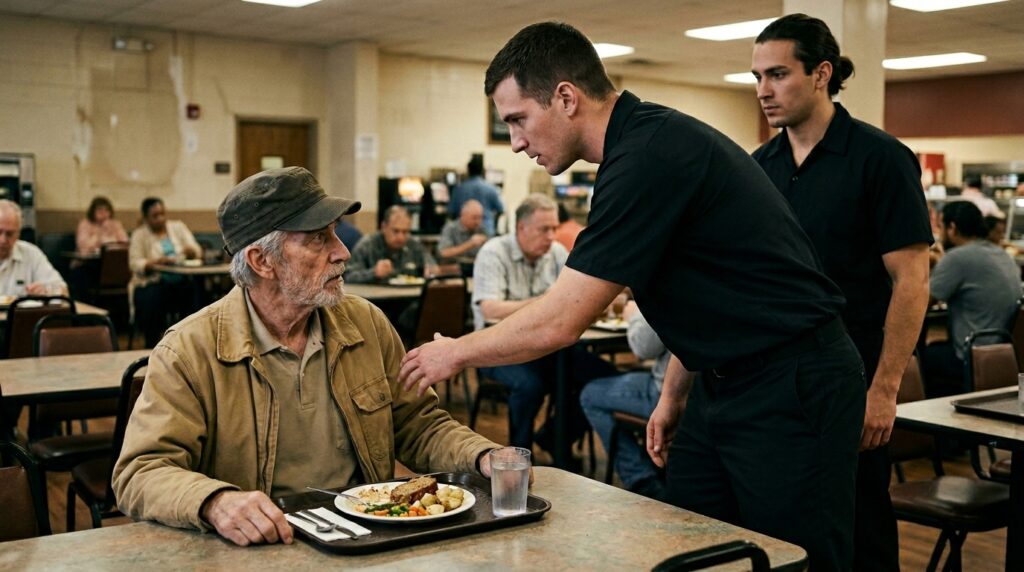
“He doesn’t want to file a complaint, Arthur. And I don’t want to haul you into a cell where some regional clerk starts running your prints through the integrated database,” Miller said, leaning down slightly so his breath fogged the glass. “But the people who lease the gravel pit—the ones who pay for my department’s cruisers—they’ve been looking for a specific name for a long time. They saw the security footage from the cafeteria. They liked the way you rotated your hips on that throw. Said it looked like a man who spent his youth in a federal coat.”
The decoy secret was bare now, sitting between them like a rusted engine block split open on the grass. The scuffle hadn’t been about small-town bullying or a dispute over community space. Miller’s family wasn’t just clearing him off the mountain for a gravel expansion; they were using the local ordinances to squeeze him, to force him into a corner where his real identity would be exposed to the entities funding the county’s backroom deals.
“You’re a long way from home, Sheriff,” Arthur said softly.
“We all are,” Miller replied. He slid the yellow paper through the crack in the window, the rough stock scraping against the glass. “Forty-eight hours. You either sign the quit-claim on the acreage and let the trucks roll through, or I send the full report—including the cafeteria tape—up to the state capital for verification. I don’t care who you used to be, old man. In this valley, you’re just a code violation that needs to be hauled to the dump.”
The Sheriff turned on his heel, his boots grinding into the gravel as he walked back toward the white sedan. He didn’t look back. He got in, slammed the door, and backed the car down the wash, leaving Arthur alone with the rhythmic thrum of his dying engine.
Arthur looked down at the yellow paper in his lap. The typed federal case code seemed to burn through the page. They thought they had him. They thought he was an old rat who would scurry the moment the light hit the nest. He squeezed his left hand into a fist, ignoring the hot scream of the torn skin. The sovereign protector of this small patch of dirt wasn’t going to run. But as he looked up at the gray, rusted horizon of the hills, he realized the ultimate truth remained dark—the people who had sent Miller weren’t just looking for an old witness. They were looking for something he had taken with him when he left.








