
Chapter 7: The Street Belonged to Everyone
One year after the water incident, the Halloween festival looked almost exactly the same.
But Karen didn’t.
She arrived early and helped place pumpkins along the pedestrian boundary.
She checked the signs.
She tested the radios.
She asked volunteers whether they understood their assignments.
Then she stepped back.
That was the difference.
She still cared intensely about safety.
She still noticed things other people missed.
But she no longer believed noticing a problem gave her permission to become the problem’s ruler.
Later that evening, Robert and Evelyn arrived.
Robert wore the same cowboy hat.
Evelyn carried the waterproof medication pouch Karen had given her.
Karen noticed it.
Evelyn smiled.
“Still works.”
Karen laughed.
“Good.”
They walked into the festival together.
Marcus watched from the information booth.
Helen stood nearby.
“You know,” Helen said, “a year ago I wasn’t sure Karen would ever come back.”
Marcus looked across the street.
“She didn’t come back as the same person.”
The festival grew crowded.
Children moved between decorated booths.
Older couples sat on benches watching them.
Teenagers took photographs beneath glowing skeletons.
Grandparents handed candy to grandchildren.
For a few hours, nobody seemed to care who had been right the year before.
Then a little boy dropped his candy bucket.
It spilled across the pavement.
Karen instinctively moved toward him.
She stopped herself.
The boy’s father was already bending down.
Karen smiled and stepped aside.
The father gathered the candy.
“Thank you,” he said.
Karen nodded.
“No problem.”
That tiny moment would have been invisible to almost everyone.
But Marcus saw it.
A year earlier, Karen would have rushed in, taken control, and explained what everyone else should have been doing.
Now she knew when help meant stepping forward—and when respect meant giving someone room.
Near the end of the evening, Marcus announced that the festival would be closing in ten minutes.
People began gathering coats and bags.
The street slowly emptied.
Karen stood beneath the same maple tree where she had watched the festival after being removed the previous year.
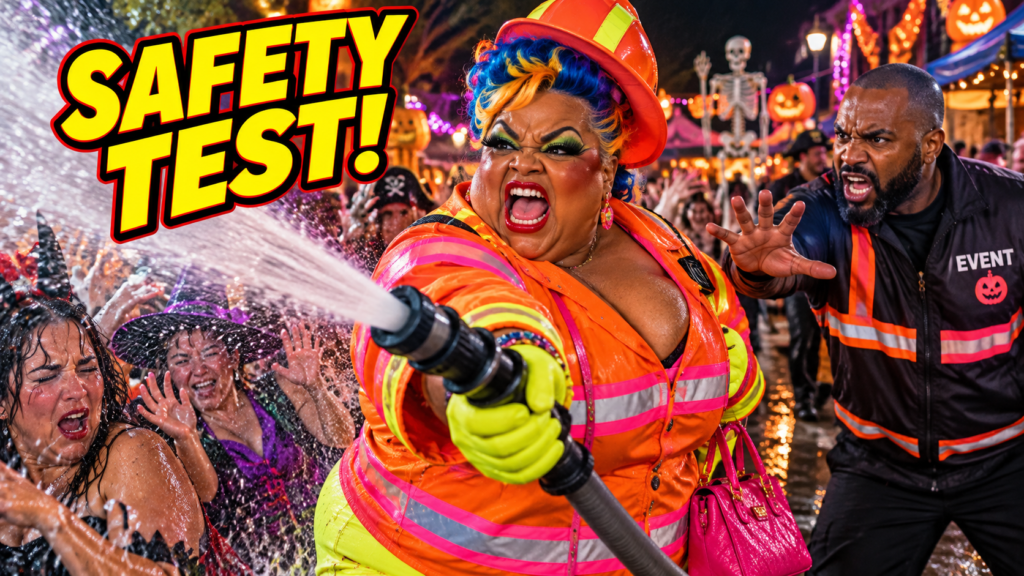
She remembered the hose.
The shouting.
The photographs.
The town meeting.
Evelyn’s medication pouch.
The little girl in the firefighter costume.
Then she reached into her handbag.
The old photograph was still there.
She looked at it once.
A woman in an absurd firefighter costume stared back at her, convinced that being right meant being in control.
Karen folded the photograph again.
But this time, she didn’t hide it.
She walked over to the community center and placed it in a small display of festival memories.
Not as a trophy.
Not as a joke.
As a reminder.
Underneath it, she wrote:
“The year I learned that protecting a community also means respecting it.”
Marcus read the note.
He didn’t say anything.
He simply nodded.
The next morning, the street would return to normal.
The pumpkins would come down.
The lights would be packed away.
The booths would disappear.
But something had changed that couldn’t be packed into a storage box.
Karen had learned that dignity did not come from having the loudest voice.
Marcus had learned that accountability could leave room for change.
Evelyn had kept her place in a tradition she loved.
And the neighborhood had gained something more valuable than a perfectly controlled Halloween.
It had learned how to make room for people who were imperfect, stubborn, embarrassed, and still capable of doing better.
The street belonged to everyone.
And for the first time, Karen understood that meant it did not belong to her.








