Chapter 1: The Safety Test
The first thing anyone heard was the violent hiss of water.
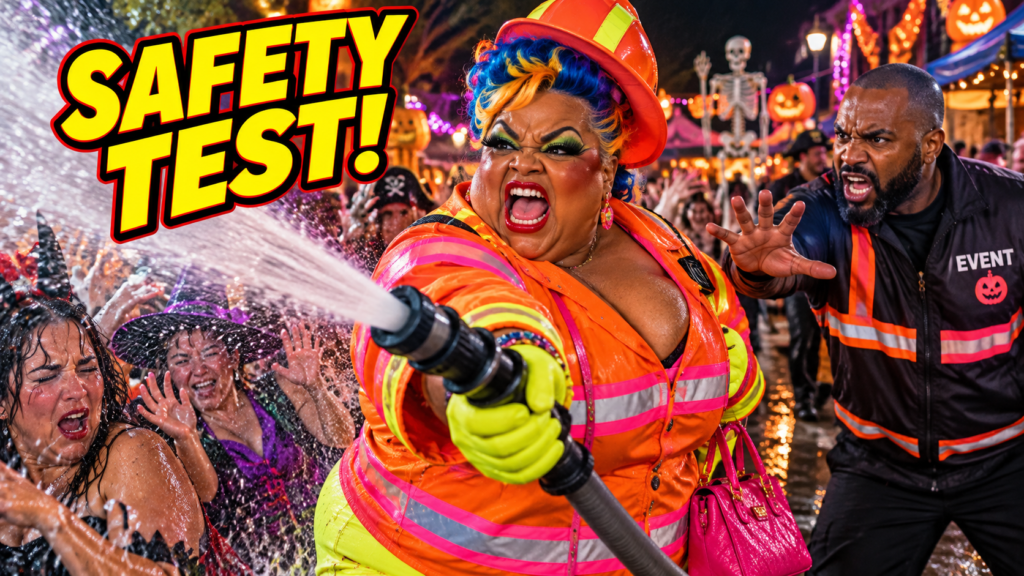
Karen’s neon-yellow gloved hands twisted the nozzle toward the adult section of the Halloween festival, and a broad sheet of water swept across the closed suburban street.
Adults jumped backward, clutching paper plates, candy bags, and costume accessories as water darkened their clothes. A man dressed as an old-fashioned cowboy threw one hand over his hat. A woman in a witch costume gasped as the brim of her hat collapsed against her forehead.
The children were nowhere near the spray. Volunteers had deliberately kept the family area several yards away, behind a line of pumpkins and orange cones.
Karen, however, seemed delighted.
She stood beneath an oversized orange firefighter helmet, wearing a ridiculous fluorescent costume covered in hot-pink and yellow reflective-style bands. Her enormous pink handbag hung from one shoulder as though she were arriving at a neighborhood luncheon rather than operating a theatrical Halloween hose.
“Nobody move!” she shouted. “I’m conducting a safety test!”
For half a second, the crowd seemed too stunned to understand what they had just heard.
Then Marcus Reed, the festival organizer, stepped forward from the dry side of the street.
“Turn that off!”
Karen swung her head toward him.
“I’m preventing an emergency!”
“You’re soaking people who came here to enjoy Halloween.”
Karen lifted her chin. “If they can’t handle a little water, they have no business standing in a crowd.”
Marcus stared at her.
The festival had a simple rule printed on signs throughout the event: NO WATER ACTIVITIES IN THE FESTIVAL AREA.
It was there because the neighborhood had older residents, families with young children, people using mobility devices, and dozens of volunteers moving equipment through the street.
Marcus pointed toward the sign.
“This isn’t a drill. You’re not a firefighter. And nobody authorized this.”
Karen finally lowered the spray.
But she didn’t release the hose.
Instead, she looked directly at the soaked adults and then at Marcus.
“If ten seconds of water exposes how unprepared everyone is,” she said, “why should I apologize for showing them the truth?”
A few people began recording on their phones.
Marcus asked a volunteer to take the hose from her.
Karen refused.
That was when something unexpected happened.
A volunteer named Helen Parker, a seventy-two-year-old retired school secretary, approached Marcus with a small plastic bag in her hand.
Inside it was the original printed safety plan for the festival.
Helen had helped prepare it.
And the document contained something Karen hadn’t mentioned.
The water restriction wasn’t merely a suggestion.
It was part of the event’s approved safety plan.
Marcus took the paper from Helen and read the highlighted section.
His expression changed.
Karen noticed.
“What?” she demanded.
Marcus folded the document carefully.
“You didn’t just ignore the festival rules,” he said. “You may have violated the conditions that allowed us to hold the event tonight.”
Karen’s smile disappeared.
For the first time, she looked uncertain.
But only for a moment.
Then she tightened her grip on the hose.
And Marcus realized the argument was no longer about a Halloween costume.
It was about what Karen was willing to do next.