
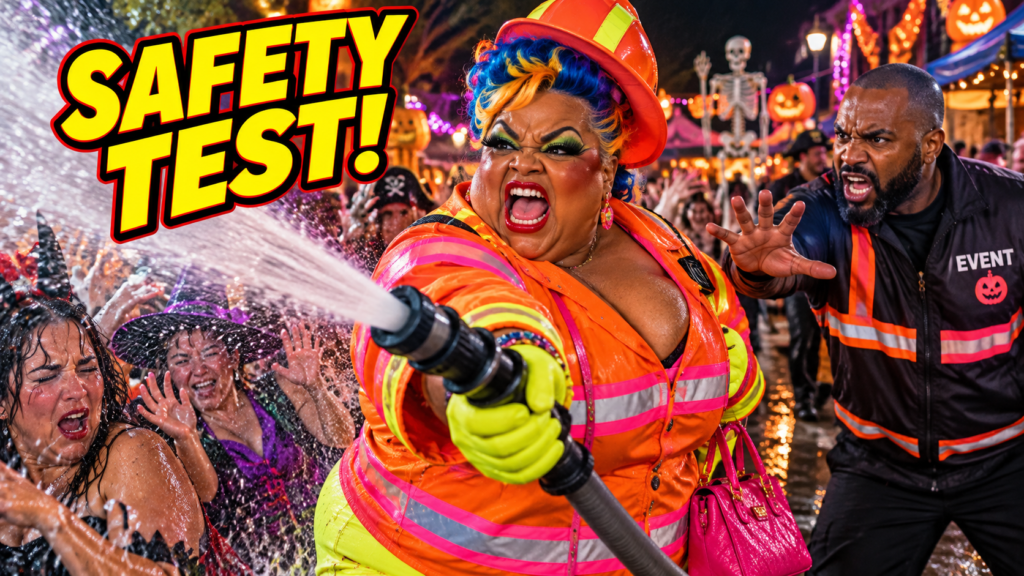
Chapter 2: The Complaint Nobody Expected
Karen did not leave quietly.
She was escorted beyond the festival boundary by two volunteers, but instead of going home, she remained across the street beneath a maple tree, still wearing her firefighter costume.
She watched.
That was almost worse.
The festival resumed cautiously. Volunteers helped dry benches and wipe down tables. Several adults laughed about the incident, but others were genuinely upset. One elderly couple left early because the woman’s medication pouch had become soaked inside her costume bag.
Marcus apologized personally to every affected vendor and attendee he could find.
The damage wasn’t catastrophic.
But it was personal.
For people in their sixties and seventies, Halloween was no longer simply about candy. It was about seeing neighbors. It was about preserving traditions. It was about having one evening when the street belonged to everyone.
And Karen had interrupted that.
By nine o’clock, Marcus believed the worst was over.
Then his phone rang.
It was the town events office.
Someone had filed a complaint claiming that the festival organizers had created an unsafe environment by allowing children and elderly residents to gather near an “active water hazard.”
Marcus knew immediately who had filed it.
Karen.
She had apparently photographed the wet pavement and several soaked adults from across the street.
Her complaint described the scene as evidence of “reckless festival management.”
Marcus sat down at the empty information table.
Helen Parker came over.
“She turned her own mess into a complaint against you,” Helen said quietly.
Marcus nodded.
“She isn’t finished.”
The next morning, the consequences became clearer.
The town events office requested the festival’s safety documentation, volunteer plan, insurance information, and incident report.
The festival wasn’t canceled, but its organizers were required to answer questions.
Marcus spent most of the morning reconstructing what had happened.
He had photographs of the signs.
He had the original safety plan.
He had witness statements.
But there was one problem.
The person who had controlled the hose was Karen.
And the festival’s own security camera had been pointed toward the entrance, not the adult activity area.
They needed proof of what actually happened.
Then Helen remembered something.
“Marcus,” she said, “I saw a camera at the pumpkin booth.”
The booth belonged to a local hardware store that had donated decorations.
The camera was privately owned.
If it had recorded the street, it might show exactly how Karen had obtained the hose, where she had stood, and whether the children had ever been anywhere near the spray.
Marcus called the store owner.
The owner checked the system.
There was footage.
But he hadn’t watched it yet.
And when Marcus arrived at the store, the owner told him something that made his stomach tighten.
“The camera recorded the whole thing,” he said.
Then he paused.
“There’s something else on it.”








