CHAPTER 4: THE CONTAINMENT ZONE
The sirens didn’t build; they arrived in a singular, physical wall of noise. Two black-and-white cruisers surged around the corner of the cul-de-sac, their light bars strobing with a relentless, rhythmic intensity that turned the morning mist into a sickening dance of blue and white. David stood his ground, but his pulse spiked, a sharp, cold jab of adrenaline hitting the center of his chest. He saw the cruiser tires bite into the asphalt, the rubber screaming as the drivers threw them into a tactical maneuver that blocked the street entirely.
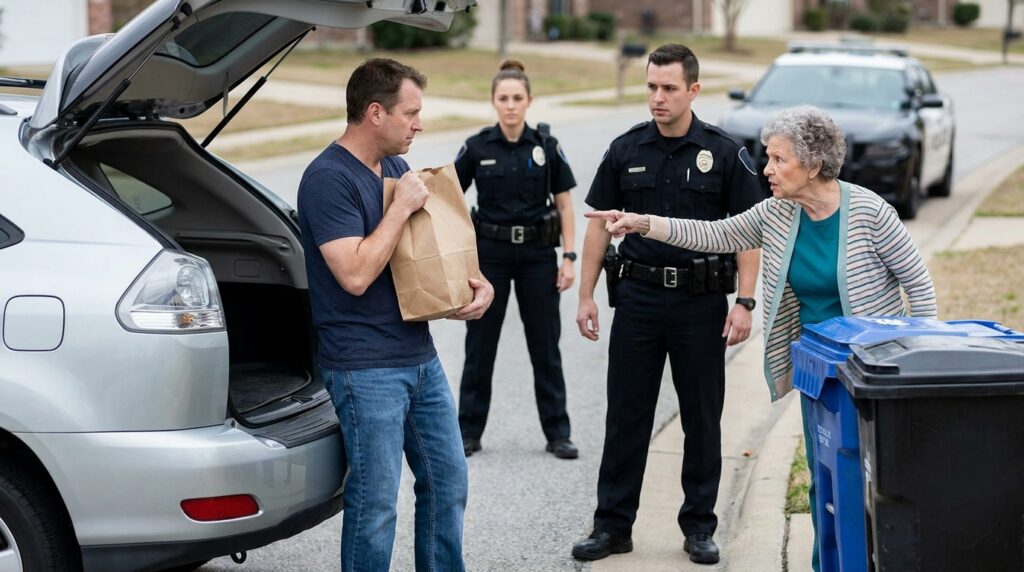
Evelyn was no longer just standing; she was vibrating. Her posture had shifted from the static threat of a neighbor to the performative agitation of a witness. She was already pointing at him as the driver’s side door of the lead unit opened.
The primary officer stepped out. He was built like a piston, his uniform pressed into sharp, unforgiving lines that seemed to absorb the strobing light. He didn’t move toward Evelyn. He didn’t look at the trash bins. He looked at David, his gaze scanning the area with a clinical, tactical detachment. Behind him, the second officer, a younger woman with her hair pulled back into a severe knot, had already positioned herself in the gap between the SUV and the trash containers, effectively severing the line of communication between David and the street.
“Turn off the engine, sir,” the primary officer commanded. His voice was a calm, low-frequency rumble that cut effortlessly through the fading siren wail.
David hadn’t even started the car, but he didn’t argue. He held his hands out, palms open and visible, the brown paper bag still clutched in his left forearm. “Engine is off, Officer. I’m just packing for a departure.”
Evelyn darted forward, her voice rising to a frantic, thin-pitched shriek. “He’s been unloading hazardous materials since four in the morning! I’ve told the board, I’ve told the city—he’s compromising the easement. He’s got unlabeled industrial chemicals in that bag, Officer, look at the way he’s holding it! He’s trying to hide it.”
The officer’s head snapped toward Evelyn, his expression a mask of professional, practiced indifference. He held up a single, gloved palm, silencing her mid-sentence. “Ma’am, step back behind the blue bin. Now.”
She recoiled as if struck, her mouth opening and closing in a jagged, surprised rhythm. She didn’t retreat, though. She pivoted, locking her eyes on David with a triumphant, malicious intensity, her lips thinning into a line of victory. She believed she had him. She believed the notarized paper in his back pocket was about to become his death warrant.
The officer turned his focus back to David, his eyes dropping to the brown paper bag. “Sir, I need you to step away from the hatch. Leave the bag on the rear bumper. Put your hands behind your head.”
David felt the friction of the world narrowing down to this single, metallic moment. The asphalt beneath his boots felt uneven, treacherous. He looked at the officer’s utility belt—the matte-black finish of the equipment, the rigid, organized pouches—and realized the utter absurdity of his position. He was a man with nothing more than schematics and personal items, yet here he was, treated like a tactical threat because an elderly woman with a 1984 permit and a grudge had mastered the art of bureaucratic weaponization.
He eased the bag down onto the cold, dented silver surface of the bumper. The paper crinkled loudly, a sound that seemed to echo against the suburban siding of the neighboring houses. As David stepped back, his boots crunching on the loose grit of the street, the officer approached the hatch. He didn’t reach for his sidearm, but his hand moved to the heavy flashlight at his hip, his stance wide and defensive.
“Don’t move, sir,” the officer said, his voice dropping into the cold, transactional register of a man who dealt in facts.
The second officer began moving toward Evelyn, her hand gesturing for her to withdraw further. “Ma’am, you’re interfering with a live scene. Move back toward the driveway.”
Evelyn’s face went splotchy with red, the color crawling up her neck in a blotched, uneven tide. “Look in the bag! He has no business being here! Check the deed, check the county registry—that property is mine to supervise!”
The primary officer ignored her. He reached out with a single, gloved hand and gripped the top of the brown paper bag. He flipped the opening wide. David watched the officer’s eyes track downward, his brow furrowing as he peered into the dark cavity of the bag. The suspense in the air was a physical weight, thick enough to make David’s throat ache.
The officer pulled out a thick, plastic-wrapped bundle of blueprints. He tilted his head, pulling one out and letting the light catch the technical schematics. He paused. A long, agonizing beat of silence followed, during which the only sound was the distant ticking of the cruisers’ cooling engines.
The officer didn’t look at David. He looked at Evelyn. The expression on his face didn’t soften; it hardened, the professional mask peeling away to reveal a deep, simmering frustration.
“Officer,” David said, his voice steadying, “I am a professional contractor. Those are project schematics. That bag contains my lunch and my transit files.”
The officer turned to his partner. He didn’t need to speak. The second officer had already stopped guiding Evelyn; she was now standing directly in front of the neighbor, her body language shifting from mediator to enforcer. The power dynamic in the cul-de-sac didn’t just shift—it inverted. The officer looked at the brass survey disc near his own feet, then back at Evelyn, who had suddenly gone very still.
“Ma’am,” the officer said, the word dripping with sudden, sharp authority. “I’m looking at a public street. I’m looking at a man loading blueprints into his car. And I’m looking at a dispatch log that says you reported an active hazmat threat.”
He tossed the bundle of blueprints back into the bag and set it on the bumper with a heavy, final thud. The silence that followed was total, and for the first time, David saw the neighborhood for what it was: a cage, and the bars were finally starting to bend.