CHAPTER 3: THE DECOY ENVELOPE
The rusted hinge of the black iron mailbox gave a thin, metallic squeal as David pulled it open. He had four minutes before the digital ticket Evelyn submitted would likely populate on a dispatcher’s screen, but his hand moved by instinct toward the heavy steel post at the edge of his grass line. Inside the dark cavity lay a single, oversized cream envelope. It hadn’t been processed by the United States Postal Service; there was no stamp, no cancellation mark, only his address printed in rigid, typewriter-style courier font across the face.
He slipped his thumb under the unsealed top flap. The paper was heavy, a high-rag bond with a distinct, textured grain that felt cold against his skin. When he pulled the document out, the top of the page bore a bold, embossed seal from the County Registrar of Deeds, dated October 14, 1984. It was a notarized property easement survey. A bright red ink stamp across the lower quadrant declared it a Permanent Right-of-Way Restriction for Municipal Access and Adjacent Visual Preservation.
According to the clean, hand-drawn lines of the plat map attached to the back, the very curb strip where his silver SUV was currently idling did not belong to his parcel’s public buffer. It was marked in dense, cross-hatched ink as an exclusive access corridor tied directly to the deed of the property next door. Evelyn’s property.
David’s chest tightened slightly, his eyes tracking the geometric coordinates laid out in the legal text. If this document was valid, his vehicle wasn’t just violating a friendly neighborhood understanding—it was legally trespassing on a non-public utility easement managed by his neighbor. The strategic advantage he thought he held under the standard city parking handbook vanished beneath the weight of a forty-two-year-old notarized covenant.
“I told you I had the papers, David.”
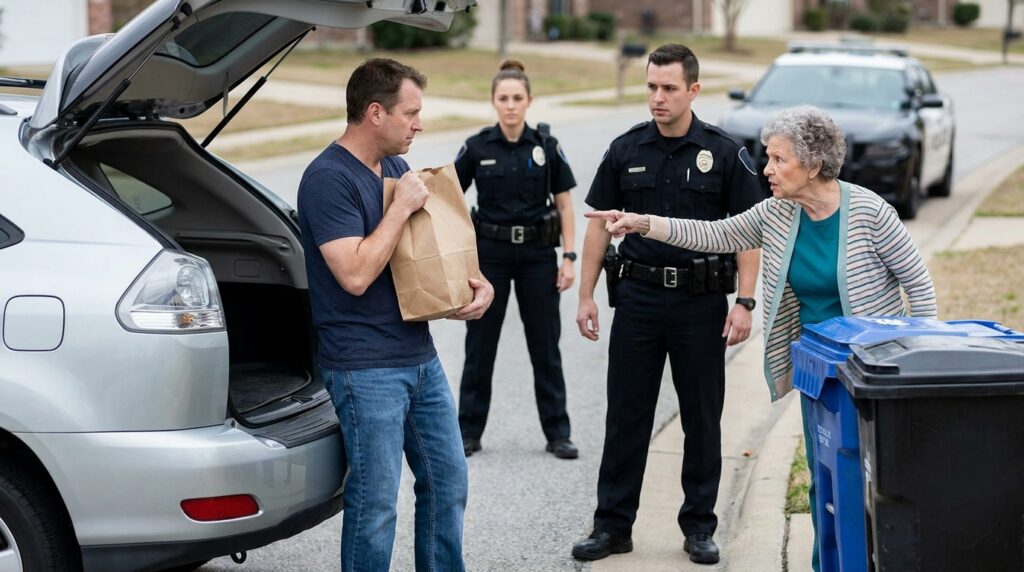
Evelyn’s voice cut through the damp morning air from ten feet away. She hadn’t moved from her position by the blue recycling bin, her small frame still pulled taut, her phone held down at her side but her finger resting firmly against the glass perimeter. She was watching him read, her chin tilted upward, her oversized sunglasses reflecting the pale white light of the rising sun. There was no hesitation in her posture now; she stood with the rigid certainty of someone who had spent decades waiting for the right moment to deploy an absolute boundary.
“You think because you bought that house from a corporate flipper three years ago that the history just disappears?” she continued, her tone dropping into a dry, mocking rhythm. “That corridor was legally assigned before your foundation was poured. The city doesn’t change its lines just because you have a heavy load to carry.”
David did not look up from the high-rag paper. He focused on the signature block at the bottom—a faded blue ink signature from a registrar named Marcus Vance, sealed with a physical, raised gold-foil wafer that felt completely authentic under his fingertip. The document looked ironclad. It was exactly the kind of physical evidence that would make a responding municipal worker or code enforcement officer side with her instantly, minimizing his defense to a simple misunderstanding of modern boundaries.
Yet, as he turned the page to check the legal description of the coordinates, his thumb brushed the very bottom edge of the backing sheet. There was a tiny, clean rectangular line where a secondary attachment had once been stapled, but the wire teeth were gone, leaving only two microscopic, rusted holes in the cream fiber. Something had been separated from the main file.
He folded the document back into its exact creases, slipping it into his rear pocket. He had to keep his posture neutral, hiding the sudden calculation running through his mind. Evelyn was watching his hands, looking for the telltale drop in his shoulders that signaled surrender. He refused to give it to her.
“The registration is old, Evelyn,” he said, keeping his voice flat, his forearms resetting against his chest as he stepped back toward the bumper of his car. “Old papers don’t always hold the current right-of-way.”
“They hold when they’re notarized, sir,” she replied, her thumb tapping the phone screen once, a sharp, electronic chime signaling the completion of an online report. “And the city truck is already on its morning loop. We’ll see what the officer says when he reads the county seal.”
The distant, low rumble of a heavy engine turned the corner at the end of the block. It wasn’t the garbage truck. The sound was too smooth, accompanied by the distinct, high-frequency hum of a modern alternator and the faint, rhythmic click of a service belt. David turned his head toward the entrance of the cul-de-sac. Two vehicles were approaching through the gray morning mist, their roof-mounted light bars dark but their black-and-white silhouettes unmistakable against the uniform green of the suburban lawns.