
CHAPTER 1: THE TORN EDGE
The thick, yellow adhesive of the sticky note did not want to peel cleanly from the windshield glass. It tore across the center, leaving a jagged scar of white paper that detailed a single, typed warning: Move it, or the city will.
David stood in the damp dawn air, his thumb scraping against the residue until the gray skin of his fingernail went white. The street was dead, silent save for the low, rhythmic thrum of a distant highway and the sharp click-clack of a plastic lawn sprinkler three houses down. He did not look toward the dark windows of the house next door. He did not have to. He knew the precise angle of the blinds in the front parlor, the three-inch gap where the plastic slats dipped under the weight of an old woman’s hand.
He folded the remaining scrap of yellow paper into his pocket, his movements deliberate, almost clinical. This was the fourth note in six days. Each one arrived between four and five in the morning, always left without a signature, always placed with the exact same geometric precision against the lower black border of his wiper blade. It was a calculated intimidation tactic, a minor structural pressure designed to wear down his patience until he surrendered the twenty feet of public asphalt bordering the curb.
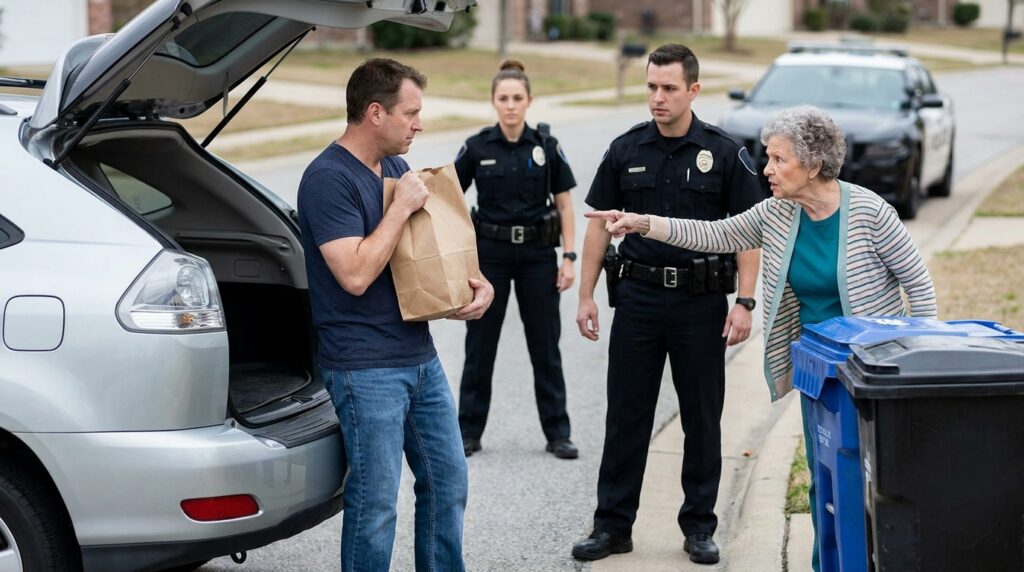
Turning on his heel, he looked down at the physical line of defense. Two massive municipal waste containers—one bright blue for recycling, one midnight black for trash—sat side by side on the street. They weren’t just out for collection; they were parked three feet deep into the roadway, spaced precisely far enough apart to ensure no vehicle could parallel park between them without touching their scuffed plastic hulls. It was a masterclass in petty territorial sovereignty.
David checked his watch. 06:12. The work trip required him to be on the interstate by seven, his trunk loaded with the heavy, unprinted schematics currently sitting on his kitchen island. He had two choices: park forty yards down the hill and carry the cargo through the morning dew, or breach the perimeter.
He pulled his car keys from his jeans pocket. The remote unlock triggered a sharp, double-chirp from his silver SUV that cut through the neighborhood silence like a scalpel. He climbed into the driver’s seat, the cold vinyl stiff against his back. He didn’t pump the gas. He shifted straight into reverse, his eyes locked on the rearview mirror as the vehicle crept backward toward the gap.
The rear bumper came within six inches of the black bin. Through the glass, he watched the plastic container shudder slightly as the displacement of air hit it. He killed the engine. The silence returned, heavier now, pregnant with the immediate consequence of his placement. He had not broken a single city ordinance, but as he stepped out of the cabin and opened the rear hatch, the front door of the neighboring house clicked open.
The cold iron of the SUV’s cargo latch felt heavy in his palm. He stood his ground by the open bumper, his chest rising evenly as the shadow of a striped cardigan moved down the concrete driveway toward his space.








