
CHAPTER 2: THE CURTAIN LINE
“You think because you have a legal registration on that windshield, the road belongs to you, David?”
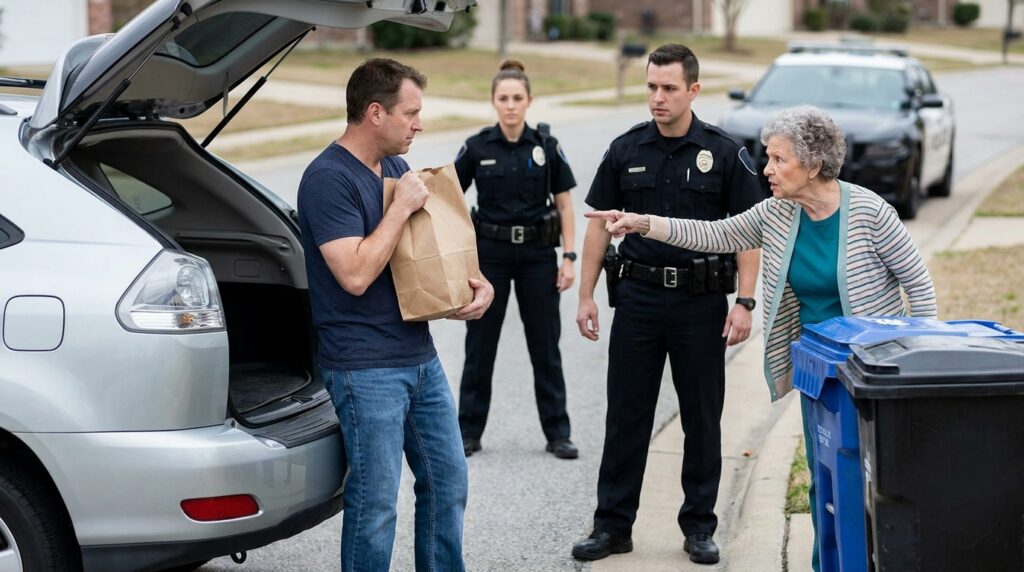
The voice was thin, reedy, but carried the sharp, practiced carrying power of someone who spent forty years projecting over committee meetings. Evelyn stood at the edge of her driveway, her small frame rigid beneath a striped knit cardigan that flapped slightly in the exhaust of a passing delivery truck two streets over. Her oversized sunglasses were pushed back into her short, curly gray hair like a plastic crown, catching the flat, white glint of the early morning sun.
David didn’t stop sliding the heavy nylon straps of his travel pack over his shoulders. He adjusted the weight, feeling the rigid plastic edge of the internal frame press against his spine through his navy t-shirt. He kept his eyes on the rear cargo floor of the silver SUV, checking the alignment of the cardboard boxes containing the schematics.
“Good morning, Evelyn,” he said. His voice remained level, a flat, uninflected baseline designed to give her no conversational leverage. “The street is clear. The vehicle is legally parked.”
“Legally is a word people use when they don’t have respect,” she snapped, stepping down from the concrete apron onto the raw asphalt of the gutter. Her white orthotic sneakers made a soft, gritty crunch against the accumulation of old sycamore seeds. She pointed a single, liver-spotted index finger toward the rear bumper of his SUV, her hand shaking with either age or a deeply nurtured anger. “Those bins are set according to the district management layout. You’re blocking the collection path. You’re creating a hazard for the municipal trucks.”
David took a slow breath through his nose, the scent of cold morning dew mixed with the faint, metallic tang of his car’s catalytic converter filling his chest. He looked down at the physical space between his bumper and her blue recycling container. There were six inches of clear daylight. The city code required three. He knew the handbook text by heart; he had downloaded the PDF three months ago after the first tire-valve cap went missing.
“The bins have eighteen inches of clearance on either side from the driveway line,” David replied, his internal clock ticking toward 06:18. Every second spent on the asphalt was a variable he hadn’t budgeted for. He reached for the handle of the silver hatch, his fingers wrapping around the cold, textured plastic. “The truck has automated arms that extend five feet. They won’t touch the bumper.”
“I have the plat maps, David. I know where the easement transitions.” Evelyn took another step forward, her chest rising under the teal fabric of her blouse. She pulled a small, black smartphone from her cardigan pocket with her left hand, her thumb hovering over the screen with a practiced, muscle-memory familiarity. Her right hand remained extended, a rigid indicator pointing toward the ground near his rear tire. “You think you’re the first person to try and squeeze an oversized utility vehicle into this turn? The city gave this block a specific allocation for clearance in eighty-four. I have the notarized seals.”
David shifted his weight. His left foot was planted near the curb, right on top of a weathered, circular brass disc stamped into the concrete—a surveyor’s marker he’d noticed three days ago while weeding the property edge. The brass was green with oxidation, its edges chipped by decades of edgers and lawnmowers, but the center bore a series of stamped numbers that didn’t match the modern county records he’d checked online.
He looked at Evelyn’s phone. The screen wasn’t dark. It was glowing with the green-and-white user interface of the local non-emergency dispatch application. She wasn’t just threatening; her thumb was already pressing the digital submission field.
“I’m loading for a commercial delivery, Evelyn,” he said, keeping his forearms flat against his chest as he reached into the rear seat to pull a final, heavy brown paper bag toward his torso. The thick paper crinkled sharply, the sound loud in the enclosed space of the cul-de-sac. “I will be gone in four minutes.”
“You won’t be gone anywhere until the supervisor looks at what you’re putting in that cabin,” she whispered, her voice dropping into a rhythmic, rhythmic hiss as she held the phone up between them like a shield. “I saw the markings on those crates last night. Unlabeled commercial freight in a residential zoning district. I’ve already sent the digital attachment to the code compliance desk.”
David closed his fingers tightly around the top of the paper bag, the raw edge of the cardboard folders inside digging into his palms through the paper. He didn’t blink. He watched the reflection of the gray suburban sky in her oversized lenses, calculating the time it would take for a low-priority traffic car to clear the precinct station three miles east.
Behind Evelyn’s shoulder, the white lace curtains of the corner house twitched. Another pair of eyes. The neighborhood was waking up, its silent, invisible machinery turning its focus toward the twenty feet of gray asphalt where the two of them stood locked in position.








