
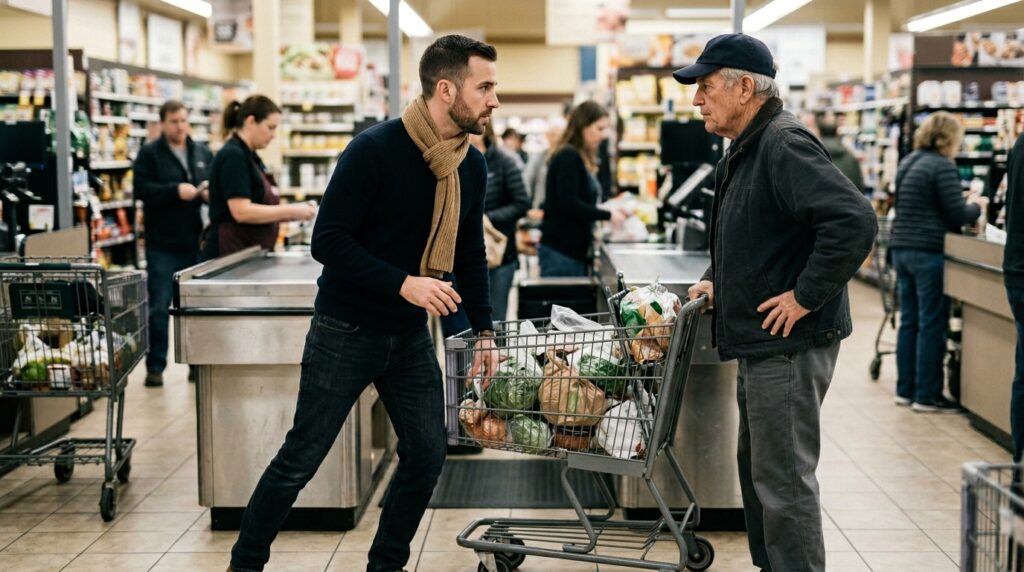
CHAPTER 5: THE SHATTERED SILENCE
“Don’t look at it like it’s a ghost,” Arthur said. His voice was barely a whisper, a dry rasp that sounded like coarse sandpaper sliding over cedar. He didn’t lift his fingers from the shopping cart handle, though the chrome felt ice-cold against his splitting skin. “It’s just paper. It goes in the trash when the week’s done.”
Brandon didn’t look up at Arthur’s face right away. His gaze remained pinned to the black conveyor belt, tracking the single drop of rainwater that slid off his own tan scarf and landed with a tiny tap directly onto the bold purple stamp of the county oncology annex. The moisture began to blur the outer edge of the cross, the ink bleeding into the cheap, high-acid paper fibers until the clean margins looked like an old bruise.
“Uncle Arthur,” Brandon said. The name came out fractured, a low rattle behind his teeth that didn’t match the crisp efficiency of his leather shoes or his stainless-steel watch. He pulled his hand out of the wire lattice of the grocery basket, but his fingers remained curled, hovering in the open air like five dead matches. “You… we thought you were still out west. Dad said you didn’t leave the ranch after the probate closed.”
“Your father says a lot of things to clear his conscience,” Arthur said. He adjusted his stance, his worn boot heel squeaking against a patch of dried salt on the floorboards. The white-hot line of fire in his left thigh had gone numb, replaced by a heavy, leaden cold that made his knee feel like it belonged to someone else’s skeleton. He didn’t allow his weight to drop into a slump. He kept his shoulders squared against the narrow passage, his chest anchoring the lane. “He tells them to you so you can run his errands without looking behind you.”
A sudden, sharp chime shattered the quiet—not the mechanical chirp of the cash register, but the high, urgent vibration of Brandon’s phone held loose in his left hand. The screen lit up against the dull gray background of the tabloid racks, casting a cold blue flare across his face.
Arthur’s eyes shifted down to the glass. A black text banner was pinned across the lockscreen, the preview text readable under the bright ceiling tubes: ICU ADMISSION NOTICE: HOLLIS VANCE. STABLE BUT FAILING. CONTACT ARRIVAL IMMEDIATELY.
The younger man didn’t grab the phone to answer it. He looked at the message, then back at the torn sheet on the belt, his jaw working silently as if he were trying to compile two completely separate languages into a single sentence. The frantic, cutting urgency that had driven him into the narrow gap three minutes ago was suddenly naked; it wasn’t the rush of a man trying to catch a corporate train, but the blind, desperate panic of a son racing toward a room where the machines were slowing down. The shared burden was right there on the black belt—one man leaving the ward, another man fighting to reach it before the doors closed for good.
Behind them, the cashier let out a soft, shaky breath, her knuckles white around the container of half-and-half she’d been holding mid-air since the confrontation peaked. She reached down, her silver rings clinking against the plastic edge, and gently pushed Arthur’s items an inch down the belt, clearing a small space around the discharge papers without touching the ink. The other shoppers in the active queue didn’t move. They stood like fence posts in a winter field, their heads lowered but their ears tuned to every breath passing between the two men.
“I have to get to the county annex,” Brandon whispered. He didn’t demand the ground anymore. He looked at the loaded grocery cart, then at Arthur’s steady, unblinking eyes under the navy cap. The modern, sharp edges of his posture had vanished; his shoulders were hunched forward, his coat hanging loose from his frame like a wet sack. “They called from the second floor twenty minutes ago. I can’t… I can’t wait behind thirty people, Arthur. He’s not going to make the night.”
Arthur looked at the young man’s trembling fingers. He saw the family trait—the narrow nail beds, the slight crook in the index joint—the exact markers his brother Hollis had carried when they were thirty years younger, sorting fence wire in the dry dust before the lawyers came between them. The anger in Arthur’s chest didn’t flare; it settled into a cold, flat stone, heavy and durable.
“Hollis always was a poor hand with a clock,” Arthur said softly. He didn’t take his left hand off the cart handle, but he shifted his forearm, his elbow clearing the six inches of passage space Brandon had tried to steal. “He never could figure out how much time a mile took.”
He looked back toward the cashier, his voice rising just enough to reach the register. “Put the milk and the bread on my tab. The boy is in the wrong lane, but he’s on the right road.”
The younger man didn’t move forward into the clearance. He stayed pinned by the sheer weight of the room’s silence, his eyes fixed on the old man’s weathered profile as the real context of the bottleneck finally settled into the floor. The decoy secret of Arthur’s stubbornness was gone, broken by the white paper on the belt, but the deeper reality—the dying brother on the second floor and the old man who had just spent three hours in the same concrete building without telling a soul—stayed strictly locked, an unexploded shell buried three feet beneath the linoleum.








