
CHAPTER 4: THE ANCHOR ANATOMY
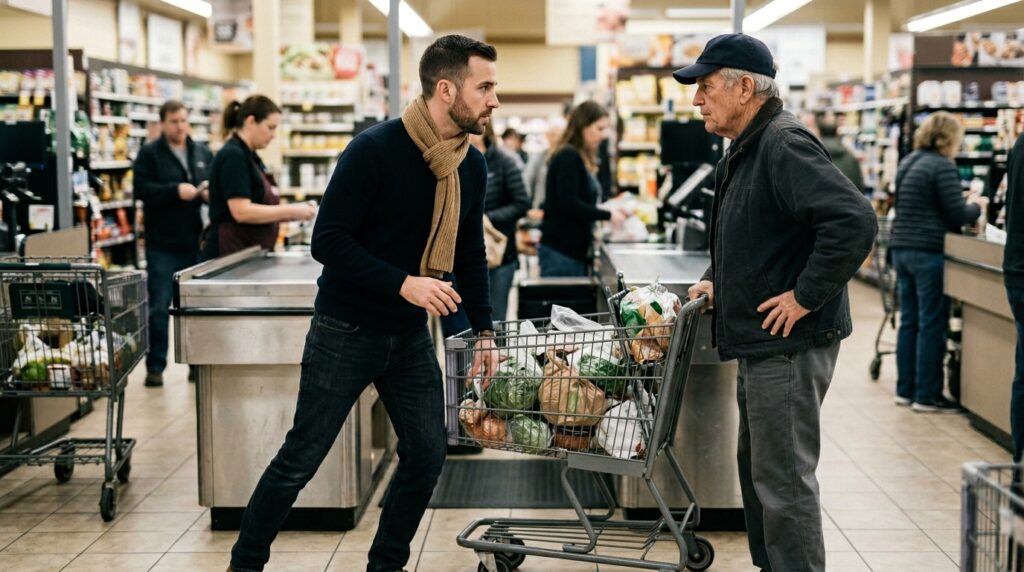
The front wheels of the grocery cart buckled sideways with a dry, metallic rattle as Brandon plunged his forearm against the upper chrome rim. He didn’t use his open palm; he used the flat of his bone, forcing his weight into the metal with the raw, clumsy momentum of someone whose mind has already left his limbs. The impact traveled up through the cart’s frame, vibrating through the heavy glass milk bottles and jars of pinto beans before striking Arthur flat in the center of his palms.
Arthur did not lean back. He took the shock through his elbows, his shoulder blades pinning against his spine with the dry, deliberate crack of an old latch-lock. Under his boots, the damp linoleum slicked with oil and tracked-in stormwater offered no traction, but his hips stayed fixed, his core drop-locked into the lane. The physical strain sent a hot, white line of fire straight down his left thigh, right where the surgical scar from his winter treatment remained tight and angry under his trousers. His breath came shallow, carrying the sour smell of cold hospital corridors and the metallic tang of the noon medication that was still wearing off.
“I said,” Brandon rasped, his face so close Arthur could see the tiny white flecks of dried salt on his lips, “get out of my way.”
He shifted his upper torso, his leather briefcase swinging out like a pendulum, striking the tabloid rack with a loud, hollow slap that sent several weekly papers sliding down onto the floor. Brandon didn’t look down at them. His fingers hooked into the steel lattice of the cart basket, his nails clawing for leverage to pull the barricade out of the bottleneck. In his frantic heave, his elbow caught the top of Arthur’s dark jacket pocket.
The thick, coarse corner of the hospital sheet tore.
The white slip didn’t just slide; it burst outward under the pressure of Brandon’s sleeve, the crisp paper unfolding along its crisp lines until it fluttered down against the conveyor belt, landing face-up right between a box of generic crackers and a jar of apple butter. The purple clinic emblem—the sharp, unmistakable cross of the county oncology annex—sat exposed under the unshielded glare of the ceiling tube. Below the stamp, the bold, typed lines of the discharge summary were instantly legible: Patient Arthur Vance. Outpatient Session 4. Restricted physical exertion for 72 hours.
Brandon’s fingers stayed frozen in the wire grid. His breath hitched, his chest remaining uncomfortably close to Arthur’s shoulder, but the forward drive vanished from his shoulders like air escaping a punctured tire. His eyes dropped to the paper on the black rubber belt, tracking the name printed in fading gray ink. He blinked once, twice, his head twisting slightly to the side as if trying to clear a thick fog from his vision.
“Arthur…?” Brandon whispered. The tone was completely different now—scraped of the corporate edge, thin, child-like, and hollow. He didn’t pull his hand back from the basket, but his grip went entirely limp.
Behind them, the cashier stopped mid-motion, an un-scanned bag of frozen corn clutched in her right hand as she stared at the paper on her belt. The silence in Lane Four grew so dense that the low, wet thud of a car door closing in the parking lot outside sounded like an explosion through the plate glass window. Nobody spoke. The row of bystanders in the next lane turned their heads slowly, their eyes locking onto the small, white document that had just redrawn the boundaries of the room.
Arthur kept his hands flat on the chrome handle, his knuckles burning from the strain of the block. He looked at the younger man’s profile, tracking the sharp, defensive set of the jaw that looked so much like his brother’s—the same brother who had stopped calling fifteen years ago after the farm probate collapsed. The family line was right there, written in the shape of the nose and the nervous twitch of the left eyelid, but it was buried under ten layers of expensive wool and thirty years of accumulated distance.
“The name is on the ticket,” Arthur said, his voice dropping into a deeper, gravel-rough crawl. “But the spot belongs to the line.”
He reached out with one stiff finger, his thumb pressing down on the edge of the torn paper to slide it back toward his pocket. His hand was shaking—a fine, involuntary tremor that he couldn’t suppress no matter how hard he locked his wrist. The physical failure was total now; his knees were beginning to give, the weight of the three-hour treatment finally dropping through his legs like lead weights. But he didn’t pull his boots from the floorboards. He stood in the narrow gap, his navy cap tilted forward, a solitary old man holding an inch of ground against a ghost who didn’t even know his own blood.








