CHAPTER 6: THE DISPATCH CORRECTION
The metal clip of Officer Miller’s citation book clicked shut against the carbon backing with a sharp, heavy report that caused Brenda to jump back an inch, her sandals skidding in her own loose gravel. The sound hung in the thick, dry air between the two houses, a clean, administrative finality overriding twenty years of neighborhood intimidation.
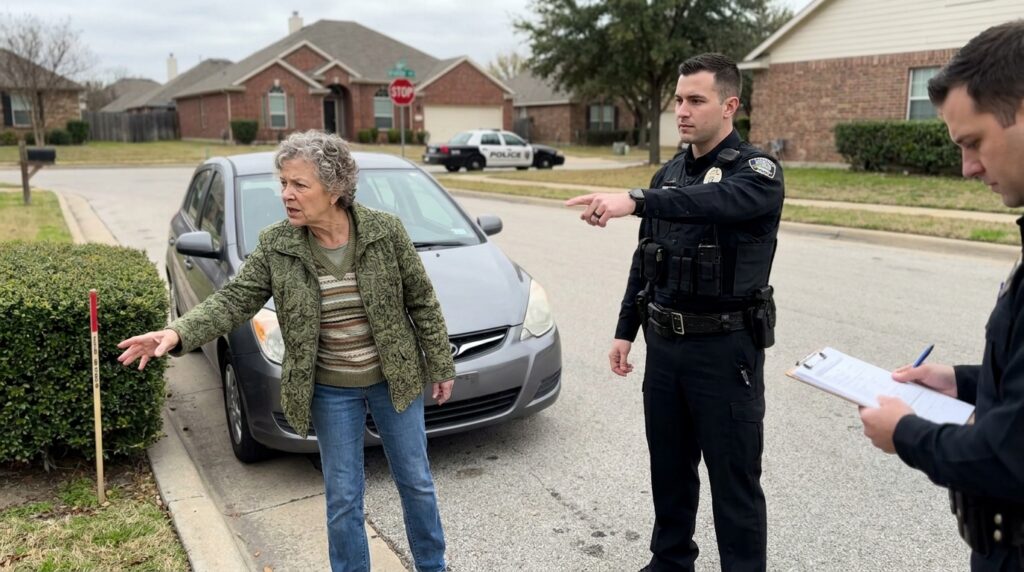
Miller stepped closer to the property boundary, his polished uniform boot hovering directly over the trench line, inches from the orange, rusted surveyor’s stake.
“Sign the lower copy, ma’am,” Miller said, his voice flat, completely devoid of any conversational heat as he thrust the black ballpoint pen toward Brenda’s chest. “It’s a formal summons. Municipal code violation for filing a fraudulent emergency services report to facilitate a civil property dispute.”
Brenda did not reach for the pen. Her heavy frame shook beneath the synthetic floral pattern of her blouse, her clipboard held loosely against her hip like a broken shield. She looked past the officer’s shoulder toward the street corner, where the blue exhaust from the departed private tow truck was slowly dissipating into the oak trees. Her voice came out thin, a high-pitched scratch that completely lacked the rhythmic cadence of the Whispering Pines rulebook. “This is a procedural error. The board president will have the county registry updated by tomorrow morning. You don’t understand how the subdivision density laws work, Officer.”
“The town map dictates the boundary, Brenda, not your clipboard,” Evelyn said softly.
She took her hand completely off the hot chrome roof of her gray sedan, her knuckles dry and powdered with the gray aggregate dust of the curb lane. She didn’t raise her voice, and she didn’t look at the neighbor who was now standing on his middle porch step down the block, watching the neighborhood enforcer crumble under the midday glare. Evelyn stood planted in her mud-stained garden clogs, her body balanced on the very edge of the public asphalt. “And according to the county charts, your board president doesn’t have a jurisdiction to update.”
Brenda’s sunglasses slipped down the bridge of her nose, her eyes scanning the rolled linen map tucked beneath the zoning inspector’s charcoal-gray arm. Her mouth twisted into a tight, desperate line. “The developer filed the master articles in ninety-eight. We have an enforceable corporation. Every deed on this street has a mandatory covenant attached to it.”
The zoning inspector, who had already reached the passenger side of the cruiser, stopped with his hand flat on the door frame. He turned back slowly, his heavy iron reading glasses resting against his chest pocket as he adjusted his grip on the faded 1954 linen cylinder. “The developer filed an intent to incorporate, ma’am,” the inspector said, his voice carrying the dead, dry weight of a records vault. “But the 1954 original charter has an active reservation clause at the foot of the ledger. The county nullified the land acquisition six months before the primary foundations were poured because the developer defaulted on the municipal utility bond. The red cancellation stamps on this document are unratified, which means the state never legally transferred these parcels out of the public domain.”
The dead quiet returned to the cul-de-sac, heavy and suffocating.
Evelyn watched the realization hit Brenda’s face—not just the shock of a single lost argument at the driveway line, but the total, systemic collapse of the artificial authority she had spent half her life maintaining. The Whispering Pines Homeowners Association wasn’t just overreaching; it didn’t legally exist. The thousands of dollars in cumulative fines, the daily citations for trash bins and lawn heights, the late-night safety committee votes—they were all nothing but hot air and expensive stationery printed by a private club that had no more right to dictate the use of the asphalt than a stranger passing through.
“Sign the line, Brenda,” Miller repeated, his hand steady as he held out the carbon paper. “I’m not going to ask a third time.”
Brenda’s hand shook violently as her fingers closed around the black plastic pen. She scribbled her name across the bottom of the summons, her signature a jagged, unreadable crawl that looked identical to the hurried marks on the fraudulent registry sheets she had clutched so confidently ten minutes ago. When she handed the pen back, her head dropped, her heavy silhouette turning away from the boundary line as she retreated up her pristine, chemical-green lawn toward the dark interior of her garage. The door began to slide down with a heavy, mechanical hum, cutting off the view of her clipboard before the metal track hit the concrete base with a dull thud.
Evelyn didn’t move until the sound of Brenda’s garage door fully died out. She looked down at the trench, then down at the front wheel of her gray compact sedan, which sat perfectly stable against the public concrete gutter lip. The rusted iron surveyor’s stake remained exposed in the dirt, a single permanent coordinate of real law that time and petty bylaws couldn’t alter.
Miller tore the yellow carbon copy from his book, holding it out to Evelyn with a brief, unreadable nod of his head. “Keep this with your property papers, ma’am. If anyone from that association board knocks on your door before the county clerk finishes the formal audit next week, you call the precinct directly.”
“Thank you, Officer,” Evelyn said, her fingers catching the corner of the yellow sheet. The paper felt cool in the slight breeze, a stark contrast to the burning metal of her car.
The officer climbed back into his black-and-white cruiser, the chassis creaking slightly as he settled behind the wheel. The engine purred, the aggregate gravel popping beneath the wide tires as he backed slowly out of the cul-de-sac, leaving Evelyn standing alone at the edge of her yard.
She slid the paper into her green jacket pocket, right next to the iron house keys. She looked across the street at the brick facades of the subdivision, realizing that by Monday morning, every resident on the block would find out their mortgages were tied to an unratified ghost town. She reached down, picked up her garden trowel from the aggregate edge, and began to slowly push the dry clay back into the trench, covering the rusted iron pin until the ancient boundary was once again completely hidden beneath the surface of the earth.