CHAPTER 2: THE PAPER LINE
“You shouldn’t be looking at things that don’t concern your taxes, Evelyn,” Brenda said.
The black plastic clipboard clicked against the metal buckle of her patterned dress as she pulled it tight against her chest, a shield of manufactured authority. Her designer sunglasses remained locked on Evelyn’s hands, which were still stained with the grey dust of the pink citation paper.
Evelyn didn’t look up from the raw trench. She kept her eyes fixed on the pitted, orange head of the steel surveyor’s pin. The cut roots of her privet hedge hung over it like frayed cables, dripping a slow, clear sap into the dry clay. “A surveyor’s stake is a matter of county record, Brenda. It concerns anyone who pays a mortgage on the dirt it’s driven into.”
“That pin was decommissioned when the phase-three drainage assessment was filed in 2022,” Brenda snapped. Her boots didn’t move from her pristine gravel, but her posture went rigid, her heavy frame blocking the sightline to her own garage. “The new boundary line accounts for the easement shift. The board sent the addendum to every resident three months ago. If you didn’t read the registry updates, that’s an administrative failure on your part, not a legal error on ours.”
“I don’t sign registry updates from a private corporation that didn’t exist when my foundation was poured,” Evelyn said softly. She stood up straight, her joints cracking with a small, dry sound that felt amplified by the dead quiet of the cul-de-sac. She rubbed her thumb against the palm of her green patterned jacket, feeling the grit of the soil she had just disturbed. “And I don’t remember the county granting the board the right to use a spade on my root systems.”
Brenda let out a short, sharp laugh—a rehearsed sound that carried no heat, only the cold confidence of a bureauctat backed by a legal fund. “We have maintenance access for all properties adjoining common areas, Evelyn. Check Section 9. Or don’t. It won’t stop the flatbed.”
At the far end of the street, where the asphalt turned toward the main county road, a low, hydraulic groan vibrated through the heavy air. A yellow commercial tow truck had backed into the mouth of the cul-de-sac, its steel ramp angled slightly downward like an open jaw. The driver didn’t clear the turn; he simply left the diesel engine idling, a heavy cloud of grey exhaust settling over the manicured lawns.
Evelyn didn’t blink. She turned her back to Brenda, walking the three paces to the driver’s side of her gray sedan. The chrome trim around the window was hot enough to sting her fingertips, the metal retaining the cumulative heat of the mid-day sun. She placed her hand flat against the roof, feeling the steady thrum of the idling tow truck through the soles of her shoes.
“You haven’t called the county tow, Brenda. That’s Miller’s Private Recovery,” Evelyn said, her voice dropping into a flat, pragmatic cadence. “They don’t have a municipal franchise contract for this township. They operate on private dispatch.”
“They operate on my authorization as a representative of the lienholder,” Brenda said, her voice rising slightly as she finally took a step closer to the property line, her shadow stretching across the severed hedge line into Evelyn’s crabgrass. “Every day that vehicle stays stationary without a valid registration sticker from the association, it accrues a seventy-five-dollar cumulative penalty. As of ten o’clock this morning, the board has placed a structural lien against this lot. We have the right to secure the asset.”
Evelyn looked down at her own front tire. The rubber was dusty, but the tread was deep enough to survive another five winters. A few inches below the hubcap, buried under the loose gravel of the curb edge, the concrete lip of the original municipal gutter showed a faint, stamped serial number from 1974—the year the county laid the water mains.
“An association can’t lien a property over an unratified parking code,” Evelyn murmured, more to herself than to the woman with the clipboard. She reached into her pocket, her fingers closing around the cold, heavy iron of her house keys. The metal felt stable, an anchor against the rising panic that usually choked the residents of Whispering Pines when Brenda showed up on their driveways. “You’re pushing the fence before you’ve bought the post, Brenda.”
“The documents are already logged in the master county database, Evelyn. I don’t bluff.” Brenda held up the clipboard, her thumb pressing down hard on the metal lever to flash a stack of thick white pages covered in official-looking blue ink stamps. “The greenway expansion gave the board total jurisdiction over the first three feet of every curb lane from the cul-de-sac to the main road. We own the dirt under your front axle.”
Evelyn watched the white pages flutter in the slight, warm breeze. The ink on the top stamp looked exceptionally dark, almost wet against the coarse texture of the paper. She didn’t look at Brenda’s hidden eyes; she looked at the signature line at the bottom of the form—a jagged, hurried scrawl that matched the handwriting on the pink citation under her wiper.
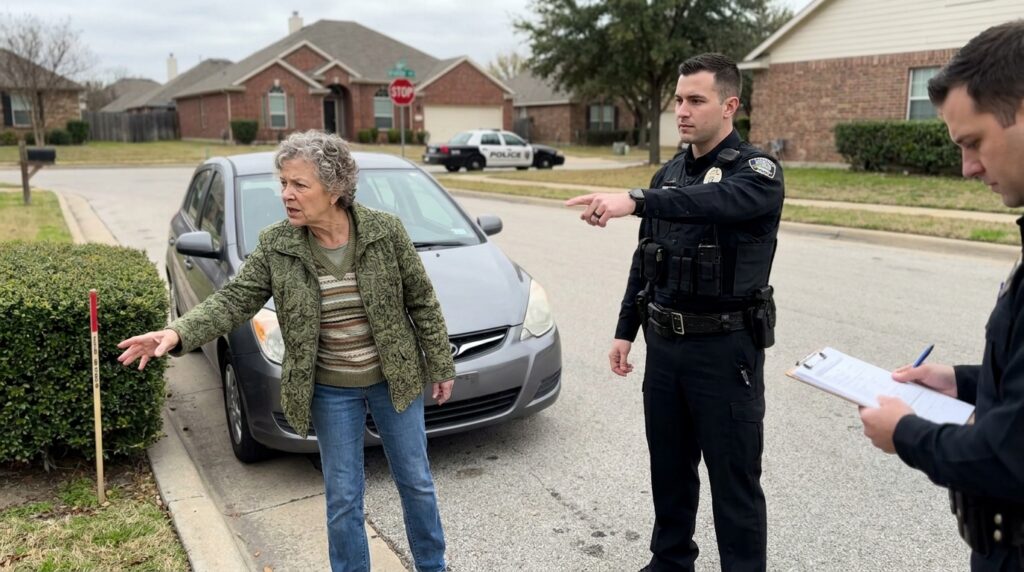
A shadow fell over the gravel between the two houses. It wasn’t Brenda’s. From around the corner of the block, the low, steady tick of a municipal engine approached, accompanied by the distinct, high-frequency chirp of a short-wave police radio adjusting its frequency. A black-and-white cruiser emerged from the shade of the suburban oaks, its roof lights dark but its front bumper moving with a slow, deliberate momentum toward the gray sedan.
Brenda’s mouth closed instantly into a hard, triumphant line. She lowered the clipboard, turning her body toward the arriving vehicle as if welcoming a long-awaited guest to a private dinner party.
Evelyn remained planted by her front tire, her hand still resting on the hot roof of her car. She didn’t reach for the pink paper. She simply watched the cruiser’s tires crunch against the public asphalt, her jaw tightening as she calculated the distance between her bumper and the rusted pin hidden in the dirt.