
CHAPTER 5: THE TOWNSHIP CHARTER EXCEPTION
Officer Miller’s boots ground into the loose driveway limestone, a sharp, white crunch that sounded loud against the low, heavy thrum of the idling tow truck. He didn’t take his hand off his tactical belt, but his body turned fully toward Brenda, his unreadable gaze dropping down to the white sheets of the clipboard she was trying to pull back against her floral blouse.
“Ma’am,” Miller said, his tone dropping into a lower, formal register that made the shortwave radio static on his shoulder sound like a distant warning. “Let me see that filed registration copy you’ve got there.”
Brenda didn’t hand it over immediately. Her synthetic dress rustled as she clutched the plastic backing tighter against her chest, her knuckles turning a deep, bloodless white under the blazing sun. Her oversized sunglasses slipped a fraction of an inch down her nose, revealing the wide, panicked whites of her eyes. “Officer, this is an internal administrative ledger. It was verified by our corporate counsel before the enforcement notices were printed. The zoning inspector is looking at an obsolete county grid.”
“The grid isn’t obsolete,” the inspector said. He didn’t look up from his aluminum ledger box, his thick fingers already sliding the heavy iron reading glasses off his face. He began rolling the yellowed linen map back into its cylinder with slow, rhythmic movements, the dry paper crackling like dead leaves. “The 1954 county grant has a non-severability clause, Brenda. The developer who sold these lots never acquired the underlying municipal easement rights for the road lanes. The township never signed over the dirt.”
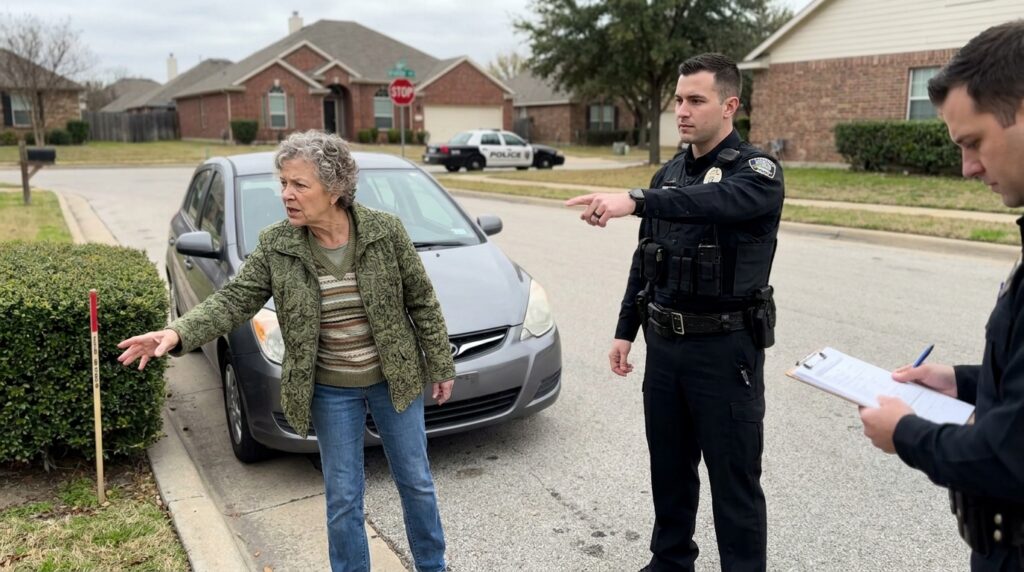
Evelyn watched Brenda’s jaw go slack, the heavy foundation on her cheeks looking dry and chalky under the brutal glare of the midday heat. Evelyn took her hand off the sedan’s hot chrome roof, her thumb still circling the notched iron key inside her jacket pocket. “The board president didn’t just sign an expansion order, Brenda. He signed a document that doesn’t have an asset behind it. You’ve been collecting seventy-five dollars a day from every driveway on this block for a perimeter that belongs to the county.”
“That is a complete mischaracterization of our regulatory structure,” Brenda said, her voice rising an octave, cracking against the quiet weight of the cul-de-sac. Two houses down, the neighbor who had been leaning over the porch railing stepped out onto his top stair, his arms crossed over his chest as he watched the uniform turn away from Evelyn’s car. “The association is a registered entity under state law. We have a corporate charter.”
“You have a charter for a corporate entity,” Evelyn said, taking a single, deliberate step across the aggregate asphalt line until her garden clogs were resting right at the edge of the raw trench Brenda had dug. She pointed down at the orange, pitted iron stake sticking out of the dry clay. “But you don’t have a charter for this dirt. You unburied that pin this morning to see how far you could push the ditch before the county noticed the water main access was blocked.”
Miller reached out, his gloved fingers wrapping around the top edge of Brenda’s clipboard. He didn’t pull it hard, but the physical weight of his arm forced her to release her grip. He flipped through the thick white pages, his eyes scanning the wet blue ink stamp and the jagged signature at the bottom of the registry sheet.
“The dispatch order for the private recovery unit is logged under a fraudulent municipal lane designation,” Miller murmured, his pen tracing the dark lines on the form. He looked over his shoulder toward the yellow flatbed idling twenty yards away. “Dispatch, this is Unit Four. Cancel the private tow on the gray sedan. Inform the driver he’s blocking a public township thoroughfare and needs to clear the cul-de-sac immediately.”
The radio chirped in response. Within seconds, the heavy diesel engine of the flatbed revved, its steel winch cables clinking as the driver threw the truck into reverse, backing out of the subdivision with a loud, mechanical groan that left a blue cloud of exhaust trailing behind it.
Brenda watched the truck disappear, her heavy silhouette shaking slightly as she turned back to the officer. “Miller, you can’t just dismiss an active lien. The association has legal precedence over neighborhood maintenance.”
“Not on a county easement, you don’t,” Miller said. He slid the clipboard under his left arm, his right hand moving to his chest pocket to pull out a small, black-bound citation book. He looked at the unrecorded red ink marks running along the bottom of the inspector’s linen chart, which was now fully rolled and secured under the inspector’s arm. “Ma’am, filing a false report regarding an emergency lane obstruction is a class-A misdemeanor under the municipal code. Especially when that report is used to execute a private vehicle seizure on land your organization doesn’t legally control.”
Evelyn didn’t feel the surge of triumph she had expected. Instead, she watched the inspector slide his aluminum ledger box into the passenger side of the cruiser, his movements clinical and unhurried. As he did, the rolled linen charter shifted, and Evelyn saw the bottom edge of the paper clearly for the first time—the red ink markings weren’t just coordinates. They were a series of unratified cancellation codes stamped directly over the original developer’s corporate signature from 1954. The entire Whispering Pines Homeowners Association hadn’t just overreached its boundaries on her driveway; according to the red lines on that charter, the entire subdivision was sitting on land that had never been legally removed from the county’s unincorporated ledger.
Brenda stood frozen on her gravel, her fingers twitching against her synthetic floral pattern as Miller pressed his pen to the carbon paper of his citation book. The dead quiet of the street returned, heavy with the scent of dry clay, cut roots, and the unyielding weight of an old iron law that was about to pull the foundation out from under the entire block.








