CHAPTER 3: THE ARRIVAL STATUS
The black-and-white cruiser didn’t rush. It glided over the concrete apron of the cul-de-sac with a heavy, administrative weight, its suspension squeaking softly as the front tires crossed from the public thoroughfare onto the lighter, aggregate asphalt of Whispering Pines. The engine gave off a dry, oily warmth that blended instantly with the heat radiating from Evelyn’s sedan.
When the brakes engaged, the vehicle pitched forward an inch, its metallic undercarriage settling directly opposite the raw trench Brenda had dug.
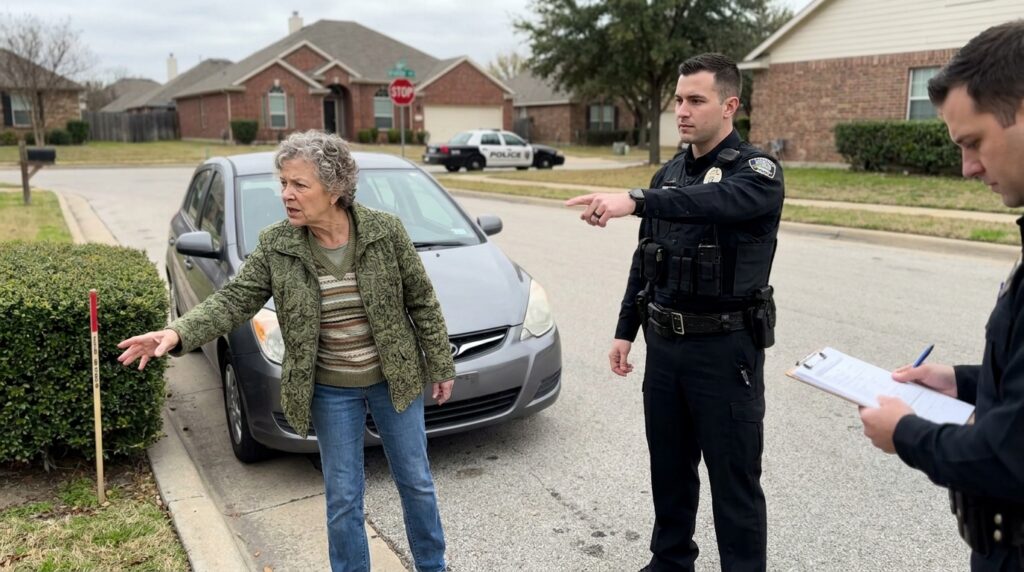
The driver-side door swung open, the hinge releasing a dry click. A uniform boot, polished but covered in a fine layer of gray limestone dust from the county access roads, planted itself firmly on the concrete gutter lip. Officer Miller—his brass nameplate glinting against the black fabric of his tactical vest—stepped out into the midday glare. He adjusted his heavy duty belt with a habitual, two-handed tug, his fingers brushing past the textured grip of his sidearm and the yellow casing of his taser before resting on his hips.
“Afternoon, ladies,” Miller said. His voice was raspy, dried out by a full shift of air-conditioned air and local radio static. He didn’t look at Evelyn first. His gaze swept the gray sedan, noted the neon-pink square of paper clutched in her hand, and then locked onto the thick white sheets flapping on Brenda’s clipboard. “Got a report about an obstruction. A commercial vehicle block on a residential fire lane.”
“Right here, Officer,” Brenda said, her voice dropping its aggressive edge, replacing it instantly with the smooth, conversational tone of an aggrieved taxpayer. She stepped off her gravel driveway, her synthetic dress rustling as her sandaled feet stopped exactly two inches short of the raw trench line. She held up the clipboard like a shield, pointing her pen toward Evelyn’s front bumper. “The vehicle has been red-tagged by the association safety committee. It’s an unregistered hazard under our municipal emergency access agreement.”
Evelyn didn’t move from her position by the front wheel. Her fingers remained buried in the pocket of her green jacket, her thumb tracing the cold, notched edge of her front-door key. “There is no hazard, Officer. And there is no fire lane on this side of the cul-de-sac. The municipal hydrant is sixty yards down, across from the mailbox bank.”
Miller didn’t answer. He turned his head slightly toward the passenger side of his cruiser, nodding once.
The passenger door opened, and a taller, thinner man climbed out of the vehicle. He didn’t wear a badge or a duty belt. His uniform was a simple charcoal-gray canvas shirt with a dark township patch sewn onto the sleeve, the edges slightly frayed from repeated washings. He carried a heavy, aluminum-backed ledger box under one arm and a rolled cylinder of heavy, linen-backed paper under the other. His eyes were small, squinting against the glare of the white concrete as he walked toward the curb.
“This is Inspector Vance from the county zoning office,” Miller said, his boots crunching as he took two deliberate steps into the narrow space between Evelyn’s sedan and Brenda’s trench. He used a low, flat hand gesture to separate them, his open palm facing down toward the hot asphalt. “Ma’am, I need everyone to step back while I get this straight.”
Brenda smiled, a quick, small movement behind her oversized sunglasses. “Inspector, I have the board minutes from last month’s infrastructure assessment right here. The greenway expansion allocation was fully codified under the regional density amendment. The three feet extending inward from this curb line were legally transferred to the association’s maintenance ledger to allow for uniform drainage installation.”
The inspector didn’t look at Brenda’s clipboard. He set his aluminum ledger box flat on the hot roof of Evelyn’s sedan with a loud, metallic clunk that made the pink paper in Evelyn’s hand vibrate. He unlatched the steel clips of the box, his thick fingers moving with a slow, mechanical precision that had nothing to do with suburban urgency.
Evelyn watched him lift a heavy pair of iron-rimmed reading glasses to his nose. “The greenway expansion,” Evelyn muttered, her eyes tracking the way the inspector’s dark uniform sleeve brushed against the gray paint of her car. “The board didn’t allocate anything three months ago, Brenda. You had a surveyor out here at five in the morning on a Tuesday while the rest of the street was asleep. That’s why the ink on that registry stamp is still dark enough to smudge.”
Brenda’s pen stopped its rhythmic clicking. Her shoulders squared beneath the floral pattern of her blouse, her heavy silhouette casting a long, dark shadow that reached across the raw trench and touched the toe of Evelyn’s garden clog. “The timing of administrative filings is completely irrelevant, Evelyn. The county approved the density adjustments. The land was ceded.”
“We’ll look at the township master grid,” the inspector said. His voice was entirely flat, devoid of any neighborly interest. He unrolled the cylinder of linen-backed paper across the roof of the car, weighting the corners down with two rusted iron brackets he pulled from his vest pocket. The paper was old, its edges yellowed and smelling of vinegar and dry storage drawers. It was the master plat map for the 1954 township survey—the original iron-and-dirt coordinates laid down before the first bulldozer ever broke ground for the Whispering Pines development.
Miller stood between them, his hands still hooked over his duty belt, his radio chirping once with a burst of digital noise that cut through the heavy heat. He looked down at the trench, his eyes focusing on the severed privet roots that hung over the orange, rusted head of the old surveyor’s pin.
“Officer,” Brenda said, her tone tightening as she leaned slightly over the trench line, her clipboard tilted toward the inspector’s face. “The current registry entry is what governs the towing ordinance. The truck is waiting at the intersection. I have the signed recovery order right here.”
The inspector didn’t look up from his map. He took a heavy iron divider from his box and placed the sharp points against the faded linen grid, measuring the distance from the old township center line to the edge of the asphalt gutter where Evelyn’s front tire rested.
“Let’s see what the dirt says,” the inspector murmured.